Why do concrete calculators disagree? Rarely because someone forgot how to multiply. The same hole can produce different bag and yard counts when tools hide different defaults for post subtraction, gravel, waste, rounding and bag yield. Below we freeze one real-world hole and change only those assumptions so the spread is visible.
The fixed example: one 4×4 post hole
Throughout this page we use one setup:
- Nominal 4×4 post (actual 3.5 × 3.5 in)
- Round hole 10 in diameter, 30 in deep
- Optional 6 in gravel base (so 24 in of concrete depth when gravel is used)
- One post, one hole
Geometry alone, with the post subtracted and 6 in of gravel removed from the concrete column, is about 1.07 ft³ of concrete (roughly 0.040 yd³). That net figure is the yardstick. Everything else is policy.
Five assumption sets, five answers
Same hole. Different defaults. 80 lb bags at 0.60 ft³ unless noted.
| Assumption set | What changed | ft³ | 80 lb bags |
|---|---|---|---|
| A. Solid cylinder | No post subtracted, no gravel, 0% waste | 1.36 | 3 |
| B. Post subtracted | Wood void removed, no gravel, 0% waste | 1.18 | 2 |
| C. Post + gravel | 6 in gravel, 24 in concrete, 0% waste | 1.07 | 2 |
| D. YardPour-style + 10% waste | Set C, then × 1.10 | 1.18 | 2 |
| E. Lower yield | Set C, but 0.45 ft³ per 80 lb bag | 1.07 | 3 |
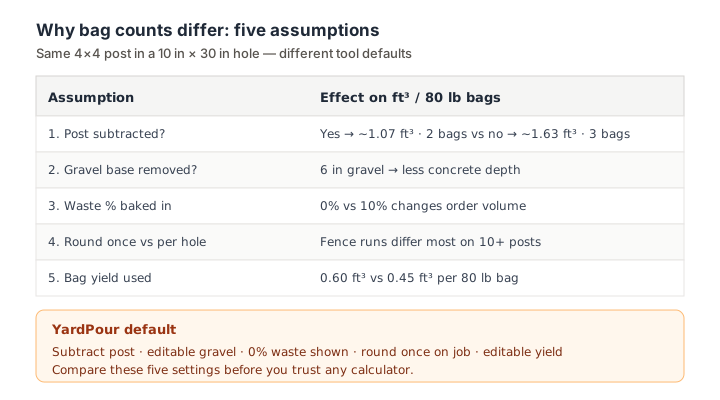
Sets A–E are not competing brands. They are the same arithmetic with different checkboxes. A tool that looks "high" may be counting the full hole as concrete. A tool that looks "low" may omit waste you wanted. Read the footnotes.
Assumption 1: post subtraction
A wood post occupies space. If the calculator treats the hole as a solid concrete cylinder, it overstates volume by the post cross-section times embedment depth. For our 3.5 in post in 24 in of concrete, that void is about 0.20 ft³—enough to flip a bag count on a small hole. Tube-form piers filled solid have no wood void; subtracting a post there would understate the pour. YardPour’s fence post and post hole tools subtract the post; the sonotube calculator does not, because the tube is the form.
Assumption 2: gravel base depth
Many fence and deck holes get a few inches of gravel before concrete. That gravel is not concrete. If a calculator uses the full dug depth as concrete depth, every inch of gravel becomes phantom mix. Our example drops from about 1.18 ft³ to 1.07 ft³ when 6 in of gravel is removed from a 30 in hole. Always match the concrete depth to what you will actually fill with mix.
Assumption 3: waste percent
Waste is not geometry. It is a cushion for irregular holes, spill and over-excavation. Some calculators silently add 5% or 10%. YardPour defaults to 0% waste and shows net and order volumes when you add margin, so you can see what is math and what is judgment. For background on why tools diverge, this is usually the first hidden dial.
Assumption 4: rounding
Bags only sell in whole numbers. Rounding each hole up, then multiplying by 40 posts, can add an extra bag on every hole—tens of bags on a long fence. Rounding once on the run total matches how you buy. YardPour’s fence tool totals the run and rounds after waste. When you compare calculators, check whether the bag count is per hole or for the whole job.
Assumption 5: bag yield
An 80 lb bag does not always yield 0.60 ft³. Fast-setting mixes, high-strength mixes and other brands publish different yields on the data sheet. Using 0.45 ft³ on our 1.07 ft³ hole jumps the count from 2 bags to 3. Editable yield fields matter more than a branded logo on the page. Change the yield to match the bag you will open.
How YardPour does the math
- Visible formulas on each tool page, with worked examples you can check by hand.
- Net vs order — waste starts at 0%; you choose 5% or 10% when you want a cushion.
- Editable bag yields with manufacturer sheet defaults you can override.
- Shape-specific voids — posts subtracted on post tools; solid fill on sonotube; curb as curb+gutter rectangles.
- One round-up on multi-post runs after waste, not once per hole.
Start with the main concrete calculator for mixed shapes, the driveway calculator for vehicle approaches, or the bag calculator when you already know the volume.
How to read any concrete calculator
- Find whether waste is included and at what percent.
- Find the bag yield and unit (ft³ per bag).
- For posts: is the wood subtracted? Is gravel removed from depth?
- For slabs: are inches and feet mixed correctly? (4 in is 0.333 ft, not 4 ft.)
- Reproduce one line with a pencil. If you cannot, do not order from that number.
Disagreement between tools is a prompt to compare assumptions, not a reason to average two wrong numbers. Pick the model that matches how you will dig, form and fill—then add the waste you decide.
Frequently asked questions
Why do concrete calculators give different bag counts?
They usually disagree on assumptions, not on π. Post subtraction, gravel depth, waste, rounding and bag yield each change the answer. Compare those five settings before you trust a number.
Should a calculator subtract the wood post?
For a post set in a dug hole, yes—the wood displaces concrete. For a cardboard tube pier filled solid, there is no wood void to subtract. Match the tool to the job.
What bag yield should I use?
Use the yield printed on your bag. YardPour defaults cite a common manufacturer data sheet (for example 0.60 ft³ per 80 lb bag) and let you edit the field when your label differs.
Is 10% waste always required?
No. Waste is a job-site cushion for spill, uneven holes and over-excavation. YardPour starts at 0% so net geometry stays visible; you add margin when you want it.
Why does rounding change the total so much on a fence?
Rounding every hole up to a whole bag, then multiplying by post count, over-orders. Rounding once on the run total is closer to what you will actually buy.
- QUIKRETE Concrete Mix No. 1101 data sheet (bag yields)
- Portland Cement Association, Design and Control of Concrete Mixtures (volume basics)