- What you need before you dig
- How deep and wide should fence holes be?
- Gravel under fence posts: yes, but only at the bottom
- Dry pour vs wet mix fence posts
- How to set fence posts in concrete, step by step
- How much concrete each hole takes
- Worked example: one 6×6 gate post
- How long for concrete to set a fence post
- Mistakes that make posts lean or rot
- Frequently asked questions
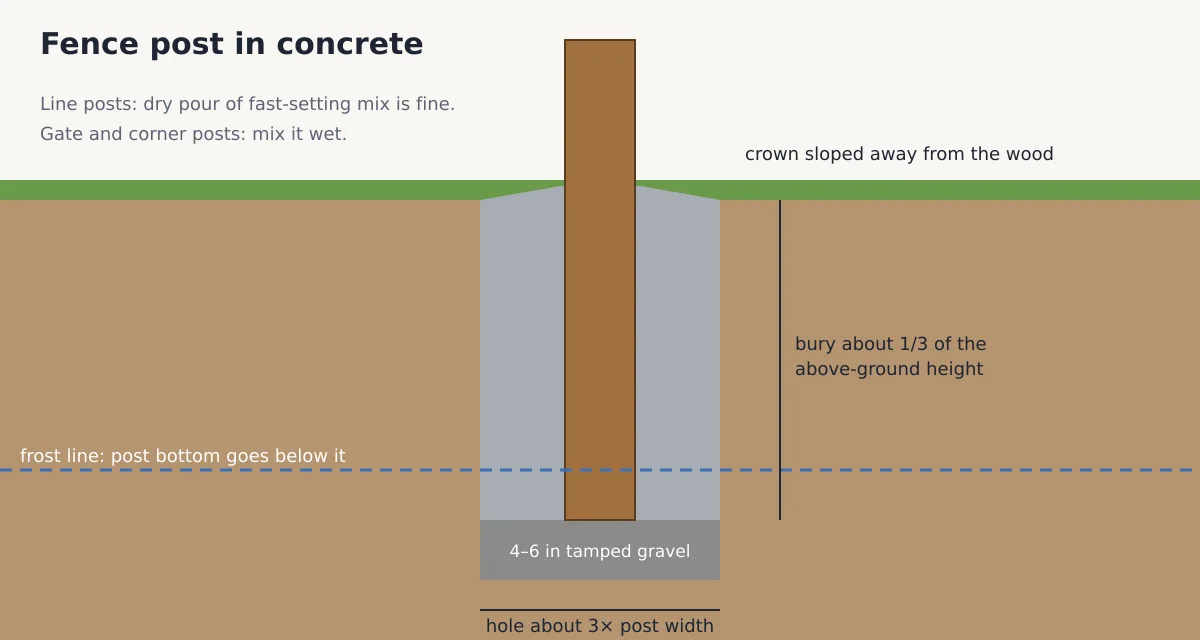
To set fence posts in concrete, dig a hole about three times the post's width. Make it deep enough that roughly one third of the post's above-ground height is buried, and go below your frost line where that is deeper. Tamp 4 to 6 inches of gravel into the bottom. Plumb and brace the post, then fill around it with concrete and slope the top away from the wood. Line posts can usually take a dry pour of fast-setting mix. Gate and corner posts deserve concrete mixed wet.
For the exact bag count on a standard 4×4 line post, the fence post concrete calculator already does the math. This guide is about the field procedure.
What you need before you dig
- Utility locate: In the US, dial 811 at least 2–3 business days before digging. Striking a gas or electric line is dangerous and expensive.
- Frost depth: Ask your building department for your region's frost line. Posts must extend below the frost depth to prevent frost heave from pushing them out of plumb.
- Layout stakes and string line: Establish end and gate post locations first, then pull a tight string to space line posts (typically 6 to 8 feet on center).
- Tools: Post-hole digger, auger, tamping bar, post level (2-vial rubber strap level), and 1x4 bracing lumber.
How deep and wide should fence holes be?
| Fence Post | Hole Diameter | Buried Depth | Gravel Bed |
|---|---|---|---|
| 4×4 Wood Line Post (6 ft fence) | 10–12 inches (3× width) | 24–30 inches | 4–6 inches |
| 6×6 Gate / Corner Post (6 ft fence) | 16–18 inches | 36–42 inches (or below frost) | 6 inches |
| 2-3/8" Steel Pipe Post (chain link) | 8 inches | 24–30 inches | 4 inches |
Make hole sides straight or slightly bell-shaped at the bottom. Avoid cone-shaped holes that taper narrower at the bottom, as frost heave easily grabs a cone and lifts it.
Bigger loads need bigger holes: a basketball hoop footing is sized by the hoop maker, often 16 in wide and 4 ft deep.
Gravel under fence posts: yes, but only at the bottom
Pour 4 to 6 inches of coarse gravel or crushed stone into the bottom of the hole and tamp it firm before setting the post. Standing the post on gravel allows ground water to drain freely away from the vulnerable end grain of the wood.
Crucial warning: Never wrap gravel up the sides of the post with concrete only at the top. Concrete must encase the entire sides of the post down to the gravel pad.
Dry pour vs wet mix fence posts
| Method | Best for | Pros & Cons |
|---|---|---|
| Dry Pour (Fast-setting mix) | Standard 4×4 line posts on privacy or picket fences | Very fast; no wheelbarrow mixing needed; sets in 20–40 min. Bottom dry mix may hydrate slower if soil is bone dry. |
| Wet Mix (Standard or high-strength concrete) | Gate posts, corner posts, terminal posts, steep slopes | Guaranteed uniform hydration and maximum 4,000 psi strength; takes 24–48 hours to cure before load. |
How to set fence posts in concrete, step by step
- Call 811 and mark the line. Have buried utilities marked a few days ahead, then run a string line between the end posts so every hole lands on the same line.
- Dig the hole. Make it about three times the post width and deep enough for the buried depth plus 6 inches of gravel. Keep the sides straight or slightly wider at the bottom, never cone-shaped.
- Add and tamp gravel. Put 4–6 inches of gravel in the bottom and tamp it firm so water drains away from the post end.
- Set and plumb the post. Stand it in the center of the hole and check two adjacent faces with a post level. Line its face up with the string.
- Brace it. Screw two scrap boards to adjacent sides and stake them to the ground so the post cannot move while the concrete sets.
- Add the concrete.
- Wet mix: shovel premixed concrete evenly around the post to 1–2 inches below grade, then rod it with a stick to push out air pockets.
- Dry pour (fast-setting mix): pour the mix into the hole and add the water the bag specifies, in lifts if the bag says so.
- Crown the top. Slope the top of the concrete away from the post so rain runs off instead of pooling against the wood.
- Check plumb again, then wait. Recheck the level in the first few minutes. Leave the braces on, and wait before hanging rails, panels or a gate (see the curing times below).
Want the exact number of bags for your whole fence? Enter post size, hole size, depth and count in our fence post concrete calculator. It subtracts the post and the gravel for you.
How much concrete each hole takes
For a standard 4×4 line post in a 10 in hole with 24 in of concrete, plan on 2 bags of 80 lb mix. Bigger posts and deeper gate holes need more, often 6 or 7 bags. Rather than repeat the numbers here, we keep one set of bag tables, with and without a gravel base, on the fence post concrete calculator. It also totals a whole fence run and rounds once, so you don't overbuy. For a single deck or mailbox post, use the post hole calculator. For piers in cardboard tubes, use the sonotube calculator. If the same truck also pours a pad or curb, combine shapes in the main concrete calculator.
How long for concrete to set a fence post
Fast-setting post mix usually firms up in well under an hour, but give it at least 24 hours before you hang rails or panels. Standard concrete mix needs about 48–72 hours. Gates put the most strain on a post, so give gate posts the longer wait, and add time in cold weather. The bag's instructions take priority over these general times.
Worked example: one 6×6 gate post
For a heavy 6-foot wooden privacy gate post:
- Post: 6×6 (actual 5.5 × 5.5 in), 10 ft long (6 ft exposed, 4 ft buried).
- Hole: 16 inch diameter, 48 inches deep.
- Gravel base: 6 inches gravel → 42 inches (3.5 ft) of concrete depth.
- Total hole volume: π × (8/12)² × 3.5 = 4.89 cu ft.
- Post displacement: (5.5/12)² × 3.5 = 0.74 cu ft.
- Net concrete: 4.89 − 0.74 = 4.15 cu ft.
- 80 lb bags needed: 4.15 ÷ 0.60 = 6.9 → 7 bags of 80 lb concrete.
Mistakes that make posts lean or rot
- Leaving a depression around the post: If concrete finishes below ground level or slopes toward the wood, water pools against the post, causing rot in 2–3 years.
- Not digging below frost depth: Frozen ground grabs the concrete plug and levers the post out of level.
- Hanging gates too early: Fast-setting mix hardens in 30 minutes, but full strength takes days. Hanging a heavy gate on day one bends the green concrete collar.
If you are fixing hardware to a slab instead, read about drilling into a new slab.
Wondering whether you can dry pour more than a post? Our guide to dry pour concrete explains where it works and where it fails.
Frequently asked questions
How deep should a fence post be in concrete?
A common rule is to bury about one third of the post's above-ground height. That is about 2 feet for a 6-foot fence, plus 4 to 6 inches of gravel below. Where frost is an issue, go below your local frost line, and set gate and corner posts deeper than line posts.
Is it better to dry pour or mix concrete for fence posts?
Dry pour is fine for line posts if the bag says the product can be used dry, usually a fast-setting post mix. Mix the concrete wet for gate, corner, and end posts, because wet mixing makes sure all of the mix is hydrated.
Should I put gravel under a fence post?
Yes. Tamp 4 to 6 inches of gravel into the bottom of the hole and stand the post on it. The gravel drains water away from the end of the post, and it gives the post a firm base while you pour.
How long before I can attach fence panels to posts set in concrete?
Fast-setting mix holds a post upright within the time printed on the bag, often under an hour, but many builders wait a day before hanging panels. With standard mix, wait one to three days. Give gate posts longer, especially in cool weather.
Should concrete come up to ground level around a fence post?
Bring it to just above ground level and slope it away from the post so water runs off. Don't leave a dish around the post, and don't cover the concrete with soil packed against the wood.
How much concrete does a fence post hole take?
For a 4×4 post in a 10 inch hole with 24 inches of concrete, about 2 bags of 80 lb mix. A 6×6 gate post in a 16 inch hole with 42 inches of concrete takes about 7. Use the fence post concrete calculator for your exact sizes.
- Sakrete, 'Setting Posts & Poles' project guide (sakrete.com/project-guide/setting-posts-poles/)
- FenceLevel, 'How Deep Should Fence Posts Be?' (fencelevel.com)
- FenceCalc, 'Fence Post Depth & Spacing' (fencecalc.co)
- Call 811 Before You Dig (call811.com)