- Why seal a concrete driveway?
- Types of concrete sealer
- When to seal: timing and temperature
- How much sealer do you need?
- How to seal a concrete driveway, step by step
- Tools and materials
- Common sealing mistakes
- How often should you reseal?
- Sealing and winter deicers
- Planning a new driveway instead?
- Checklist: sealing a concrete driveway before winter
- Frequently asked questions
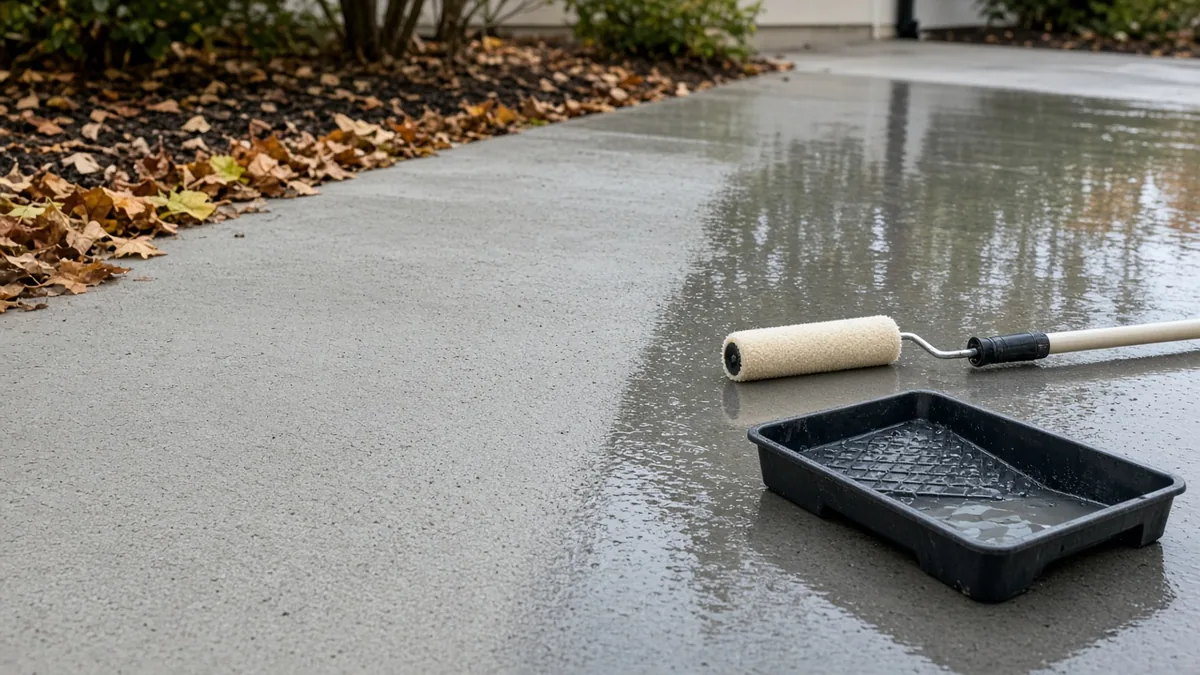
Knowing how to seal a concrete driveway before winter is one of the cheapest ways to protect it. A good penetrating sealer helps keep out water and deicing salt, the two things that drive most winter damage. The job takes an afternoon: clean the surface, let it dry, and roll or spray on the sealer while the weather is still warm enough.
The catch in late October and November is temperature. Many sealers need air and surface temperatures of at least 50°F and no rain or freezing for a day afterward. This guide explains which sealer to choose, how much you need, the step-by-step process, and how to time it so the sealer cures before the cold arrives.
Why seal a concrete driveway?
Concrete absorbs water. In winter that water freezes and thaws repeatedly, and when deicing salt is involved, the surface can start to flake, a problem known as scaling. The Pennsylvania Aggregates and Concrete Association (PACA) says silane or siloxane penetrating sealers give the highest level of resistance to deicers and freeze-thaw damage, and that water-repellent sealers made for concrete also help.
Sealing also helps with stains. QUIKRETE describes its silane-siloxane waterproofing sealer as repelling water and protecting from oil, gasoline, grease, salts and UV rays without significantly changing the surface's appearance.
Types of concrete sealer
| Sealer type | How it works | Look | Best for |
|---|---|---|---|
| Penetrating (silane, siloxane, silane-siloxane) | Soaks in and repels water from inside the surface | Little or no change | Driveways and walks exposed to deicers |
| Acrylic (film-forming) | Forms a thin coating on top | Often adds sheen or a "wet look" | Decorative and stamped concrete |
| Epoxy / urethane | Thick, hard film | Glossy | Mostly garage floors and interiors |
For garages and basements, compare interior floor coatings.
For a plain gray driveway in a freeze-thaw climate, a penetrating sealer is the usual choice, because it does not form a slippery film and it targets water and salt.
Want color instead of a clear finish? See how to paint a concrete patio.
If the surface is pitted, consider resurfacing a concrete driveway before you seal it.
When to seal: timing and temperature
Seal after a broom finish has cured; sealer will not fix a surface that was textured while it was still bleeding.
New concrete
Wait for the concrete to cure. QUIKRETE's data sheet for its Concrete & Masonry Waterproofing Sealer says to allow at least 30 days for new concrete to cure before applying it. Check your product, because waiting times vary. If your driveway was poured in late September or October, it may not be ready to seal until it is too cold, in which case follow our advice on salt and new concrete this winter and seal in spring.
Temperature window
Read the label, but expect limits like these. QUIKRETE's waterproofing sealer data sheet says:
- Apply only when air and surface temperatures are between 50°F and 90°F.
- Do not apply if rain, heavy dew or temperatures below 50°F are expected within 24 hours.
- Keep the product from freezing.
QUIKRETE's commercial-grade concrete sealer instructions are a little more forgiving, saying not to apply below 40°F or when rain is likely. Different products, different rules: the label on your can wins.
Best time of day
On a cool autumn day, the surface may only reach the required temperature in the early afternoon. Start once the slab has warmed and finish with enough daylight for the sealer to dry before evening dew.
How much sealer do you need?
Coverage depends on the product and how porous the concrete is. QUIKRETE's waterproofing sealer covers about 75 to 150 square feet per gallon.
Worked example for a two-car driveway, 20 × 24 feet:
- Area: 20 × 24 = 480 square feet.
- At 150 sq ft per gallon: 480 ÷ 150 = 3.2 gallons.
- At 75 sq ft per gallon: 480 ÷ 75 = 6.4 gallons.
So plan on somewhere between 3.2 and 6.4 gallons, depending on how thirsty your concrete is. A 5-gallon pail plus a 1-gallon bottle covers the high end of that range. Rough, older or broom-finished concrete usually soaks up more.
How to seal a concrete driveway, step by step
1. Check the forecast
Pick a dry day that meets the label's temperature range, with no rain or frost expected for at least 24 hours.
2. Repair cracks first
Sealer does not fill cracks. Clean and fill them first, following our guide to how to fix cracks in concrete, and let the filler cure for the time on its label.
If a white haze is on the slab, remove efflorescence and let the surface stay dry before you seal.
3. Clean the surface
QUIKRETE's instructions call for a clean, dry surface with oil stains, dirt and other contaminants removed. Sweep, scrub oil spots with a concrete cleaner, and rinse well. Remove or repair any unsound or flaking concrete. First remove oil stains from the concrete so the sealer can bond. The same scrub-and-rinse routine works for patios, as shown in how to clean a concrete patio.
4. Let it dry completely
Water in the pores blocks penetration. After washing, give the slab at least a full dry day, longer in cool weather.
5. Test for porosity
QUIKRETE suggests a simple test for previously sealed surfaces: place drops of water on the concrete. If the water is absorbed, the surface is porous enough to accept sealer. If it beads, the old sealer is still working.
6. Apply the sealer
Use a roller, brush or garden sprayer. Work in sections and keep a wet edge. For QUIKRETE's waterproofing sealer, the data sheet says a second coat can go on while the first is still wet, after 5 to 10 minutes, applied perpendicular to the first coat. Wipe off excess before it dries and do not let it pool.
7. Keep traffic off
Keep people off until it is dry to the touch and cars off for as long as the label says. QUIKRETE lists a drying time of about one hour for its waterproofing sealer at 50°F to 90°F; cooler, damp days take longer.
Lift sunken sections first with our sunken concrete slab repair guide.
Tools and materials
Gather everything before the weather window opens, so you are not driving to the store on the one warm afternoon of the week:
- Penetrating concrete sealer, enough for your area plus a little extra.
- Concrete cleaner or degreaser for oil spots.
- Stiff-bristle scrub brush and a push broom.
- Garden hose or pressure washer.
- Roller with an extension pole, a brush for edges, or a pump garden sprayer.
- Nitrile gloves, as QUIKRETE recommends impervious gloves when handling its sealer, plus eye protection.
- Painter's tape and plastic sheeting to protect the garage door, siding and plants.
- Crack filler, if you have cracks to repair first.
- Cones or tape to keep people and cars off while it dries.
Common sealing mistakes
- Sealing too soon. New concrete needs its full cure time first.
- Sealing in the cold. Below the label's minimum, the sealer may not penetrate or cure properly.
- Too much product. Puddles leave blotchy, slippery spots. Thin, even coats work better.
- Sealing over dirt or oil. Contaminants block penetration and can trap stains.
- Using the wrong product. Film-forming sealers can be slippery on a sloped driveway in winter.
- Expecting sealer to fix poor concrete. It helps, but low-strength or badly finished concrete can still scale.
How often should you reseal?
It depends on the product, traffic and climate. Use the water-drop test each fall: if water soaks in quickly instead of beading, it is time to reseal. Many penetrating sealers last longer than film-forming ones because there is no surface film to wear away, but follow the manufacturer's guidance.
Sealing schedules differ for asphalt driveways, which we compare here.
Sealing and winter deicers
A sealer helps, but it is not permission to use any deicer you like. PACA and the Iowa concrete associations both say never to use deicers containing ammonium nitrate or ammonium sulfate. Our companion guide, is salt bad for concrete?, compares deicers and explains the first-winter rule.
Planning a new driveway instead?
If your driveway is past saving, plan the replacement with the right strength and volume. Our guide to concrete PSI for a driveway explains strength and air entrainment, the concrete slab calculator gives cubic yards and the gravel base, and the concrete cost calculator compares ready-mix with bags. For mixing small batches by hand for repairs, see our recent guide to mixing concrete in a wheelbarrow. Sealing is also the last step for stained concrete.
Checklist: sealing a concrete driveway before winter
- [ ] New concrete: wait the full cure time on the sealer label (30 days for QUIKRETE's waterproofing sealer).
- [ ] Pick a dry day within the label's temperature range, with no rain or frost for 24 hours.
- [ ] Fill cracks first and let the filler cure.
- [ ] Clean oil and dirt, rinse, and let the slab dry fully.
- [ ] Do the water-drop test, then apply thin, even coats.
- [ ] Keep traffic off until it is dry, and recheck each fall.
Frequently asked questions
When is the best time to seal a concrete driveway?
On a dry day when air and surface temperatures are within the sealer's range, often 50°F to 90°F, with no rain or freezing expected for 24 hours. In much of the US that means early to mid fall or late spring.
Can you seal concrete in cold weather?
Only within the label's limits. QUIKRETE's waterproofing sealer needs at least 50°F, and its commercial-grade concrete sealer should not be applied below 40°F. If it is colder, wait for spring.
How long after pouring can you seal concrete?
Wait for the concrete to cure. QUIKRETE says to allow at least 30 days before applying its Concrete & Masonry Waterproofing Sealer. Check your product's label.
How much sealer do I need for a driveway?
Divide the area by the coverage on the label. At 75 to 150 square feet per gallon, a 20 × 24 foot driveway (480 square feet) needs about 3.2 to 6.4 gallons.
What type of sealer is best for a concrete driveway?
For winter protection, a penetrating silane or siloxane sealer. PACA says these give the highest resistance to deicers and freeze-thaw damage, and they do not leave a slippery film.
How do I know if my driveway needs resealing?
Sprinkle drops of water on it. If the water soaks in, the concrete is porous and ready for sealer. If it beads up, the existing sealer is still working.
- https://www.quikrete.com/pdfs/data_sheet-concrete%20masonry%20waterproofing%20sealer%208800-05.pdf
- https://www.quikrete.com/pdfs/projects/sealingconcreteandmasonry.pdf
- https://www.pacaweb.org/blog/protecting-concrete-from-deicer-damage