- Concrete vs asphalt driveway at a glance
- What a good concrete driveway looks like
- What a good asphalt driveway looks like
- Winter performance: the real deciding factor
- Maintenance compared
- Installation and curing time
- Questions to ask any driveway contractor
- Which should you choose?
- How to estimate concrete for a driveway
- Concrete driveway cost worksheet
- Checklist: before you sign a driveway contract
- Frequently asked questions
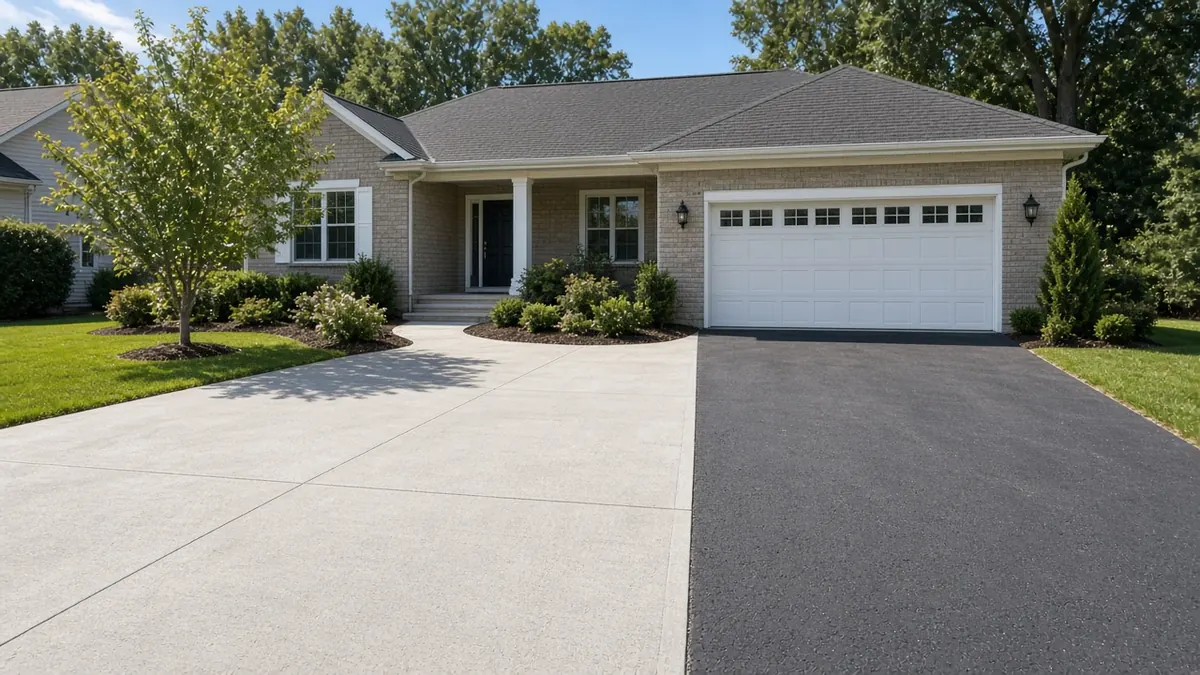
Concrete vs asphalt driveway: which is better? Concrete usually lasts longer and needs less routine maintenance, but it can crack in freeze-thaw winters and must be protected from deicers in its first year. Asphalt is flexible, can be driven on sooner and is easy to patch, but it needs periodic sealing and typically wears out sooner. InterNACHI's life-expectancy chart gives asphalt driveways 15 to 20 years. The right choice depends on your climate, how long you plan to stay and how much upkeep you want.
This guide compares the two materials side by side, with a special focus on winter performance, because that is where most driveways fail. We do not quote prices here: costs vary too much by region and season. Instead, we show you how to estimate the concrete you would need, so you can get accurate local quotes.
Concrete vs asphalt driveway at a glance
| Factor | Concrete | Asphalt |
|---|---|---|
| Typical design | 4 in minimum, 4,000 psi, air-entrained | hot-mix asphalt over a compacted base |
| Lifespan | long-lasting with good design and care | 15 to 20 years (InterNACHI chart) |
| Time before driving | about 7 days for cars (IRMCA) | sooner; ask your installer |
| Routine maintenance | sealer every few years | sealcoat once the surface has aged |
| Winter weakness | salt scaling, freeze-thaw cracks | cracks, potholes from water under the surface |
| Repairs | harder to patch invisibly | easier to patch and resurface |
| Heat | stays cooler in summer | softens and absorbs more heat |
| Appearance | can be colored, stamped or brushed | uniform black finish |
What a good concrete driveway looks like
The Illinois Ready Mixed Concrete Association (IRMCA) publishes homeowner guidelines for driveways. Its key recommendations are:
- Thickness: at least 4 inches.
- Strength: 4,000 psi at 28 days.
- Air entrainment: 6.5% plus or minus 1.5%, so the concrete can survive freeze-thaw cycles.
- Control joints: no more than 10 feet apart, cut to at least one quarter of the slab depth.
- Drainage: slope the surface about 1/8 inch per foot so water runs off.
Alberta's concrete industry guidelines (ACE) also call for air-entrained concrete, at 5% to 8% air, and immediate curing after finishing. These details matter more than the word "concrete" on a quote. A thin, non-air-entrained slab in a cold climate is far more likely to crack and scale.
If you are deciding between 3,000 and 4,000 psi, our guide to what psi concrete for a driveway explains the difference in detail.
What a good asphalt driveway looks like
An asphalt driveway is a layer of hot-mix asphalt laid over a compacted aggregate base. The base does most of the structural work, so ask any installer how thick the base and the asphalt layers will be and how they will compact them.
Asphalt is flexible. It bends slightly under load and with temperature changes, which helps it ride out small ground movement without the sharp cracks you see in concrete. The trade-off is that it softens in heat, can rut under heavy vehicles, and oxidizes in sunlight, which is why it needs sealcoating once it has aged.
Winter performance: the real deciding factor
If you live where it freezes, winter is the biggest test of any driveway. Here is how each material behaves.
Concrete in winter
- The first winter is the riskiest. IRMCA says to shovel snow and use sand for traction in the first winter, and not to use deicers at all. ACE gives the same first-winter advice.
- Some deicers should never be used. IRMCA warns against ammonium sulfate and ammonium nitrate deicers on concrete at any age.
- Scaling is the common failure. When water freezes in the surface and salt adds more freeze-thaw cycles, thin flakes can pop off. Air entrainment and sealing reduce the risk.
Our guide is salt bad for concrete covers which deicers are safer and how to protect an older slab.
Asphalt in winter
- Snowplows and shovels: asphalt can be gouged by a metal blade, so use a plastic shovel edge or set plow skids higher.
- Water is the enemy: cracks let water reach the base. When it freezes and expands, it lifts and breaks the surface, which turns into potholes in spring.
- Deicers: asphalt is generally more tolerant of rock salt than young concrete, but salt still speeds up wear around cracks and edges.
Verdict for cold climates: a well-built, air-entrained concrete driveway that is protected through its first winter performs very well. A poorly specified concrete slab can fail faster than asphalt. Asphalt's advantage is that winter damage is easier and cheaper to patch.
Maintenance compared
Sealing concrete
ACE's guidance is to reapply an acrylic sealer about every two years, or a penetrating sealer about every five years, and not to switch from acrylic to penetrating later because the two are incompatible. Sealing is usually done in dry weather above the product's minimum temperature. Our step-by-step guide on how to seal a concrete driveway walks through the process.
Sealcoating asphalt
The Asphalt Institute's technical FAQ says a new asphalt driveway generally should not be sealed for about two to five years, and it does not recommend coal-tar sealers. Sealing too early or too often can do more harm than good, so ask your installer for a schedule based on your climate.
Crack repair
- Concrete: fill hairline and small cracks before winter so water cannot get in. See how to fix cracks in concrete.
- Asphalt: use a rubberized crack filler and patch potholes as soon as they appear.
Installation and curing time
Concrete: IRMCA's guidelines say to wait 7 days before driving a car on a new driveway, and longer for heavy trucks. Our drive on new concrete timeline explains the stages day by day. Pouring late in the season? Read pouring concrete in cold weather first, because cold slows curing and raises the risk of early freeze damage.
Asphalt: usually ready for traffic sooner than concrete. Ask your installer how long to wait, avoid turning the steering wheel while parked on fresh asphalt, and keep heavy loads off the edges for the first season.
Questions to ask any driveway contractor
Whichever material you lean toward, the quality of the installation matters more than the label. Ask every contractor the same questions so you can compare quotes fairly:
- How deep will the base be, and how will you compact it? A weak base causes problems under both materials.
- What thickness and mix will you use? For concrete, ask for the psi and air content in writing.
- How will water drain? Puddles that freeze are a leading cause of winter damage.
- Where will the joints go? For concrete, a joint plan prevents random cracks.
- What maintenance do you recommend in years one to five? A good contractor will explain sealing and first-winter care without being asked.
- What does the warranty cover? Ask whether cracking, scaling or settling are included.
Which should you choose?
Choose concrete if:
- You plan to stay in your home for many years.
- You want lower routine maintenance once it is built.
- You like decorative options such as color or stamped patterns.
- Your contractor will use air-entrained, 4,000 psi concrete with proper joints.
Choose asphalt if:
- You want a faster installation and shorter wait before driving.
- Your ground moves a lot and you prefer a flexible surface.
- You want easy, low-cost patching and resurfacing later.
- You are comfortable with sealcoating every few years once it has aged.
How to estimate concrete for a driveway
Before you collect quotes, work out how much concrete your driveway needs. Multiply length by width by thickness to get the volume, then convert to cubic yards. A 4-inch slab is one third of a foot thick.
Example: a driveway 40 feet long and 12 feet wide at 4 inches thick is 40 × 12 × 0.333 = about 160 cubic feet, which is about 5.9 cubic yards. Add 5% to 10% for waste and uneven base, and order about 6.5 cubic yards.
Use our concrete slab calculator to run your own dimensions, then the concrete yard calculator to convert to yards. When you are ready, our guide on how to order ready-mix concrete explains what to say to the plant. For budgeting, the concrete cost calculator lets you plug in your own local price per yard.
Concrete driveway cost worksheet
Fill in your quotes: net yd³ from the driveway calculator, price per yd³, delivery, short-load fee if under minimum, and tax in the cost calculator. Compare that total to asphalt bids on lifecycle, not material alone.
Checklist: before you sign a driveway contract
- [ ] Confirm thickness (concrete 4 in minimum) and base depth in writing.
- [ ] For concrete, ask for 4,000 psi and air entrainment.
- [ ] Ask where control joints will go (no more than 10 ft apart).
- [ ] Ask how long to wait before driving and parking.
- [ ] Get a written sealing schedule for the first five years.
- [ ] Plan the first winter: shovel and sand only on new concrete.
Frequently asked questions
Is concrete or asphalt better for a driveway?
Concrete usually lasts longer and needs less routine upkeep, while asphalt is quicker to install, flexible and easier to patch. In cold climates, concrete must be air-entrained and protected from deicers in its first winter.
How long does an asphalt driveway last?
InterNACHI's life-expectancy chart lists asphalt driveways at 15 to 20 years. Actual life depends on the base, drainage, climate and how well cracks are sealed.
Is concrete or asphalt better in cold climates?
Both can work. Air-entrained concrete laid at the right thickness handles freeze-thaw well if you avoid deicers in the first winter. Asphalt flexes with the cold and is easier to repair when winter damage happens.
When should you seal a new asphalt driveway?
The Asphalt Institute says a new asphalt driveway generally should not be sealed for about two to five years. It also does not recommend coal-tar sealers.
Can you use salt on a new concrete driveway?
Industry guidelines from IRMCA and ACE say not to use any deicers in the first winter. Use sand for traction, and never use ammonium sulfate or ammonium nitrate deicers on concrete.
How thick should a concrete driveway be?
IRMCA recommends a minimum of 4 inches of 4,000 psi, air-entrained concrete for residential driveways. Thicker slabs may be needed for heavy vehicles; ask your contractor.
- https://irmca.org/resources/irmca-technical-resources/category/for-homeowners/profile/driveways
- https://www.asphaltinstitute.org/engineering/engineering-faqs/
- https://www.ace-concrete.ca/wp-content/uploads/bsk-pdf-manager/2019/01/Concrete-Driveways-Best-Practices.pdf
- https://www.nachi.org/life-expectancy.htm