- Why new concrete needs time before drilling
- Quick guide: how long to wait
- What anchor makers say
- Choosing the right drill and bit
- How deep and how close to the edge
- Step by step: drilling into concrete safely
- What if you do not know how old the slab is?
- Drilling into old concrete is different
- Alternatives if you cannot wait
- Common mistakes
- Frequently asked questions
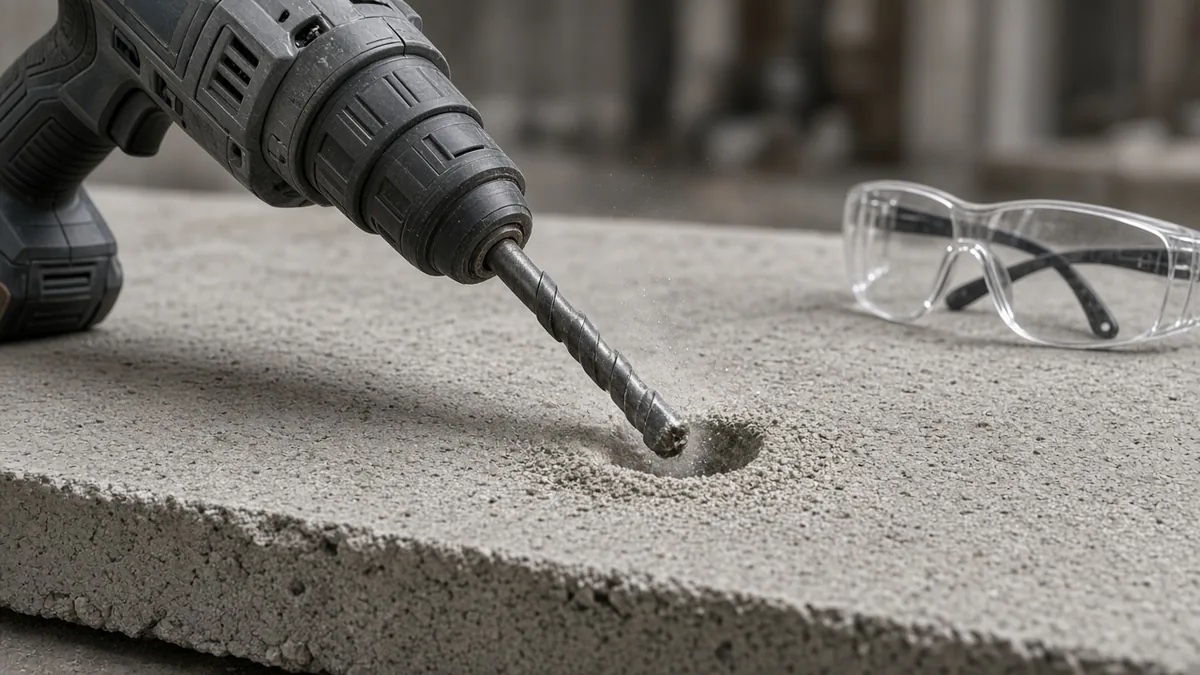
When can you drill into new concrete? For light, non-structural fixings such as a hose hanger, a mailbox bracket or a small shelf, waiting at least 7 days is the usual minimum, and longer in cold weather. For anchors that carry real loads, such as railings, posts, ledgers or machinery, plan on 28 days, because most anchor load ratings assume concrete that has reached its design strength. Some anchor makers set their own minimums, so the instructions for your exact anchor always win.
This guide explains why the wait matters, which drill and bit to use, how close to edges and joints you can drill, and how to avoid cracking a young slab. If you are still planning the pour, our concrete slab calculator gives the volume and bag count first, and the main concrete calculator handles mixed shapes on one order.
Why new concrete needs time before drilling
Concrete does not dry; it cures. Cement reacts with water and gains strength over weeks, quickly at first and then more slowly. Our guide to driving on new concrete explains the common 7-day and 28-day milestones in detail: at about a week, a well-cured slab has a good share of its strength, and at 28 days it is close to the strength it was designed for.
Drilling and anchoring put concentrated stress on a small area. A hammer drill pounds the concrete around the hole, and an expansion anchor pushes outwards against the sides of the hole. In young concrete, that can cause:
- Spalling: chips breaking out around the hole, especially near edges.
- Cracks running from the hole towards a nearby edge or joint.
- Lower holding power, because weaker concrete grips the anchor less.
That is why anchor manufacturers publish minimum concrete ages and base their load tables on fully cured concrete.
Approximate wait before drilling (follow the anchor maker's cure time)
| Task | Typical minimum wait | Notes |
|---|---|---|
| Light screws / small brackets | About 7 days | Non-structural only; longer if cold |
| Wedge anchors (moderate load) | About 14–28 days | Install only when the anchor data sheet allows |
| Heavy anchors / structural | About 28 days | Rated loads assume design strength |
These rows are planning figures. The anchor manufacturer's published minimum concrete age and cure time always override this table.
Cold weather adds time
Cool pours gain strength slowly. If the slab was placed in fall or winter weather, add days before drilling or loading anchors. See pouring concrete in cold weather for blankets and temperature protection.
Quick guide: how long to wait
| What you are fixing | Typical minimum wait | Notes |
|---|---|---|
| Light items: hose hanger, bracket, sign | 7 days | longer if it has been cold |
| Fence or gate hardware into a slab | 7 to 14 days | do not load the gate until 28 days |
| Mechanical anchors carrying loads | 28 days for rated capacity | some makers allow installation at 7 days but not loading |
| Adhesive (epoxy) anchors | often 21 days or more | follow the product's minimum concrete age |
| Structural work: railings, posts, ledgers | 28 days and engineer's specs | the design and local code control |
These are planning figures, not a guarantee. Cold weather slows curing, and a slab that was not kept moist during its first week will be weaker than one that was. If the concrete was poured in cool weather, add time; our cold weather concrete guide explains why.
What anchor makers say
Anchor manufacturers test their products in concrete of a known age and strength, and their technical guides reflect that.
- Hilti's anchor technical guidance recommends against installing mechanical anchors in concrete younger than 7 days unless the installation is tested on site, and notes that published loads assume concrete that has reached its specified strength.
- Simpson Strong-Tie's engineering blog explains that adhesive anchors are commonly qualified for concrete at least 21 days old, and that installing earlier needs the designer's approval and reduced design values.
The pattern is consistent: you may be able to install some anchors earlier, but you should not rely on full holding power until the concrete is fully cured. For anything that protects people, such as a stair railing, use the anchor maker's instructions and, where required, an engineer's design.
Choosing the right drill and bit
The tool matters as much as the timing.
- Hammer drill: fine for holes up to about 1/2 inch in diameter in most home projects. Set it to hammer mode.
- Rotary hammer (SDS): better for larger holes, many holes or hard aggregate. It drills faster with less effort and less heat.
- Carbide-tipped masonry bit: essential. Match the diameter to the anchor exactly; the anchor packaging gives the size.
Drill at the speed the tool recommends, let the tool do the work, and pull the bit out every few seconds to clear dust. Pressing hard does not make it faster; it overheats the bit.
How deep and how close to the edge
Every anchor has a minimum embedment depth, a minimum distance from the edge of the slab and a minimum spacing from other anchors. These numbers are printed on the packaging or in the technical data. As rules of thumb from common anchor guides:
- Drill the hole a little deeper than the anchor's embedment so dust has somewhere to go.
- Keep anchors well away from slab edges and control joints. Edge distance is one of the most common reasons anchors crack out.
- Do not drill into the cut of a control joint. It is designed to crack.
- Space anchors apart as the instructions require so their stress zones do not overlap.
If your slab has rebar or wire mesh, you may hit steel. Stop, move the hole slightly, and never cut reinforcement in a structural element without advice. Our rebar vs wire mesh guide shows where reinforcement usually sits.
Step by step: drilling into concrete safely
- Check the age of the slab. Count days from the pour, not from when the forms came off.
- Mark the hole. Use a pencil and a center punch so the bit does not wander.
- Wear protection. Safety glasses, hearing protection and a dust mask or respirator. Concrete dust contains crystalline silica, and OSHA treats exposure to it as a health hazard.
- Start slowly. Begin in rotation-only mode for a few turns to seat the bit, then switch to hammer mode.
- Drill to depth. Use the depth stop or a piece of tape on the bit.
- Clean the hole. Blow out dust with a hand pump and brush it, then blow again. Adhesive anchors in particular need a clean hole.
- Set the anchor. Follow the instructions for torque or cure time. Over-tightening is a common way to crack young concrete.
What if you do not know how old the slab is?
If you moved into a house with a new patio or a contractor poured a pad while you were away, you may not know the exact pour date. A few ways to find out:
- Check the paperwork. The delivery ticket from the ready-mix plant shows the date and time of the pour, and contractors' invoices usually show it too.
- Ask the installer. Most crews can tell you the pour date and the mix strength they ordered.
- Look at the surface. Freshly cured concrete is often darker and more uniform in color than older concrete, but color alone is not reliable.
If you cannot confirm the age, treat it as new and wait. A few extra weeks costs nothing; a cracked corner costs a repair.
Drilling into old concrete is different
Once concrete is fully cured, the main challenges change. Old slabs are harder, so bits wear faster, and older slabs may hide old fixings, pipes or wiring in walls or floors. Before drilling into a floor or wall, check for buried services. For a slab outdoors, call 811 before any digging near it, and avoid drilling where conduit or irrigation lines are known to run.
The safety steps are the same at any age: eye and hearing protection, dust control and the right bit.
Alternatives if you cannot wait
Sometimes the project cannot wait four weeks. A few options:
- Cast in the fixing. If you know you will need an anchor, set a cast-in anchor bolt or sleeve while the concrete is wet. This is common for fence posts, columns and sill plates.
- Use a temporary freestanding solution. A weighted base for a sign or a freestanding hose reel avoids drilling altogether.
- Install now, load later. Where the anchor maker allows it, install after the minimum age but do not hang the load until the concrete has fully cured.
If you are setting posts rather than drilling for them, our guide to setting fence posts in concrete covers the cast-in approach.
Common mistakes
- Drilling a week-old slab near the edge. The most common cause of chipped corners.
- Using a regular drill bit. It will dull in seconds; use carbide masonry bits.
- Skipping hole cleaning. Dust reduces anchor grip, especially with epoxy.
- Over-torquing wedge anchors. Extra torque does not add strength; it adds stress.
- Ignoring weather. A slab poured in cold weather may need weeks longer than one poured in summer.
Frequently asked questions
How long after pouring concrete can you drill into it?
For light, non-structural fixings, wait at least 7 days, longer in cold weather. For anchors that carry loads, wait 28 days so the concrete reaches its design strength, and follow the anchor maker's minimum.
Can you drill into concrete after 24 hours?
It is not a good idea. Concrete at one day old is still weak and drilling can chip or crack it. If you need a fixing that early, cast it in while the concrete is wet.
Can I put anchors in 7-day-old concrete?
Some mechanical anchors can be installed in 7-day-old concrete according to their makers, but full holding power is usually rated for cured concrete. Install if allowed, but delay loading until about 28 days.
What drill is best for drilling into concrete?
A hammer drill handles small holes in most home projects. A rotary hammer with SDS bits is faster for larger holes or many holes. Always use a carbide-tipped masonry bit.
How far from the edge should I drill into concrete?
Follow the anchor's minimum edge distance, which is printed in its instructions. As a rule, keep well away from slab edges and control joints to avoid cracking out.
Does cold weather affect when I can drill into concrete?
Yes. Cold weather slows curing, so concrete poured in cool conditions takes longer to gain strength. Add time before drilling and loading anchors.
Can I drill into concrete that is 3 days old?
Only for very light, temporary fixings, and with care. Concrete a few days old is still weak, so a hammer drill can spall the hole edge. If anything will carry load, wait for the anchor maker's minimum and plan on 28 days before loading it.
- https://seblog.strongtie.com/2023/06/common-engineering-technical-inquiries-part-i-anchors/
- https://www.buildsite.com/pdf/hilti/HAS-HIS-HIT-Z-HIT-V-HIT-S-Anchor-Rods-Elements-Technical-Notes-2910207.pdf
- https://www.osha.gov/silica-crystalline