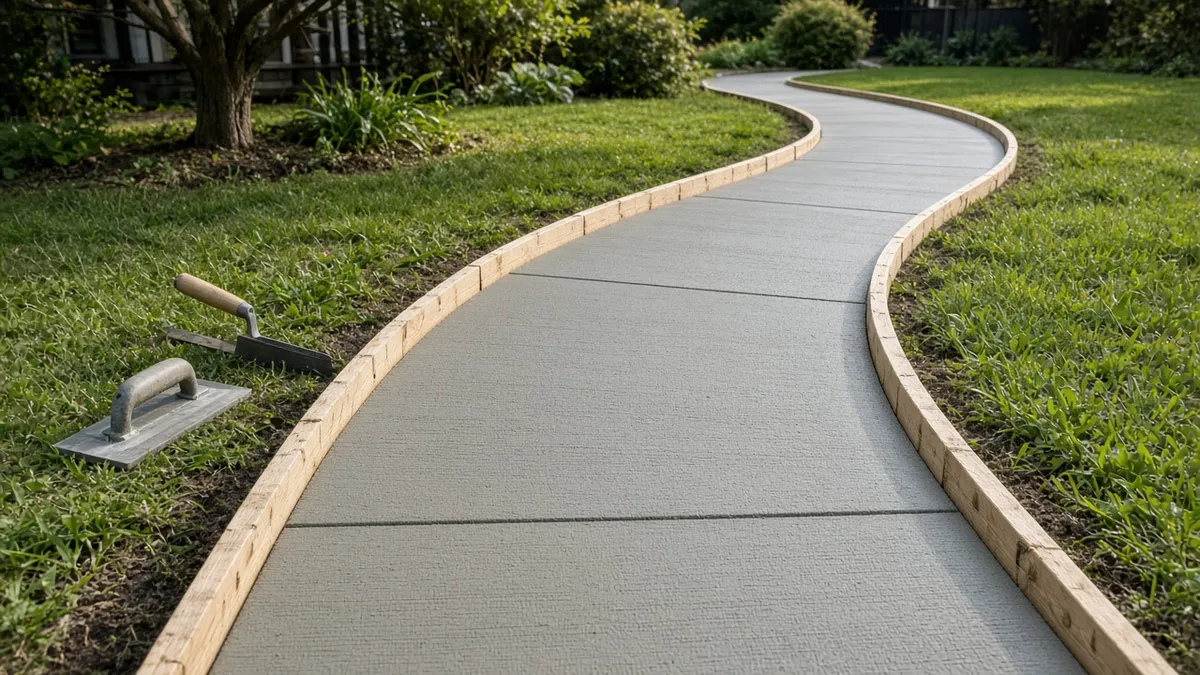
How to pour a concrete walkway: mark the path, dig out about 8 inches, compact 4 inches of gravel, set 2x4 forms (or bendable hardboard for curves) with a gentle slope of about 1/4 inch per foot for drainage, then pour 4 inches of concrete, screed it flush with the forms, float it, round the edges, cut control joints every 4 to 5 feet and finish with a broom. Keep it damp for about a week while it cures. A 30-foot path, 3 feet wide, needs a little over 1 cubic yard, or about 50 bags of 80-lb mix.
A walkway is one of the most rewarding first concrete projects: it is low to the ground, the forms are simple, and you can pour it in sections if you are working alone. The tricky parts are the length, which makes finishing a race against the clock, and the joints and slope, which decide whether it cracks neatly or randomly. This guide covers all of it.
Plan the walkway first
For a lighter, cheaper path, cast stepping stones instead of a continuous walk.
Width
Most garden and side-yard paths are 3 feet wide. Front walks that lead to the door are often 4 feet, which lets two people walk side by side. If the path needs to work for wheelchairs or walkers, plan at least 36 inches of clear width, the minimum for accessible routes in the ADA standards, and more if you can.
Thickness and base
A residential walkway is usually 4 inches of concrete on about 4 inches of compacted gravel. That handles foot traffic, wheelbarrows and lawn mowers. If a vehicle will ever cross it, treat that section like a driveway and go thicker; see our guide on driveway concrete strength. For base depth by soil type, read how much gravel to put under a concrete slab.
Slope and drainage
Water must run off, not pool. Slope the walk about 1/4 inch per foot to one side, away from the house. On a 3-foot-wide path that is a 3/4-inch drop from one edge to the other, which you will barely notice underfoot. Along its length, the path can follow the natural grade of the yard.
Permits and utilities
Front sidewalks that meet a public sidewalk or curb are often regulated by the city. Garden paths usually are not, but check locally. Always call 811 before you dig so buried lines can be marked.
Tools and materials
- Stakes, string line, line level and marking paint
- Square shovel, mattock, and a plate compactor or hand tamper
- Crushed gravel base (often sold as 3/4-inch minus or road base)
- Straight 2x4 boards for forms, 1/4-inch hardboard or plywood strips for curves, wood stakes and screws
- Bagged concrete mix or ready-mix, a mixer or wheelbarrow and hoe
- Screed board, bull float or magnesium float, edging tool, groover, and a stiff broom
- Expansion joint strip for where the walk meets the house, steps or driveway
- Gloves, eye protection and rubber boots (wet concrete is caustic)
How much concrete does a walkway need?
Multiply length x width x thickness in feet. Four inches is 0.333 feet.
| Walkway | Volume | Cubic yards | 80-lb bags (0.60 cu ft) | 60-lb bags (0.45 cu ft) |
|---|---|---|---|---|
| 20 ft x 3 ft x 4 in | 20 cu ft | 0.74 | 34 | 45 |
| 30 ft x 3 ft x 4 in | 30 cu ft | 1.11 | 50 | 67 |
| 40 ft x 4 ft x 4 in | 53 cu ft | 1.98 | 89 | 119 |
Add about 10 percent for uneven ground and spillage. Our concrete bag calculator does the bag math, and the concrete slab calculator gives cubic yards. Around 1 cubic yard and up, ordering a truck can be easier than mixing 50-plus bags; see how to order ready-mix concrete.
How to pour a concrete walkway step by step
Step 1: Lay out the path
Mark both edges with stakes and string for straight runs, or lay two garden hoses for curves, then spray-paint the outline. Keep curves gentle; tight curves are hard to form and finish.
Step 2: Excavate
Remove sod and soil to about 8 inches deep (4 inches of gravel plus 4 inches of concrete), a few inches wider than the finished path so you have room for forms and stakes. Keep the bottom roughly flat across and following your planned slope.
Step 3: Build the base
Spread gravel in two lifts and compact each one until it is firm and does not shift when you walk on it. A well-compacted base is the best defence against settling and cracks.
Step 4: Set the forms
Set 2x4s on edge along both sides, with the top edge at the finished height of the walk. Drive stakes every 2 to 3 feet on the outside and screw the boards to them, keeping stake tops below the form edge so they do not catch the screed. Use your level to set the side-to-side slope. For curves, bend strips of hardboard or thin plywood and add more stakes, about every foot on tight bends.
Where the walk meets the house foundation, steps or a driveway, glue or nail an expansion joint strip so the new concrete can move independently.
Where the walk meets a porch, garage slab or foundation, set an isolation joint before you pour.
Step 5: Mix and pour
Mix to a stiff, oatmeal-like consistency. Too much water weakens concrete and causes cracking and dusting. Start at the far end and work toward your exit, filling the forms slightly above the top edge and pushing concrete into the corners with a shovel. If you are working alone with bags, pour one section between form dividers at a time. Our guide to mixing concrete in a wheelbarrow has batch tips.
Step 6: Screed and float
Pull a straight board across the forms in a sawing motion to strike the surface flush. Fill low spots and screed again. Then go over it with a float to push down the stones and bring up a thin layer of cream. Stop when water starts to rise to the surface (bleed water), and wait.
Step 7: Edge and cut control joints
Once the bleed water has gone and the surface has lost its sheen, run an edging tool along both forms to round the edges. Then cut control joints across the walk with a groover, guided by a straight board. On a 3- to 4-foot walk, space them about every 4 to 5 feet so each panel is roughly square, and cut them at least a quarter of the slab depth, which is 1 inch on a 4-inch walk. Concrete will crack as it shrinks; joints make it crack in a straight line in the groove instead of randomly.
Step 8: Broom finish
Drag a stiff broom across the walk in one direction, at right angles to foot traffic, for a slip-resistant texture. Pull lightly for a fine texture and harder for a coarse one. Re-run the edger and groover if the broom roughed them up.
Step 9: Cure
Keep the concrete damp for about a week by misting it or covering it with plastic, or use a curing compound. Slow curing makes stronger, more crack-resistant concrete. Light foot traffic is usually fine after 24 to 48 hours; keep wheelbarrows and heavy loads off for about a week. Pull the forms after a couple of days and backfill the edges with soil.
If your walkway meets a slope or a door, you may need to pour concrete steps as well.
If you are pouring late in the year, read pouring concrete in cold weather first. Fresh concrete must not freeze.
Common walkway mistakes
- Skipping the slope. Flat walks hold puddles and ice.
- Thin or loose base. Soft spots settle and crack.
- Adding extra water. It is easier to place but weaker and dustier.
- Joints too far apart or too shallow. Expect random cracks between them.
- Finishing too early. Working bleed water back into the surface causes flaking.
- No isolation joint at the house. The walk and foundation move differently.
Finishing touches
After the bleed water is gone, a broom finish concrete pass gives the walk traction in the rain.
Once it has cured for about a month, you can seal it to resist stains and freeze-thaw damage, or add color with a stain. Our guide on how to stain concrete explains acid and water-based options, and is salt bad for concrete covers winter care.
Want a pebbly, slip-resistant walk instead of a broom finish? Read about exposed aggregate concrete.
Frequently asked questions
How thick should a concrete walkway be?
Four inches is standard for residential walkways, on about 4 inches of compacted gravel. Any section a vehicle might cross should be thicker, like a driveway.
How wide should a walkway be?
Three feet is common for garden and side-yard paths, and 4 feet for front walks so two people can walk together. Accessible routes need at least 36 inches of clear width.
How many bags of concrete do I need for a sidewalk?
A 30-foot walk, 3 feet wide and 4 inches thick, is about 30 cubic feet, or roughly 50 bags of 80-lb mix or 67 bags of 60-lb mix. Add about 10 percent for waste.
How far apart should control joints be in a sidewalk?
On a 3- to 4-foot-wide walk, about every 4 to 5 feet, so each panel is roughly square. Cut them at least a quarter of the slab depth, about 1 inch on a 4-inch walk.
Do I need rebar or mesh in a walkway?
Many short garden walks on a good base are poured without it, and joints control the cracking. Reinforcement can help on poor soil or where the walk may carry heavier loads; check local practice.
How long before you can walk on a new concrete walkway?
Light foot traffic is usually fine after 24 to 48 hours. Keep heavy loads, wheelbarrows and vehicles off for about a week, and keep the concrete damp while it cures.