How to calculate concrete for a driveway
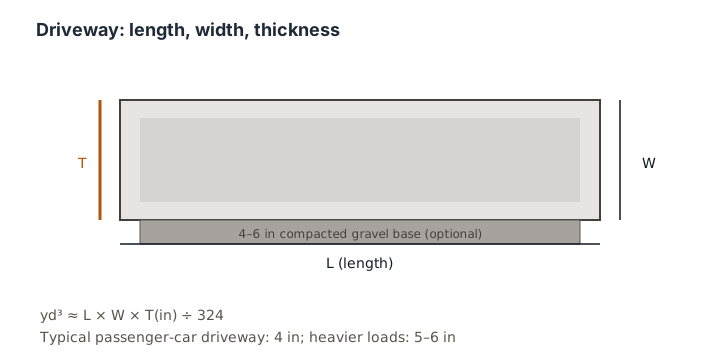
- Measure the paved length and width in feet. Split an L-shaped or flared apron into rectangles and add each as its own section.
- Pick thickness in inches. Four inches is common for cars; five or six inches is common for heavier loads or soft soil.
- Square feet = length × width.
- Cubic yards = square feet × thickness (in) ÷ 324.
- Read net yards first. Add 5% or 10% waste only after the geometry looks right, then round up to how your supplier sells.
Why 324? One cubic yard is 27 cubic feet, and a foot is 12 inches, so 27 × 12 = 324. The same identity powers every YardPour slab tool. The formula guide walks through the algebra with units kept visible.
Worked example: 20 × 12 ft driveway, 4 in thick
- Area: 20 × 12 = 240 sq ft.
- Cubic yards: 240 × 4 ÷ 324 = 2.96 yd³.
- Cubic feet: 2.96 × 27 = 80 ft³.
- 80 lb bags at 0.60 ft³: 80 ÷ 0.60 = 133.3, so 134 bags.
- 60 lb bags at 0.45 ft³: 178 bags.
- With 10% waste: 3.26 yd³ ordered, about 147 bags of 80 lb mix.
At nearly three yards, most homeowners call a ready-mix plant rather than mix bags. Compare truck and bag quotes with your own prices in the concrete cost calculator.
Common driveway sizes at a glance
Net volume, no waste, 80 lb bags at 0.60 ft³ each . Yards = sq ft × thickness (in) ÷ 324.
| Driveway | 4 in | 5 in | 6 in |
|---|---|---|---|
| 12 × 20 ft | 2.96 yd³ · 134 bags | 3.70 yd³ · 167 bags | 4.44 yd³ · 200 bags |
| 12 × 24 ft | 3.56 yd³ · 160 bags | 4.44 yd³ · 200 bags | 5.33 yd³ · 240 bags |
| 20 × 24 ft | 5.93 yd³ · 267 bags | 7.41 yd³ · 334 bags | 8.89 yd³ · 400 bags |
| 10 × 40 ft | 4.94 yd³ · 223 bags | 6.17 yd³ · 278 bags | 7.41 yd³ · 334 bags |
When to pour 5 or 6 inches, and 4,000 PSI
Four inches on a compacted base handles many passenger-car driveways. Step up to five or six inches when the approach sees pickups, delivery vans, an RV pad or weak subgrade. Mix strength matters with thickness: residential driveways are commonly ordered at about 4,000 psi, with air entrainment in freeze-thaw climates. Our driveway PSI guide lists what to say on the phone. Thickness alone does not replace a firm base, control joints or curing.
Gravel base under a driveway
Most driveways sit on 4 to 6 inches of compacted crushed stone. Base volume uses the same area × depth math as the slab. A 20 × 12 ft driveway on 4 inches of gravel needs 240 × 4 ÷ 324 = 2.96 yd³ of base before compaction allowance. Stone is often sold by the ton; confirm tons per cubic yard with your supplier . Open the gravel panel above for yards and approximate tons from your dimensions, and read the field guide on gravel under a concrete slab for stone type and compaction.
Control joints, slope and edges
- Control joints are usually cut to about one-quarter of the slab depth, spaced roughly 8 to 12 feet apart on a 4 inch driveway so shrinkage cracks follow the saw cuts.
- Slope of about 1/8 to 1/4 inch per foot sheds water away from the garage and house. Measure forms before you pour so thickness stays even.
- Expansion joints at the garage apron, sidewalks and walls keep the driveway from pushing against fixed structures as it moves with temperature.
- Thickened edges or a footing under the apron add volume. Toggle thickened edge in the calculator, or add a footing section in the main concrete calculator.
Driveway concrete cost example
Example only: 20 × 12 ft at 4 in ≈ 2.96 yd³ net; with 10% waste, order ~3.25 yd³. At $130/yd plus $75 delivery, concrete ≈ $498 before tax—enter your quotes in the concrete cost calculator.
Bags versus ready-mix for driveways
A full driveway is usually a truck job (~45 bags of 80 lb mix per yard). Compare bag vs truck with your prices on the cost calculator; see concrete vs asphalt driveway for lifespan and winter upkeep.
Driveway vs patio or shed pad
This URL owns driveway volume searches. Patios, shed pads, sidewalks and round pads stay on the concrete slab calculator, which keeps those intents separate so each page can answer its own FAQs. If your pour mixes a driveway with steps or a curb, combine shapes on the main concrete calculator, or size the curb alone with the concrete curb calculator.
After you pour
Keep the surface moist while it cures, keep cars off for about a week in mild weather, and wait longer for heavy trucks. See when you can drive on new concrete. In cold weather, protect the slab with blankets and follow cold-weather pouring guidance. Once cured, a breathable sealer helps against water and deicers—see how to seal a concrete driveway.
Sources
- QUIKRETE Concrete Mix No. 1101 data sheet (40 / 50 / 60 / 80 lb yields)
- Portland Cement Association, Design and Control of Concrete Mixtures (overview)
- International Residential Code Table R402.2 (compressive strength minimums, ICC Digital Codes)
Checked October 11, 2026.