Concrete cylinder calculator (solid and hollow)
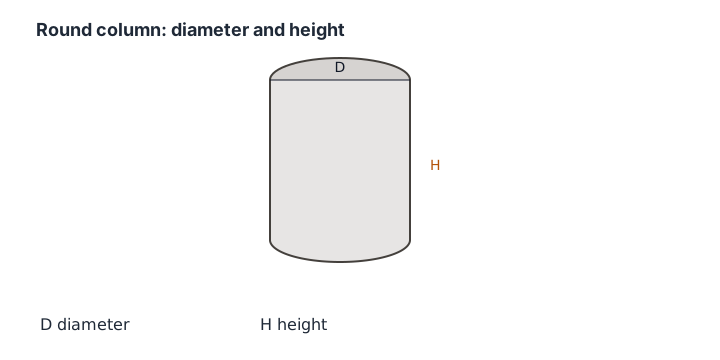
A solid round column is a cylinder: volume = π × radius² × height. In the calculator, choose Round column / tube form for a solid pour or Hollow tube to subtract an inner diameter (pipe sleeve or thin wall). For branded Sonotube forms with optional pad and bell footings, use the dedicated sonotube concrete calculator.
Round column formula
Worked example: one 12 in tube, 4 ft tall
- Radius: 12 ÷ 2 = 6 in = 0.5 ft.
- Area: π × 0.5² = 0.785 ft².
- Volume: 0.785 × 4 = 3.14 ft³ = 0.116 yd³.
- 80 lb bags: 3.14 ÷ 0.60 = 5.2, so 6 bags.
Concrete per foot of round column
Volume per foot is π × (diameter ÷ 24)² ft³. For a full diameter-by-depth bag table on branded tube forms, pads and bells, use the sonotube calculator.
Pillars and bollards
Short porch pillars and parking bollards are the same cylinder math: enter diameter and above-grade height, then add any buried depth and an optional pad in the footing calculator.
How to figure concrete for a cylinder, by hand
Square the radius, multiply by π (3.1416), multiply by the height, and keep every measurement in feet. Divide the cubic feet by 27 for yards or by your bag yield for bags. Working in inches is fine too, as long as you divide cubic inches by 1,728 to get cubic feet.
Worked example: four porch pillars, 16 in diameter, 8 ft tall
- Radius: 16 ÷ 2 = 8 in = 0.667 ft. Radius squared: 0.444 ft².
- One pillar: 3.1416 × 0.444 × 8 = 11.17 ft³.
- Four pillars: 44.7 ft³ = 1.66 yd³ net.
- As 80 lb bags at 0.60 ft³: 44.7 ÷ 0.60 = 74.5, so 75 bags before waste—enough that a short ready-mix load is worth pricing.
Square and rectangular columns
Formed square columns are simpler: width × depth × height. A square column holds about 27% more concrete than a round one of the same width (1 ÷ 0.785), so do not swap shapes in the calculator without changing the answer.
| Column size | ft³ per ft | 80 lb bags per ft | Height per yd³ |
|---|---|---|---|
| 8 × 8 in | 0.44 | 0.74 | 60.8 ft |
| 10 × 10 in | 0.69 | 1.16 | 38.9 ft |
| 12 × 12 in | 1.00 | 1.67 | 27.0 ft |
| 16 × 16 in | 1.78 | 2.96 | 15.2 ft |
| 18 × 18 in | 2.25 | 3.75 | 12.0 ft |
| 24 × 24 in | 4.00 | 6.67 | 6.8 ft |
Bag yield is QUIKRETE 1101 at 0.60 ft³ per 80 lb bag. For a rectangular column, multiply width × depth in feet for the per-foot volume. Above-ground columns that carry a beam or deck need reinforcement and a footing designed for the load; that design is outside this calculator.
Setting a fence or deck post?
A post sitting in a hole takes up part of the space, so a solid-column calculation overstates the concrete. Use the fence post concrete calculator, which subtracts the post and any gravel base and rounds the bags for the whole job. This page is for round tube forms, columns and piers.
Concrete column calculator tips
- Many tube forms are sold in 12 ft lengths and cut to size. Measure the buried depth plus the part above grade.
- A wide footing under the column, often a square pad or a bell-shaped base, is extra volume. Add it in the concrete footing calculator.
- For a mix of columns, slabs, and stairs, use the main concrete calculator.
- Setting a hoop? See how much concrete for a basketball hoop, with maker hole sizes.
Common mistakes with round columns
- Using outside diameter of a branded tube. Nominal sizes (8 in, 12 in) match the form label; measure the actual inside diameter if you are pouring against an existing pipe or sleeve.
- Skipping the footing pad. A pier on grade often needs a wider base for frost and bearing. That concrete is not in the cylinder formula—model it separately.
- Ordering bags without rounding up. Partial bags are not sold. The calculator rounds bag counts up; ready-mix should be rounded to your plant’s increment (often ¼ yd).
- Confusing hollow tube mode with a post hole. Hollow mode is for thin-walled forms or pipes. A wood post in a dug hole still needs the fence post tool, which subtracts post volume and optional gravel.
Placement and code context
Exposed columns and deck piers must meet your local IRC or IBC adoption for frost depth, reinforcement, and anchor bolts. ACI's Guide to Residential Concrete Construction (ACI 332) is a common reference for residential footings and piers; your permit office may cite different editions. This page only outputs volume.
Volume only. Column size, rebar, and footing design come from your plans or an engineer.
Sources
Checked October 11, 2026.