How to use this fence post concrete calculator
- Pick the post size, or choose round or custom for steel pipe and other posts.
- Enter the hole you will actually dig: diameter and full depth from grade to the bottom of the hole.
- Add the gravel base thickness if you are using one. Gravel sits under the post and is not counted as concrete.
- Enter the number of posts, or use Count posts from fence length at the top of the calculator: run length ÷ spacing + 1 for a straight section. Use "Add gate / corner posts" if some posts are bigger or deeper, then pick your bag size and read the whole-job bag count.
- For a single deck, mailbox, or hoop hole (not a fence line), use the post hole concrete calculator.
Count posts from fence length
For a straight fence run, divide the run length by your post spacing and add one post for the starting end. Example: a 100 ft run with posts every 8 ft is 100 ÷ 8 + 1 = 14 line posts. Corner posts, gate posts, and a terminal end that needs its own hole stay in a second group with their own count. The calculator includes this helper above the post groups so you do not have to count stakes on paper before you enter bag math.
What each input does
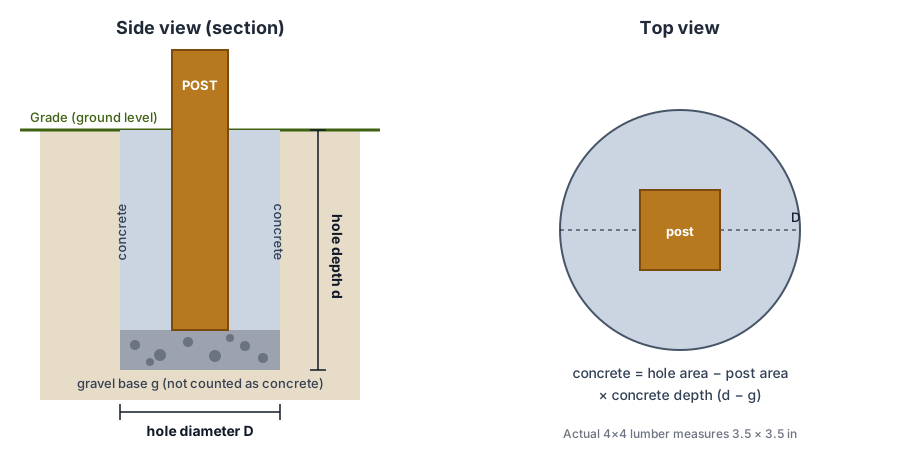
- Hole diameter. Posts sit in a round hole, so the concrete is the ring between the hole wall and the post. Doubling the width of a hole roughly quadruples the volume, so a few extra inches of diameter adds up fast across a whole fence. Manufacturer guides commonly suggest a hole about three times the post width, which is 10 to 12 in for a 4×4.
- Hole depth. Enter the full dug depth. How deep a post should go depends on its height, the soil and your frost depth; the field guide on how to set fence posts in concrete covers that decision, and the optional depth helper below the calculator gives a starting number.
- Gravel base. A layer of gravel under the post helps water drain. It takes up depth at the bottom of the hole, so the calculator takes it off the concrete depth and lists the gravel volume separately.
- Fill stops below grade. Some project guides stop the concrete a few inches under ground level and finish with soil. Leave this at 0 if you will crown the concrete at grade.
- Waste. Holes are rarely perfect cylinders. The default is 0% so you see the true geometry; many builders add 5 to 10% for ragged holes and spills.
- Bag yield. A bag's weight is not its volume. Each size makes a set number of cubic feet of mixed concrete, and brands differ, so edit the yield to match the label on your bag.
Fast-setting concrete for fence posts
Fast-setting bags (such as QUIKRETE 1004) often use the same ~0.375–0.45 ft³ yield as standard mix but set in 20–40 minutes. Edit the yield field to match your bag; hole math is unchanged.
How much concrete for a 4×4 fence post?
A 4×4 post is really 3.5 × 3.5 in. In a 10 in hole dug 24 in deep it leaves about 0.92 cubic feet of space to fill. That is 2 bags of 80 lb concrete mix (0.60 ft³ each) or 3 bags of 50 lb mix (0.375 ft³ each), after rounding up. Add a 4 in gravel base and the same hole needs about 0.77 cubic feet, which still rounds to 2 bags of 80 lb mix. Change the hole size or depth above to see how fast the number moves.
Bags of concrete per fence post (quick tables)
Concrete per post, 0% waste. Bags are shown as decimals per post; the last two columns round once for 10 posts. 80 lb = 0.60 ft³, 50 lb = 0.375 ft³ per bag.
No gravel base, concrete to grade.
| Post | Hole (dia × depth) | Concrete per post | 80 lb bags per post | 50 lb bags per post | 80 lb bags for 10 posts | 50 lb bags for 10 posts |
|---|---|---|---|---|---|---|
| 4×4 | 10 in × 24 in | 0.92 ft³ | 1.5 | 2.5 | 16 | 25 |
| 4×4 | 10 in × 30 in | 1.15 ft³ | 1.9 | 3.1 | 20 | 31 |
| 4×4 | 12 in × 30 in | 1.75 ft³ | 2.9 | 4.7 | 30 | 47 |
| 4×4 | 12 in × 36 in | 2.10 ft³ | 3.5 | 5.6 | 36 | 57 |
| 4×6 | 12 in × 30 in | 1.63 ft³ | 2.7 | 4.3 | 28 | 44 |
| 6×6 | 12 in × 30 in | 1.44 ft³ | 2.4 | 3.8 | 24 | 39 |
| 6×6 | 14 in × 42 in | 3.01 ft³ | 5.0 | 8.0 | 51 | 81 |
| 6×6 | 16 in × 48 in | 4.74 ft³ | 7.9 | 12.7 | 80 | 127 |
| 2⅜ in round pipe | 8 in × 30 in | 0.80 ft³ | 1.3 | 2.1 | 14 | 22 |
Same holes with a 4 in gravel base (concrete depth = hole depth − 4 in).
| Post | Hole (dia × depth) | Concrete per post | 80 lb bags per post | 50 lb bags per post | 80 lb bags for 10 posts | 50 lb bags for 10 posts |
|---|---|---|---|---|---|---|
| 4×4 | 10 in × 24 in | 0.77 ft³ | 1.3 | 2.0 | 13 | 21 |
| 4×4 | 10 in × 30 in | 1.00 ft³ | 1.7 | 2.7 | 17 | 27 |
| 4×4 | 12 in × 30 in | 1.52 ft³ | 2.5 | 4.0 | 26 | 41 |
| 4×4 | 12 in × 36 in | 1.87 ft³ | 3.1 | 5.0 | 32 | 50 |
| 4×6 | 12 in × 30 in | 1.41 ft³ | 2.4 | 3.8 | 24 | 38 |
| 6×6 | 12 in × 30 in | 1.25 ft³ | 2.1 | 3.3 | 21 | 34 |
| 6×6 | 14 in × 42 in | 2.72 ft³ | 4.5 | 7.3 | 46 | 73 |
| 6×6 | 16 in × 48 in | 4.35 ft³ | 7.2 | 11.6 | 73 | 116 |
| 2⅜ in round pipe | 8 in × 30 in | 0.69 ft³ | 1.1 | 1.8 | 12 | 19 |
Actual lumber sizes are used: a 4×4 is 3.5 × 3.5 in, a 4×6 is 3.5 × 5.5 in, a 6×6 is 5.5 × 5.5 in. These are volumes, not hole recommendations. Other bag sizes and yields: use the calculator or the bag yield table.
The formula
Everything is in inches inside the formula and converted to cubic feet by dividing by 1,728. The same steps for slabs, columns and stairs are in the concrete volume formulas guide.
Worked examples
One 4×4 line post
Hole: π × 5² × 24 = 1,885 in³ (1.09 ft³). Post: 3.5 × 3.5 × 24 = 294 in³ (0.17 ft³). Concrete: 1,591 in³ = 0.92 ft³. 80 lb bags: 0.92 ÷ 0.60 = 1.53, so 2 bags. 50 lb bags: 0.92 ÷ 0.375 = 2.46, so 3 bags.
A straight run of 14 posts
4×4 posts, 10 in holes 30 in deep, 4 in gravel base, 10% waste. Concrete depth is 26 in, so each post takes 1.00 ft³ (0.997 before rounding). Net for 14 posts: 13.96 ft³. With waste: 15.36 ft³ (0.57 yd³). 80 lb bags: 15.36 ÷ 0.60 = 25.6, so 26 bags when you round once. If you round every post up on its own (2 bags each), you would buy 28. Gravel: 2.55 ft³ (0.09 yd³).
A fence with gate and corner posts
18 line posts (4×4, 10 × 30 in) plus 3 gate and corner posts (6×6, 14 in × 42 in), all with a 4 in gravel base and 10% waste. Line posts: 18 × 1.00 = 17.95 ft³. Gate and corner posts: 3 × 2.72 = 8.16 ft³. Net 26.11 ft³, order 28.72 ft³ (1.06 yd³). That is 48 bags of 80 lb mix or 77 bags of 50 lb mix, plus 4.34 ft³ of gravel. At about a cubic yard, it is worth comparing ready-mix with bags on the concrete cost calculator.
Why other calculators give different bag counts
| What differs | Effect on a 4×4 post in a 10 in × 24 in hole | What YardPour does |
|---|---|---|
| The post is not subtracted | 1.09 ft³ instead of 0.92 ft³ (about 18% more). On 12 posts that is 22 bags of 80 lb instead of 19 | Subtracts the post using actual lumber size |
| Gravel counted as concrete | A 4 in gravel base in a 30 in hole: 1.15 ft³ instead of 1.00 ft³ (about 15% more) | Takes gravel off the concrete depth and lists it separately |
| Rounding each post up | 14 posts: 28 bags instead of 26 | Rounds once on the whole job and shows the per-post figure as well |
| A different bag yield | 80 lb mix at 0.60 ft³ vs another brand's printed yield | Editable yield per bag size |
None of this is wrong math, only different assumptions. Match the assumptions to your hole and your bag, and the numbers agree.
Frost line and hole depth: a planning note
Ground that freezes can push a post upward, so posts that must stay put are usually set below the local frost depth. That number comes from your building department, not from this page, and the calculator does not know it. Enter the depth your plan requires, or type your frost depth into the depth helper and it will use the larger of that and the rule-of-thumb depth. One manufacturer's project sheet says posts used for structural support, such as deck posts, should extend at least 6 in below the frost line. This is a volume tool, not engineering advice. Check local code before you dig.
What this calculator does not do
It estimates concrete volume and bag counts only. It does not choose hole depth for your soil or wind exposure, design deck or pergola footings, or check local code. Hollow posts, sleeves and special anchors may use less concrete or a different method; follow the manufacturer's instructions. QUIKRETE is a registered trademark of its owner. YardPour is not affiliated with or endorsed by it. Slabs and other shapes belong on the concrete calculator. Round tube forms and columns stay on the round tube forms and columns page.
Frequently asked questions
How many bags of concrete do I need per fence post?
It depends on post size, hole size and depth. A 4×4 post in a 10 in hole dug 24 in deep needs about 0.92 cubic feet of concrete, which is 2 bags of 80 lb mix or 3 bags of 50 lb mix when rounded up (using 0.60 and 0.375 cubic feet per bag). Wider or deeper holes need more, so enter your own numbers in the calculator.
How much concrete do I need for 20 fence posts?
Work out one post, multiply by 20, add waste, divide by the bag yield and round up once. For 20 posts of 4×4 in 10 in holes 30 in deep with a 4 in gravel base and 10% waste, that is about 21.9 cubic feet, or 37 bags of 80 lb mix (59 bags of 50 lb mix).
Do I subtract the post from the hole when I calculate concrete?
Yes. The post takes up room in the hole, so concrete equals hole volume minus the buried post. Ignoring the post adds about 18% for a 4×4 in a 10 in hole 24 in deep (1.09 instead of 0.92 cubic feet), and that adds up over a long fence. A 4×4 is really 3.5 by 3.5 in.
Does the gravel base count as concrete?
No. Gravel under the post is a separate material. Enter its thickness in the gravel base field and the calculator takes it off the concrete depth and shows the gravel volume on its own line.
What hole diameter should I enter?
Enter the hole you will actually dig. Manufacturer guides commonly suggest about three times the post width, which is 10 to 12 in for a 4×4. For how to dig and fill the hole, see our guide to setting fence posts in concrete.
Why does another calculator give me a different number of bags?
Usual reasons: it does not subtract the post, it counts the gravel base as concrete, it uses a different bag yield, or it rounds every post up separately instead of rounding the whole job once. This calculator shows each assumption so you can match your own bag.
Should I round bags up per post or for the whole job?
Round once for the whole job, because leftover mix from one hole fills the next. The calculator shows both numbers. For 14 posts of 4×4 in 10 in holes 30 in deep with a 4 in gravel base and 10% waste, it is 26 bags of 80 lb mix for the whole job but 28 if you round every post up.
Can I use this for deck, mailbox or pergola posts?
The volume math is the same for any single post in a round hole. Structural posts such as deck and pergola posts often need deeper holes or footings set by local code or a plan, so confirm those requirements before you dig. For footings that are not round holes, use the concrete footing calculator.
Cite this page
YardPour Team. (November 17, 2026). Fence Post Concrete Calculator: How Many Bags per Post. YardPour. https://yardpour.com/fence-post-concrete-calculator/
Accessed October 11, 2026. Calculator inputs stay in your browser unless you use a share link.
Download the bags-per-fence-post chart (PDF) — free to use with a link to YardPour.
Sources
- QUIKRETE, Setting Posts project sheet (hole width about 3× post width; 6 in gravel base; structural posts 6 in below frost line)
- QUIKRETE Concrete Mix No. 1101 data sheet (bag yields 0.30 / 0.375 / 0.45 / 0.60 ft³ for 40 / 50 / 60 / 80 lb)
- QUIKRETE Fast-Setting Concrete Mix No. 1004-50 data sheet (50 lb bag ≈ 0.375 ft³)
- Call 811 before you dig
Checked October 11, 2026.