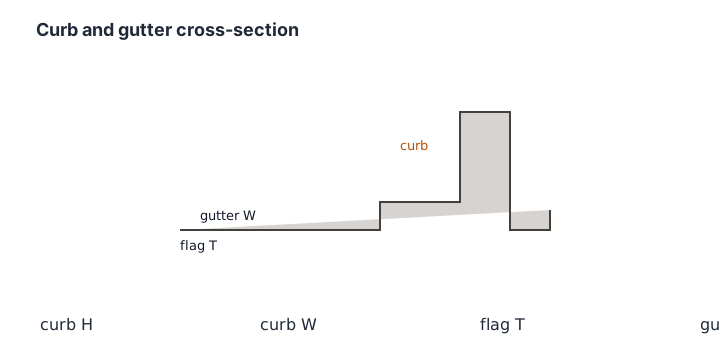
How curb and gutter volume is figured
A typical US curb-and-gutter section is two rectangles sharing the length of the pour: the upright curb face and the horizontal gutter pan (sometimes called the flag). Convert every small dimension to feet, multiply, add the two areas, then multiply by length.
Defaults match common residential dims: 6 in curb width, 18 in curb height, 18 in gutter width, 6 in flag thickness. Edit any field to match your forms or municipal standard. Bag yields default to manufacturer sheet values (0.60 ft³ for 80 lb, 0.45 ft³ for 60 lb) and stay editable in the calculator .
Worked example: 100 ft of curb and gutter
- Curb rectangle: (6 ÷ 12) × (18 ÷ 12) = 0.5 × 1.5 = 0.75 ft².
- Gutter rectangle: (18 ÷ 12) × (6 ÷ 12) = 1.5 × 0.5 = 0.75 ft².
- Section area: 0.75 + 0.75 = 1.50 ft².
- Volume: 100 × 1.50 = 150 ft³ = 5.56 yd³.
- 80 lb bags at 0.60 ft³: 250 bags before waste.
- With 10% waste: 6.11 yd³ ordered, 275 bags of 80 lb mix.
At over five yards, this is a ready-mix order. Confirm short-load fees and whether the plant batches to the nearest quarter yard before you call.
Bags and yards per 10 feet (default section)
Default cross section: 6 × 18 in curb plus 18 × 6 in gutter. Net volume, 0% waste. 80 lb bags at 0.60 ft³, 60 lb at 0.45 ft³ .
| Length | ft³ | yd³ | 80 lb bags | 60 lb bags |
|---|---|---|---|---|
| 10 ft | 15.0 | 0.56 | 25 | 34 |
| 20 ft | 30.0 | 1.11 | 50 | 67 |
| 40 ft | 60.0 | 2.22 | 100 | 134 |
| 50 ft | 75.0 | 2.78 | 125 | 167 |
| 100 ft | 150.0 | 5.56 | 250 | 334 |
Ten feet alone is about 15.0 ft³ (0.56 yd³). Multiply the 10 ft row by how many segments you pour, or enter the full length once so waste and bag rounding happen a single time.
Trapezoid (sloped curb) option
Some curb faces are wider at the bottom than at the top. Use the trapezoid shape: average the top and bottom widths, multiply by height and length. Example: 40 ft long, 6 in top, 12 in bottom, 12 in height → section = ((6 + 12) ÷ 2 ÷ 12) × (12 ÷ 12) = 0.75 ft², volume = 40 × 0.75 = 30 ft³ (1.11 yd³). The same trapezoid mode lives on the main concrete calculator when the curb pours with a driveway or sidewalk.
Forming tips (volume only)
- Stake forms to the plan dimension; a half-inch wider curb along 100 ft adds real yards.
- Measure curb height from the gutter flow line, not from unfinished dirt grade.
- If the gutter pan thickness varies, use the average depth or split the run into two sections.
- This tool estimates concrete volume. It does not design curb height, reinforcement or drainage for municipal acceptance.
Where this page fits next to other tools
Owner keyword: concrete curb calculator / curb and gutter calculator. Driveway slabs stay on the concrete driveway calculator. Straight poured walls use the concrete wall calculator. Strip footings under a curb wall use the footing calculator. When one truck pours curb plus apron plus steps, combine shapes on the main hub so one order sheet covers the day.
Bags, waste and ordering
Waste starts at 0% so net geometry stays honest. Add 5–10% if forms flex, the subgrade is uneven or a pump line will hold concrete. Round bags up after waste; never round down mid-pour. For bag-only comparisons across sizes, the concrete bag calculator lists 40 through 80 lb yields side by side. For truck yards with rounding increments, use the concrete yard calculator.
Sources
- QUIKRETE Concrete Mix No. 1101 data sheet (40 / 50 / 60 / 80 lb yields)
- Portland Cement Association, Design and Control of Concrete Mixtures (overview)
Checked October 11, 2026.