- The short answer by hoop type
- How much concrete for a basketball hoop: the formula
- Bags of concrete for a basketball hoop: quick table
- Basketball hoop hole size and depth
- Call 811 before you dig
- In-ground basketball hoop concrete: step by step
- How deep to bury a basketball pole
- Weight: what you are carrying
- Bagged mix or ready-mix?
- Installing in late fall or winter
- Common mistakes
- Plan your hoop footing
- Frequently asked questions
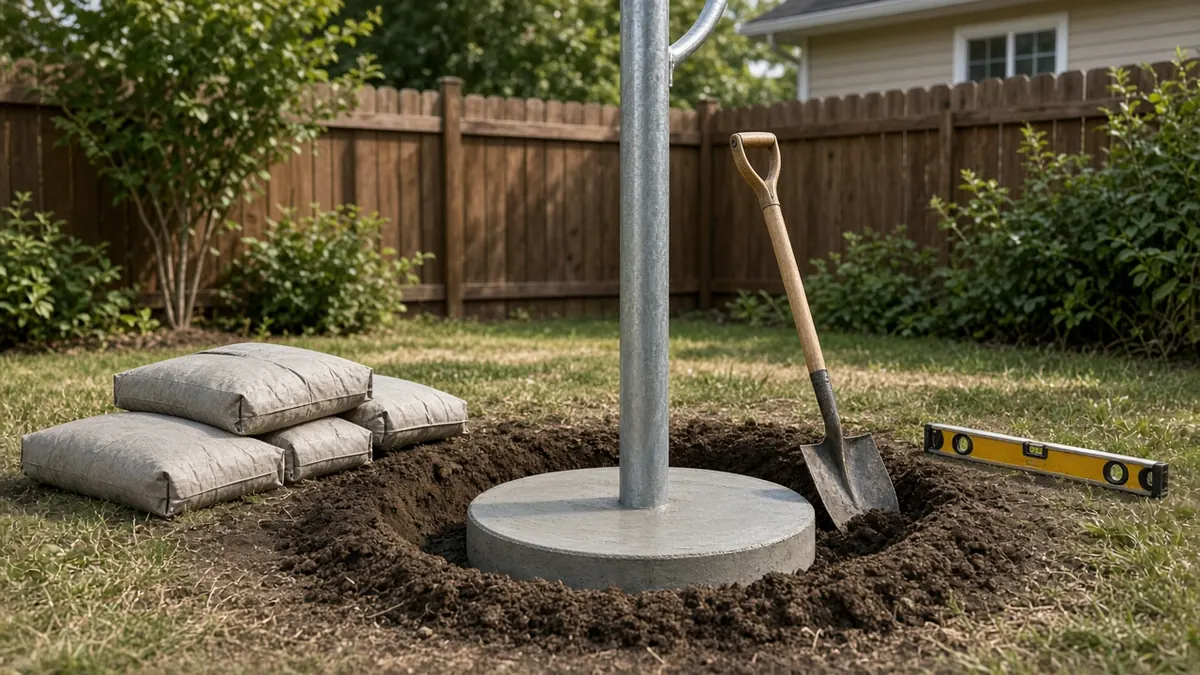
How much concrete for a basketball hoop? For most in-ground hoops, plan on roughly 5 to 13 bags of 80 lb concrete mix, depending on the hole the manufacturer specifies. Goalrilla's anchor system, for example, uses a hole 16 inches wide and 48 inches deep and calls for eleven 80 lb bags. Lifetime's in-ground systems use shallower, wider holes and 420 to 640 lb of concrete. Your hoop's manual is the authority; use our post hole concrete calculator for bag counts from your hole size. This guide shows you how to check its numbers and buy the right amount.
The short answer by hoop type
| Hoop / anchor type | Hole the maker specifies | Concrete the maker specifies |
|---|---|---|
| Goalrilla anchor system | 16 in diameter × 48 in deep | 11 bags of 80 lb (Goalrilla suggests buying 12 to 13) |
| Lifetime in-ground systems | 18 to 24 in diameter × 21 to 24 in deep (by model) | 420 to 640 lb (by model) |
| Any other brand | Read the manual | Read the manual, then check it with the math below |
Two brands, two very different holes. A deep, narrow anchor hole and a shallow, wide hole can need similar amounts of concrete, so never copy a neighbour's number for a different hoop.
How much concrete for a basketball hoop: the formula
A basketball hoop footing is a cylinder, so the math is the same one our concrete column calculator uses for round holes:
- Find the radius. Divide the hole diameter by 2. A 16 in hole has an 8 in radius.
- Find the volume in cubic inches. Multiply 3.1416 × radius × radius × depth. For 16 × 48 in: 3.1416 × 8 × 8 × 48 = about 9,651 cubic inches.
- Convert to cubic feet. Divide by 1,728. That is about 5.59 cubic feet.
- Convert to bags. Divide by the yield printed on the bag. Quikrete lists about 0.60 cubic feet for an 80 lb bag and 0.45 cubic feet for a 60 lb bag.
For the Goalrilla hole, 5.59 ÷ 0.60 = about 9.3 bags of 80 lb mix. Goalrilla specifies 11, and it suggests buying 12 to 13. The gap is normal. Real holes are rarely perfect cylinders: the sides bulge where soil falls in, and the bottom is often wider than the top. A bag or two of extra mix is cheaper than a second trip to the store with wet concrete already in the hole.
If you want to skip the arithmetic, enter the diameter and depth in the concrete bag calculator and it returns bags for each size.
Bags of concrete for a basketball hoop: quick table
These are pure cylinder volumes at the bag yields above, before any extra for waste. Round up, then add your margin.
| Hole size (diameter × depth) | Cubic feet | 80 lb bags (0.60 ft³) | 60 lb bags (0.45 ft³) |
|---|---|---|---|
| 16 × 48 in | 5.59 | 9.3 | 12.4 |
| 18 × 21 in | 3.09 | 5.2 | 6.9 |
| 21 × 24 in | 4.81 | 8.0 | 10.7 |
| 24 × 24 in | 6.28 | 10.5 | 14.0 |
If your manual gives a weight instead of bags (Lifetime gives pounds), divide by the bag weight. 640 lb is eight 80 lb bags; 420 lb is five and a quarter, so buy six.
Basketball hoop hole size and depth
The hole the maker specifies is part of the engineering of the hoop. It sets how much soil and concrete resist the leverage of a heavy backboard on a long arm, plus the force of a dunk or a strong wind.
- Stick to the manual's diameter and depth. A narrower hole saves a bag but reduces the footing the maker designed for.
- Frost matters. Lifetime notes that climate conditions such as frost heave can change the required dimensions and tells owners where frost heave is a problem to ask the local building inspector. Your local frost depth is set by your area, not by the hoop.
- Keep the edge near the court. Lifetime says the edge of the hole should be flush with the edge of the playing surface, and Goalrilla says to place the hole close to the playing surface without touching it.
- Square the top. Goalrilla's older anchor instructions recommend a form for the top 4 inches so the collar of the footing is neat. A cardboard tube or a ring of 2×4s works.
Call 811 before you dig
Both Goalrilla and Lifetime tell you to have buried utility lines marked before you dig. In the US, call 811 a few days ahead. A 4 ft hole near a driveway is exactly where gas, power, water and cable often run. The call is free, and it is the step most people skip.
In-ground basketball hoop concrete: step by step
Every hoop has its own sequence, so treat this as an overview and follow your manual where it differs.
- Mark and dig. Dig to the diameter and depth in the manual, measured from the playing surface, not from the lawn.
- Prepare the bottom. Lifetime systems place bricks or patio blocks in the hole as a base for the pole or ground sleeve. Goalrilla's anchor system uses an anchor plate and J-bolts set into the wet concrete.
- Mix in batches. Goalrilla recommends mixing 1 to 2 bags at a time and lists about 6 pints (2.8 L) of water per 80 lb bag or 4 pints (1.9 L) per 60 lb bag. Aim for a stiff, oatmeal-like mix. Too much water weakens it.
- Place and rod. Pour soon after mixing and work the concrete as you go to remove air pockets, especially around rebar and bolts.
- Set the pole or anchor level. Check level on two sides, then check again after five minutes, because wet concrete can shift a heavy pole.
- Leave it alone. Lifetime pauses assembly for 3 days (72 hours) while the concrete sets, and Goalrilla also describes a three-day cure before the goal goes on. Do not hang the backboard early.
Concrete keeps gaining strength well past those three days, so hold off on hard dunking for a while longer if you can.
How deep to bury a basketball pole
"Bury" depends on the design. With a direct-bury pole, the bottom pole sits in the concrete itself; Lifetime's manuals use a mark on the pole to set the depth. With an anchor system, only bolts sit in the concrete and the pole bolts on top. That design lets you remove the pole later without breaking up the footing. Either way, the depth comes from the manual, not from a rule of thumb.
Weight: what you are carrying
Eleven 80 lb bags is 880 lb of dry mix. Plan for a wheelbarrow, a hoe or a mixing tub, and a helper. Lifetime says it is not recommended to install a hoop alone, and that is just as true when you are moving bags. If you want the finished weight of the footing, the concrete weight calculator converts the volume to pounds.
Bagged mix or ready-mix?
For a single hoop, bagged mix almost always makes sense: 6 to 13 bags is an afternoon's work, and ready-mix trucks usually have minimum orders far larger than one footing. If you are also pouring a slab for a half court, the slab will need ready-mix, and you could pour the footing on the same day. Our guide to how to order ready-mix concrete covers truck day.
Installing in late fall or winter
A hoop is a popular holiday gift, which means many footings go in when it is cold. Concrete gains strength slowly in low temperatures and must not freeze while it is young. If nights are near freezing, read pouring concrete in cold weather before you dig, and consider waiting for a mild spell. Frozen ground is also hard to dig, so a gift-card-and-spring-install plan is not a bad one.
Common mistakes
- Buying the math, not the margin. The cylinder formula gives the minimum. Buy at least one extra bag.
- Measuring depth from the lawn. The manual's depth is usually measured from the playing surface.
- Skipping 811. It is free, and the risk is not.
- Adding water to make it pour. A soupy mix is weaker. Follow the bag.
- Rushing assembly. Wait the full cure time the manual gives.
- Using fence-post rules. A fence post carries far less load. Our guide to setting fence posts in concrete explains why those holes are smaller.
Plan your hoop footing
Measure the hole in the manual, run it through the YardPour concrete calculator, and buy the number of bags it gives plus your margin. Five minutes of math saves a frantic store run with a half-filled hole.
Frequently asked questions
How many bags of concrete do I need for a basketball hoop?
It depends on the hole your hoop's manual specifies. Goalrilla's anchor system calls for eleven 80 lb bags for a 16 × 48 in hole, and Lifetime's in-ground systems use 420 to 640 lb depending on the model. Check the manual, then run the numbers.
What size hole do I dig for a basketball hoop?
Use the size in your manual. Goalrilla's anchor system uses 16 in wide by 48 in deep. Lifetime's in-ground systems use 18 to 24 in wide by 21 to 24 in deep, depending on the model, and more where frost heave is a concern.
Can I use 60 lb bags instead of 80 lb bags?
Yes. Quikrete lists about 0.45 cubic feet per 60 lb bag versus 0.60 for an 80 lb bag, so you need about a third more bags. Divide the hole volume in cubic feet by 0.45.
How long should concrete cure before I put up the basketball hoop?
Follow the manual. Lifetime pauses assembly for 72 hours, and Goalrilla also describes a three-day cure before the goal is mounted. Cold weather slows curing.
Do I need rebar in a basketball hoop footing?
Only if your hoop's instructions call for it. Some do: Goalrilla's older anchor kit instructions place four rebar bars in the concrete, and some Lifetime manuals use rebar inside the pole. Follow the specific manual.
Should I mix concrete by hand or order a truck for a basketball hoop?
For one footing, bagged mix is usually the practical choice, because 6 to 13 bags is manageable by hand. Ready-mix makes sense if you are also pouring a court slab on the same day.
- https://www.goalrilla.com/pages/basketball-hoop-installation-guide
- https://www.lifetime.com/blog/post/in-ground-basketball-assembly
- https://www.quikrete.com/pdfs/data_sheet-concrete%20mix%201101.pdf