- Which fix for which problem
- Leveling an uneven indoor concrete floor
- Why concrete slabs sink
- How mudjacking works
- How polyjacking works
- Mudjacking vs polyjacking at a glance
- When leveling works, and when to replace
- What happens on leveling day
- Leveling different kinds of slabs
- Why fixing trip hazards matters
- Can you level concrete yourself?
- Preventing future settling
- Questions to ask a leveling contractor
- Frequently asked questions
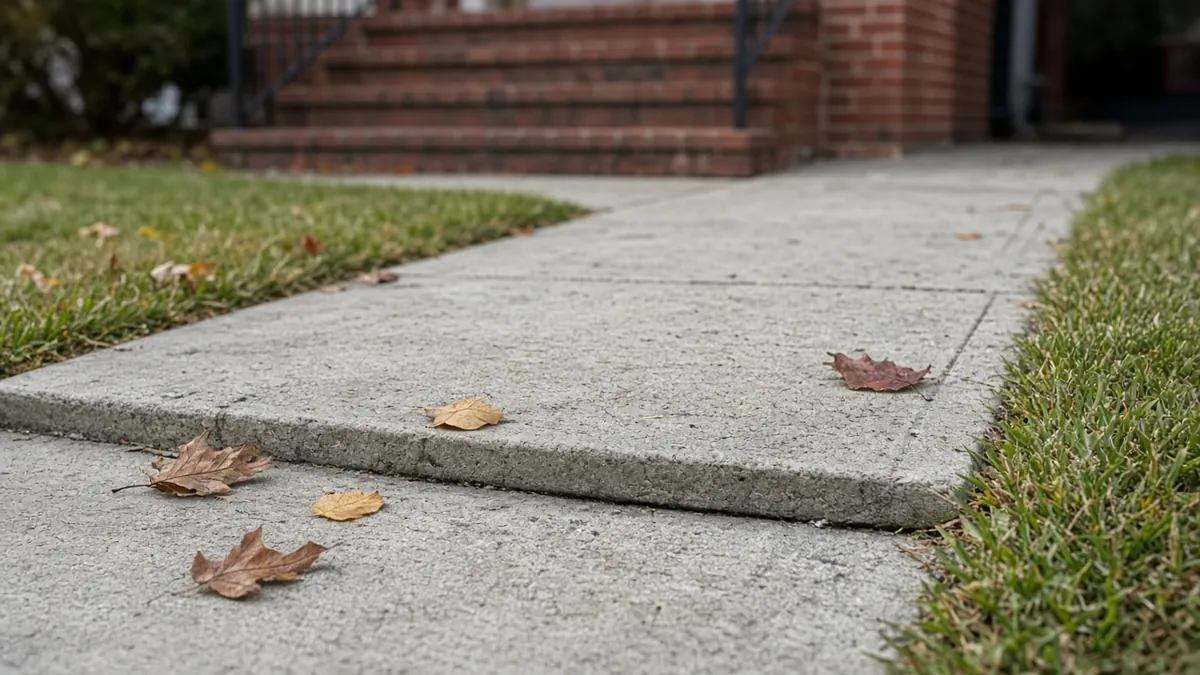
Concrete leveling lifts a sunken slab back into place by filling the empty space beneath it, instead of tearing it out and pouring new concrete. It is used for settled sidewalks, patios, driveways, garage aprons, pool decks and steps. There are two main methods: mudjacking, which pumps a cement-based slurry under the slab, and polyjacking, which injects expanding polyurethane foam. Both can fix trip hazards and drainage problems quickly, as long as the slab itself is still in decent condition.
Concrete slab leveling and concrete floor leveling mean different things depending on what failed. If the whole section has dropped or rocks on voids, you want mudjacking or foam lifting on this page. If the slab is sound but uneven indoors before new flooring, use a self-leveling underlayment instead. To size a replacement pour after a failed lift, use the concrete slab calculator or yard calculator for ready-mix.
This guide explains why slabs sink, how each method works, how to choose between lifting and replacing, and what you can safely do yourself. Note that this is different from self-leveling concrete, which is a pourable topping used to flatten indoor floors.
Which fix for which problem
"Concrete leveling" covers several different repairs. Start by working out what is actually wrong. Lay a long straightedge or a 10 ft board across the floor, slide a tape under it at the low spots, and see whether the slab is sound and just uneven, or whether a whole section has dropped.
| What you see | Usual fix | DIY? |
|---|---|---|
| A raised lip at a joint or a few high spots on an indoor floor | Grind the high spots with a diamond cup wheel | Yes, with dust control |
| Shallow dips and humps under planned flooring, slab otherwise sound | Self-leveling underlayment; see how to pour self-leveling concrete | Yes |
| Rough, worn or lightly scaled surface that is still flat overall | Patch deep spots, then a resurfacer rated for the location | Yes |
| One section has dropped (trip edge, patio tipping toward the house) | Mudjacking or polyjacking (foam) to lift it | Usually a contractor |
| Slab broken into many pieces, crumbling, or keeps sinking | Fix drainage, then remove and replace | Depends on size |
For an indoor floor going under new flooring, check the flooring maker's installation guide. Most state a flatness tolerance as a maximum gap under a straightedge over a set length, and that number tells you how much grinding or filling you need.
Leveling an uneven indoor concrete floor
- Map the floor. Mark high and low spots with chalk as you move the straightedge in a grid.
- Take down the highs first. Grinding a hump is often less work than raising the whole room to meet it. Use a grinder with a vacuum shroud; OSHA's silica guidance covers dust control.
- Repair cracks and holes. Fill anything deeper than your leveler allows with a repair mortar; see how to fix cracks in concrete.
- Fill the lows. Feather-edge patch for small dips, or a self-leveling underlayment for wider areas.
- Check moisture before flooring. Follow the flooring maker's moisture limits.
If the floor is uneven because the slab is still moving or cracking, a topping will crack with it. Find the cause first: water, poor base, or tree roots.
Why concrete slabs sink
A slab is only as stable as the ground under it. Most settling comes from one of these causes:
- Poor compaction. Fill soil that was not compacted before the pour slowly settles. This is common around new houses, where soil was dug out for the foundation and backfilled.
- Water erosion. Downspouts, sprinklers or poor drainage wash soil from under the edges of a slab, leaving voids.
- Soil shrinkage. Clay soils shrink during dry spells, and the slab drops.
- Frost heave and thaw. In cold climates, freezing water lifts slabs, and they settle unevenly when it thaws.
- Tree roots. Roots can lift one side of a slab or, when trees die, leave voids as they decay.
- Missing base. Slabs poured on topsoil without a compacted base are much more likely to sink. Our guide to gravel under a concrete slab explains how a good base prevents this.
Fixing the cause matters as much as lifting the slab. If water keeps washing soil away, the slab will sink again.
How mudjacking works
Mudjacking, also called slabjacking, is the older method. A crew drills holes about 1 to 2 inches wide through the slab, then pumps a slurry of water, soil or sand, and cement into the void. As the slurry fills the space, pressure lifts the slab. The crew watches the slab rise and stops when it is level, then patches the holes with cement.
Pros of mudjacking:
- Usually costs less than polyjacking.
- Uses simple, natural materials.
- Works well for large voids.
Cons:
- Larger, more visible holes.
- The slurry is heavy, which can add load to weak soils.
- Takes longer to cure, often a day or more before heavy use.
- The material can wash out over time if drainage is poor.
How polyjacking works
Polyjacking, also called foam leveling or poly leveling, uses high-density polyurethane foam. The crew drills small holes, often around 5/8 inch, and injects two liquid parts that react and expand into a rigid foam. The foam fills voids and lifts the slab. It cures quickly, so many slabs can be walked on soon after and driven on the same day, depending on the product.
Pros of polyjacking:
- Small holes that are easy to patch and hard to notice.
- Lightweight foam adds little load to the soil.
- Fast cure and quick return to use.
- The foam does not absorb water or wash out.
Cons:
- Usually costs more than mudjacking.
- Requires trained crews and specialized equipment.
- Over-injection can crack slabs or lift them too high, so skill matters.
Mudjacking vs polyjacking at a glance
| Mudjacking | Polyjacking | |
|---|---|---|
| Material | cement-based slurry | expanding polyurethane foam |
| Hole size | about 1–2 in | about 5/8 in |
| Weight of fill | heavy | light |
| Time before use | often 24 hours or more | often minutes to hours |
| Water resistance | can erode over time | does not absorb water |
| Relative cost | lower | higher |
| Best for | budget repairs, large voids, stable soils | quick repairs, weak soils, visible areas |
Prices vary widely by region, slab size and access, so get at least two quotes. Ask each contractor which method they use and why it suits your soil.
When leveling works, and when to replace
Leveling is a great fix when the slab is sound but sunken. It is usually not worth it when the slab is badly damaged.
Good candidates for leveling:
- Sidewalk sections with a trip edge where one slab has dropped.
- Patios sloping toward the house.
- Driveway or garage apron sections that sank near the edges.
- Pool decks with low spots that hold water.
- Concrete steps that pulled away from the house.
Better to replace:
- Slabs broken into many pieces.
- Concrete with widespread scaling, crumbling or spalling.
- Slabs that have sunk repeatedly despite drainage fixes.
- Areas where you want a new size, shape or finish anyway.
If you replace, plan the new slab properly: compacted base, correct thickness and reinforcement. Our concrete slab calculator and concrete PSI for driveways guide help with sizing and strength.
What happens on leveling day
Most residential leveling jobs take a few hours. A typical visit runs like this:
- Inspection. The crew checks how far each slab has dropped, looks for cracks and asks about drainage.
- Drilling. They drill a pattern of holes through the low slab, spaced so the lift is even.
- Injection. Slurry or foam goes in one hole at a time while a crew member watches a level or string line. Slabs rise slowly, often a fraction of an inch at a time.
- Fine-tuning. The crew stops when the slab meets the neighboring slab or the planned slope.
- Patching. Holes are filled with cement patch, and the joints are often sealed.
- Cleanup. The crew cleans the surface and tells you when the slab can take foot and vehicle traffic.
Once the slab is level again, a concrete resurfacer can give the worn top a fresh, even finish.
Leveling different kinds of slabs
Sidewalks are the most common job. Lifting one or two sections to remove a trip edge is usually quick.
Driveways need more care because the slab carries vehicle loads. Contractors often fill voids under the whole section, not just the low corner, so it does not rock.
Patios and pool decks are leveled to restore the slope away from the house or pool, so water drains properly again.
Steps can be lifted if they are a solid block, but steps attached to the foundation need an experienced crew to avoid stressing the house wall.
Garage floors inside a building can be leveled, but crews must check for utilities and the vapor barrier beneath the slab before drilling.
Why fixing trip hazards matters
A sunken sidewalk slab is a common trip hazard. As a reference point, the federal ADA design standards say that on accessible routes, vertical changes in level over 1/4 inch need to be beveled or treated, and changes over 1/2 inch need a ramp. Those standards apply to public and commercial sites, not private homes, but they show how small a dangerous edge can be. Many cities also require homeowners to repair public sidewalks in front of their property, so check your local rules.
Can you level concrete yourself?
DIY foam kits exist, but slab lifting is harder than it looks. Too much pressure can crack a slab, and lifting the wrong slab first can make the problem worse. For most homeowners, these are the safe DIY steps:
- Fix drainage first. Extend downspouts away from slabs, regrade soil so water flows away, and adjust sprinklers.
- Fill small edge gaps. Pack and compact soil along slab edges where erosion has started.
- Seal joints. Use a flexible joint sealant between slabs and along the house to keep water out.
- Grind small lips. A rented concrete grinder can bevel a small trip edge, but wear proper eye, ear and dust protection.
Leave the lifting itself to an experienced contractor, especially for driveways, steps attached to the house, and anything near the foundation.
Preventing future settling
- Manage water. Most settling starts with water. Keep downspouts and sprinklers aimed away from slabs.
- Seal cracks and joints. Our guide on how to fix cracks in concrete covers sealing.
- Avoid heavy loads at edges. Slab edges are weakest. Keep heavy trucks and equipment off the edges of driveways.
- Build new slabs right. A compacted gravel base, proper thickness and good drainage prevent most problems.
- Use deicers carefully. Some salts can damage concrete surfaces. See is salt bad for concrete.
Questions to ask a leveling contractor
- Which method do you use, mudjacking or polyjacking, and why for my slab?
- How many holes will you drill, and how will you patch them?
- How soon can we walk and drive on the slab?
- Do you seal the joints after lifting?
- Is there a warranty, and what does it cover if the slab settles again?
- Can you show photos of similar jobs?
Frequently asked questions
What is concrete leveling?
Concrete leveling lifts a sunken slab by filling the space underneath it with a cement slurry (mudjacking) or polyurethane foam (polyjacking). It restores the slab to level without tearing it out.
Is mudjacking or polyjacking better?
Polyjacking uses smaller holes, lighter material, cures faster and resists water, but usually costs more. Mudjacking is often cheaper and works well for large voids on stable soil. The best choice depends on your slab and soil.
How long does concrete leveling last?
It can last many years if the cause of settling is fixed. If water keeps washing soil from under the slab, it can sink again, so drainage repairs are important.
Can I drive on concrete right after polyjacking?
Polyurethane foam cures quickly, so many slabs can handle traffic the same day. Your contractor will tell you the exact wait for the product used. Mudjacked slabs often need a day or more.
Is concrete leveling cheaper than replacement?
Usually, yes. Leveling avoids demolition, disposal and new concrete. Replacement makes more sense if the slab is badly cracked, crumbling or has sunk repeatedly.
Is self-leveling concrete the same as concrete leveling?
No. Self-leveling concrete is a pourable topping used to flatten indoor floors. Concrete leveling lifts an existing sunken slab by filling the void beneath it.
What is the cheapest way to level a concrete floor?
For a sound indoor floor with a few high spots, grinding them down is usually the least material and cost. For shallow dips, a patch or self-leveling underlayment is next. Lifting or replacing a sunken slab costs more and usually needs a contractor.
What is concrete mudjacking?
Mudjacking pumps a cement-based slurry under a sunken slab to fill voids and lift it back up. It uses larger drill holes than foam lifting and cures more slowly, but is often less expensive for large voids on stable soil.
How much does concrete leveling cost?
Quotes depend on region, access, slab size and whether the crew uses mudjacking or foam. Get at least two local quotes; this guide does not publish price tables because they go stale quickly.
- https://www.concrete.org/