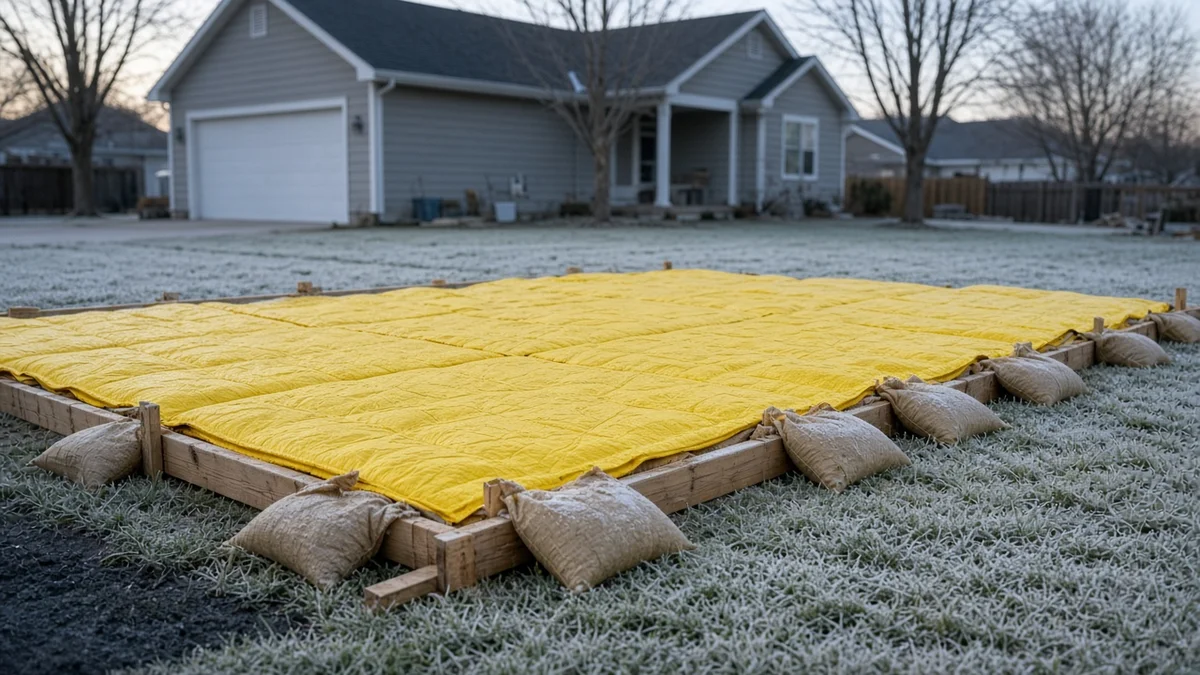
Concrete makes its own heat through hydration, but a thin slab loses it fast on a frosty night. A blanket does not heat the concrete. It slows heat loss, which is often all a driveway, patio or footing needs. This guide covers how curing blankets work, how to choose an R-value, how to lay them, and how long to leave them on.
How concrete curing blankets work
When water and cement react, the mix warms up. That heat is what lets concrete keep curing in cold air. The danger is the first day or two: if the water in fresh concrete freezes before the slab has gained some strength, the ice expands and can permanently damage the surface and weaken the slab.
The American Concrete Institute's cold-weather guidance (ACI 306) recommends protecting concrete from freezing until it reaches about 500 psi, noting that this strength only protects against one freeze-thaw cycle. For sections less than 12 inches thick, which covers most home slabs, it recommends keeping the concrete at 55°F or warmer during the protection period. A blanket helps by trapping hydration heat and reducing the effect of wind, which strips heat from an uncovered surface quickly.
For the bigger picture on temperatures, accelerators and pour timing, see our guide to pouring concrete in cold weather. This post focuses on the blankets themselves.
Types of curing blankets
| Type | What it is | Best for |
|---|---|---|
| Insulated foam blanket | Closed-cell foam inside a woven poly shell | Most slabs, driveways and footings in cold weather |
| Heated (electric) blanket | Built-in heating elements; needs power | Very cold sites, frozen ground thawing, faster cures |
| Wet curing blanket | Absorbent fabric kept damp, sometimes with a plastic face | Warm-weather curing to keep moisture in |
| Plastic sheeting | Polyethylene film | Holding moisture in; adds little insulation |
| Straw under plastic | Traditional, cheap insulation | Small jobs; messy and less predictable |
Do not confuse wet curing blankets with insulated ones. Wet curing covers hold moisture in warm weather; insulated blankets hold heat in cold weather. They solve different problems.
Choosing an R-value
R-value measures resistance to heat flow, so a higher number holds heat longer. There is no single R-value in ACI 306. The right choice depends on air temperature, wind, slab thickness and how long you need protection. As a starting point, blanket supplier ALCO Covers publishes this guide by overnight low:
| Expected overnight low | Suggested blanket R-value |
|---|---|
| 35-45°F | About R-1.8 to R-2.5 |
| 25-35°F | About R-2.8 to R-3.4 |
| 10-25°F | About R-5.1 to R-5.6 |
| Below 10°F or long cures | R-6 or more, or two blankets stacked |
Go one step higher for wind, shade or thin slabs, because a 4-inch slab has less mass to store heat than a thick footing. Stacking two blankets adds their insulation together. If the forecast is well below the range above, an insulated blanket alone may not be enough; you may need a heated blanket or an enclosure with a heater, and that is a good time to ask your ready-mix supplier for advice.
How to use curing blankets on fresh concrete
Before the pour
- Check the ground. Never pour on frozen ground or snow. Lay blankets on the subgrade for a day or two before the pour to thaw it and keep it warm.
- Count your blankets. Measure the slab plus at least 1-2 feet of overlap on every side, so you can tuck the edges down. Corners and edges lose heat fastest.
- Have weights ready. Lumber, sandbags or concrete blocks keep wind from lifting the edges.
- Order the right mix. Ask for a cold-weather mix when you order ready-mix concrete; a non-chloride accelerator or heated water can help, especially around rebar.
Laying the blankets
- Finish first. Complete floating, troweling and broom finishing as normal. Do not cover bleed water that is still on the surface.
- Cover quickly. As soon as the surface can take a cover without marking, usually once it has stiffened, lay the blankets. Some contractors put a sheet of plastic down first to hold moisture and keep the blanket clean.
- Overlap seams. Overlap blankets by about a foot so no strip of concrete is exposed.
- Seal the edges. Tuck blankets down the sides of the forms and weigh them down. Gaps let cold air sweep under, and the edges are where freeze damage usually starts.
- Watch the temperature. A simple thermometer under the blanket, or a surface sensor, tells you whether the slab is staying warm. If it is dropping toward freezing, add a second layer.
How long to leave them on
Plan on keeping blankets on for at least the first few days in cold weather, and longer when nights stay below freezing. The aim is to protect the concrete until it reaches about 500 psi, then keep it from cooling too quickly. Pulling blankets off a warm slab on a very cold morning can cause surface cracking from the sudden temperature change, so remove them in the warmest part of the day and, if possible, step down by removing one layer at a time.
Even after the blankets come off, the slab is still young. Keep cars off until it is ready, and check our guide on when you can drive on new concrete.
How to tell if fresh concrete froze
Frost damage is not always obvious on day one. Warning signs include a surface that looks white, frosty or crystal-patterned when you lift the blanket, a top layer that crumbles or scratches easily with a key once it has thawed, and flaking or scaling that appears in the first weeks. If you suspect a freeze, keep the slab covered and warm so it can keep curing, then check the surface again after a week. Light surface damage can often be repaired later by resurfacing the concrete; deep damage may mean the section has to be replaced, which is why covering early is so much cheaper than fixing it afterward.
Common curing blanket mistakes
- Waiting too long to cover. The first hours after finishing are the most vulnerable.
- Leaving edges open. A blanket that stops at the form line leaves the weakest part exposed.
- Using plastic alone in a freeze. Plastic holds moisture but adds very little insulation.
- Using blankets with holes or torn seams. Patch or replace them, because cold air finds every gap.
- Pulling blankets off too early. One mild afternoon does not mean the slab is out of danger.
- Spreading deicing salt on the new slab. Fresh concrete is especially vulnerable. Read is salt bad for concrete before winter.
Buying vs renting concrete curing blankets
Insulated curing blankets are sold by size, commonly 6 x 25 ft, 12 x 25 ft and similar, by construction supply stores, rental yards and online suppliers. For a one-off patio or driveway, renting from a tool rental store or borrowing from your concrete contractor can make sense. If you pour every winter, buying a few good blankets pays off, and they also work for thawing ground before digging footings. Store them dry, rolled or folded, and out of direct sun so the shell lasts.
Curing blankets on small DIY pours
Not every winter job is a full driveway. For a small concrete slab, fence post footings or a pad for a shed, a single blanket and some weights can be the difference between a sound pour and a flaking surface in spring. Even fence posts set in concrete benefit from a blanket tucked around the base when nights drop below freezing. Before you pour, use our concrete calculator so you know the volume and do not end up waiting on a second delivery while the light fades.
Frequently asked questions
Do you need curing blankets for concrete?
In freezing or near-freezing weather, usually yes. Without insulation, a thin slab can lose heat quickly and the surface can freeze before the concrete has gained enough strength. In mild weather they are not needed for heat, though moisture curing still matters.
What R-value curing blanket do I need?
It depends on the overnight low, wind and slab thickness. One supplier's guide suggests about R-2.8 to R-3.4 for nights of 25-35°F and about R-5 or more for 10-25°F. Use more insulation, or stack two blankets, in colder or windier conditions.
How long should curing blankets stay on concrete?
Keep them on until the concrete has reached about 500 psi, which protects it from one freeze-thaw cycle, and longer if freezing nights continue. In cold weather that often means several days. Remove them gradually in the warmest part of the day.
Can you put curing blankets directly on concrete?
Yes, once the surface has stiffened enough not to mark. Many contractors lay a plastic sheet first to hold moisture and keep the blanket clean.
Do curing blankets heat concrete?
Standard insulated blankets do not produce heat. They trap the heat the concrete makes as it cures. Heated electric blankets do add heat and are used in very cold conditions.
Can you use regular blankets or tarps instead?
Household blankets and tarps add little insulation, absorb water and blow away easily. A plastic sheet with straw underneath works for small jobs, but purpose-made insulated curing blankets are far more reliable.
- https://www.concrete.org/Portals/0/Files/PDF/Previews/306.1-90(02)_preview.pdf
- https://www.concrete.org/Portals/0/Files/PDF/University/306R-16%5Fexcerpt.pdf
- https://www.constructioncovers.com/product/insulated-cement-curing-blankets/