- Cast-in-place or precast?
- Choosing the mix
- Countertop volume, bags and weight
- How thick should a concrete countertop be?
- How much do concrete countertops weigh?
- Building the form
- Reinforcement
- Mixing and pouring
- Curing and demolding
- Grinding, filling and polishing
- Sealing concrete countertops
- Is DIY right for you?
- Frequently asked questions
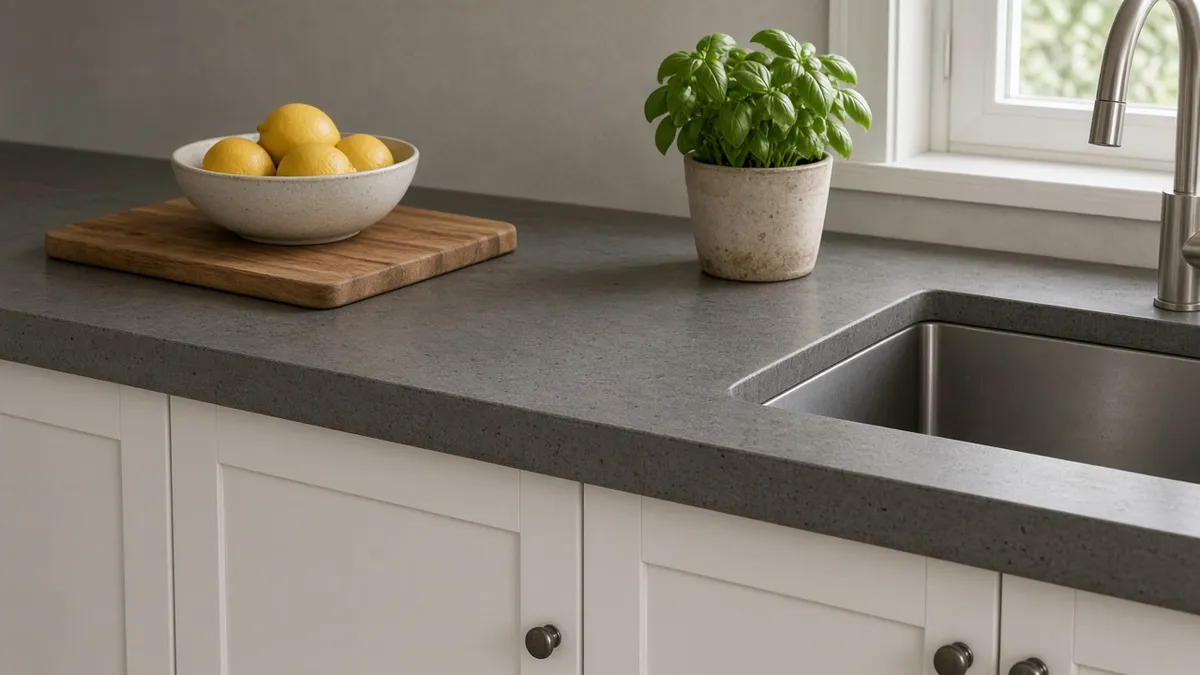
DIY concrete countertops are a serious weekend project, but they are within reach if you are comfortable with basic carpentry and mixing concrete. You build a form, mix a flowable countertop mix, pour it about 1.5 in. thick with reinforcement inside, keep it damp while it cures, then grind or sand it and seal it with a food-safe sealer. The result is a heavy, custom surface that costs far less in materials than most stone. This guide explains the choices that decide whether your counter looks great or cracks: the casting method, the mix, the reinforcement, the weight and the seal.
Concrete counters are having a design moment this fall, with searches for concrete kitchen countertops climbing in Google Trends. Here is what it takes to make one yourself.
Cast-in-place or precast?
There are two ways to build a concrete countertop.
| Cast-in-place | Precast | |
|---|---|---|
| Where you pour | On top of the cabinets | In a form on a workbench or the garage floor |
| Surface you see | The top of the pour (troweled) | The bottom of the pour (against the form), usually smoother |
| Form | Plywood base and edge strips on the cabinets | Melamine box with the top face down |
| Moving it | No lifting needed | Must be carried and set in place |
| Mess in the kitchen | High | Low |
| Best for | Long runs, outdoor kitchens, simple shapes | Bathroom vanities, islands, pieces you can lift with helpers |
Many DIYers prefer precast in melamine forms because the surface against the melamine comes out smooth and dense, and the mess stays in the garage. Cast-in-place avoids lifting, which matters because concrete is heavy (see below). Quikrete notes that its countertop mix can be placed directly on plywood for cast-in-place work, and that a form release should be used for precast work so the mix does not bond to the form.
Choosing the mix
Use a mix made for countertops rather than ordinary concrete. Countertop mixes are designed to flow into a form with little effort and to give a dense surface.
Quikrete's Countertop Mix data sheet describes it as a flowable, high-strength mix with a super-plasticizer and 3/8 in. aggregate. Each 80 lb bag yields about 0.60 cu ft. Its older sheet lists 5,000 psi at 28 days and its current sheet lists 6,000 psi, either of which is well above typical slab concrete. Quikrete's own bag table for a 1.5 in. thick counter is a good starting point:
| Countertop area | 80 lb bags at 1.5 in. thick |
|---|---|
| 6 sq ft | 2 |
| 10 sq ft | 3 |
| 25 sq ft | 6 |
| 50 sq ft | 11 |
Those numbers do not allow for waste, so buy at least one extra bag. For other thicknesses, our concrete bag calculator converts the volume into bag counts. You can add liquid cement color to the mixing water if you want a tint; mix every batch the same way so the color matches.
Countertop volume, bags and weight
Run counter length × width × thickness in feet for cubic feet, or enter the mold volume on the concrete bag calculator. Check total weight on the concrete weight calculator before you lift a precast piece.
How thick should a concrete countertop be?
Most DIY countertops are 1.5 in. thick, which balances strength and weight. Thinner counters crack more easily unless you use specialty mixes and techniques. Thicker counters, 2 to 3 in., look chunky and are common outdoors, but you can get a thick look without the weight by building a deeper edge (a drop edge) while keeping the main slab at 1.5 in.
How much do concrete countertops weigh?
Normal-weight concrete weighs roughly 145 to 150 lb per cubic foot. At 1.5 in. thick, that works out to about 18 to 19 lb per square foot.
| Counter size | Approx. area | Approx. weight at 1.5 in. |
|---|---|---|
| Bathroom vanity, 2 x 3 ft | 6 sq ft | 110 lb |
| Kitchen run, 2 x 8 ft | 16 sq ft | 300 lb |
| Island, 3 x 6 ft | 18 sq ft | 340 lb |
Two things follow. First, check that your cabinets are sturdy, level and well fastened; most standard base cabinets carry stone counters of similar weight, but weak or damaged boxes should be reinforced. Second, if you precast, plan your seams so no piece is heavier than your crew can carry safely.
Building the form
For a precast counter, the usual form is melamine-faced board, because the slick face releases cleanly and leaves a smooth surface.
- Cut a melamine base to the exact size of the counter.
- Screw melamine strips around the edges to set the thickness, for example 1.5 in. tall.
- Seal every inside corner with a thin bead of silicone and tool it smooth; this gives slightly rounded edges and stops leaks.
- Add knockouts for the sink and faucet holes: foam blocks or a sink template screwed to the base, and PVC pipe for the faucet.
- Level the whole form on a sturdy table. A form that is out of level makes a counter that is thicker on one side.
- Wipe on a light coat of form release.
For cast-in-place, screw a plywood base to the cabinets, attach the edge strips around the outside, and protect the cabinets with plastic.
Reinforcement
A thin slab needs reinforcement to hold together if it cracks. Quikrete's product team recommends flexible reinforcement such as wire mesh for large, thin spans to limit shrinkage cracking, and rigid reinforcement such as rebar or dowels for cantilevers and narrow, fragile sections, like the strip in front of a sink.
Suspend the mesh in the middle of the thickness, not on the bottom of the form. In a precast counter, the bottom of the form becomes the top of the counter, so mesh lying on the form would show through. Keep all steel at least 1/2 in. away from every surface and edge. For the bigger picture on mesh and rebar, see our guide to rebar vs wire mesh.
Mixing and pouring
- Mix in a mixer. Quikrete's sheet calls for a barrel or mortar mixer, roughly 7 to 8 pints of water per 80 lb bag (the newer sheet allows up to 9), and at least three minutes of mixing after the last water. Mix only what you can place within about an hour.
- Fill the form from one end. Fill to full depth at one end and work toward the other so the mix pushes air ahead of it.
- Consolidate. Vibrate the form to bring trapped air out. Pros use a vibrating table; DIYers tap the sides with a rubber mallet or run an orbital sander (without paper) along the form sides.
- Strike off. Drag a straight board across the edge strips in a sawing motion to level the top.
- Trowel. For cast-in-place, trowel the surface smooth once the bleed water has gone. For precast, the top is the underside, so a basic float finish is enough.
If you have never mixed bagged concrete, our wheelbarrow mixing guide explains consistency, although a mixer is the better choice for countertop work.
Curing and demolding
Start curing right away. Quikrete recommends moist curing by tenting plastic over the counter, without letting the plastic touch the fresh surface because it leaves marks. Its current sheet says the counter can come out of the form after 18 hours or more; an older sheet says 48 to 72 hours. On a first project, waiting the longer time is the safer choice, because the counter is still fragile around knockouts.
Concrete keeps gaining strength for weeks. Handle the slab carefully, lift it on edge rather than flat, and keep it out of freezing temperatures; our cold-weather concrete guide explains why.
Grinding, filling and polishing
Once out of the form, most counters show a few pinholes. Mix a cement slurry (a thin paste of cement and water, or a matching grout) and squeeze it into the holes, then sand it off once it hardens. Then sand or polish the surface to the look you want:
- Smooth, cream finish: light sanding with fine pads. Little aggregate shows.
- Salt-and-pepper finish: grind a little deeper to expose fine aggregate.
- Exposed aggregate: grind deeper still. This takes wet grinding equipment and creates slurry, so do it outdoors or in a garage.
Sealing concrete countertops
Concrete is porous, and kitchen spills such as lemon juice, vinegar, wine and oil can etch or stain it. Quikrete advises that kitchen countertops be sealed with a suitable high-solids acrylic sealer or a food-safe wax for sanitary reasons and better resistance to acids such as citric acid and vinegar. Many builders also use penetrating sealers or two-part coatings made for countertops; follow the maker's instructions and food-contact guidance.
Timing matters. Quikrete's product team says to wait about 7 days before a water-based stain or sealer, and typically 28 days before acid staining. Test your sealer on an offcut or the underside first. Even a well-sealed concrete counter will develop a soft patina over time, which many owners like; use cutting boards and trivets, and wipe up acids promptly.
Is DIY right for you?
DIY concrete counters suit you if you enjoy hands-on projects, have helpers for lifting, and are happy with a handmade look that includes small variations. Hire a pro if you need very thin profiles, long cantilevers or a flawless finish on the first try. Either way, start with a small piece such as a bathroom vanity, a bar top or an outdoor grill counter; you will learn the whole process on something light enough to redo if needed.
Frequently asked questions
How thick should DIY concrete countertops be?
About 1.5 in. is the common DIY thickness. It balances strength and weight. For a thicker look, build a deeper drop edge instead of making the whole slab thicker.
How much does a concrete countertop weigh?
At 1.5 in. thick, normal-weight concrete weighs roughly 18 to 19 lb per square foot. A 2 by 8 ft kitchen run is about 300 lb, so plan for sturdy cabinets and helpers.
What is the best concrete mix for countertops?
Use a mix made for countertops, such as Quikrete Countertop Mix. It flows easily into forms, has fine 3/8 in. aggregate and is rated at 5,000 psi or more at 28 days.
Do concrete countertops need rebar or mesh?
Yes. Use wire mesh in large thin spans to hold the slab together and limit shrinkage cracking, and add rebar or dowels in cantilevers and narrow sections such as in front of a sink.
How long before you can seal a concrete countertop?
Quikrete suggests waiting about 7 days before a water-based stain or sealer, and typically 28 days before acid staining. Always follow the sealer maker's instructions.
Are concrete countertops food safe?
Seal kitchen counters with a high-solids acrylic sealer or a food-safe wax, as Quikrete recommends, and follow the sealer maker's guidance on food contact. Use cutting boards and wipe up acidic spills promptly.
- https://www.quikrete.com/pdfs/data_sheet-countertopmix.pdf