- Choose the right concrete saw
- Pick a diamond blade
- How deep should you cut?
- Wet cutting vs dry cutting
- Safety gear and setup
- Check for hidden hazards
- Step by step: how to cut concrete slabs
- Breaking out and removing the cut section
- Cutting pavers, blocks and steps
- Repairing or replacing after you cut
- When to hire a pro
- The bottom line
- Frequently asked questions
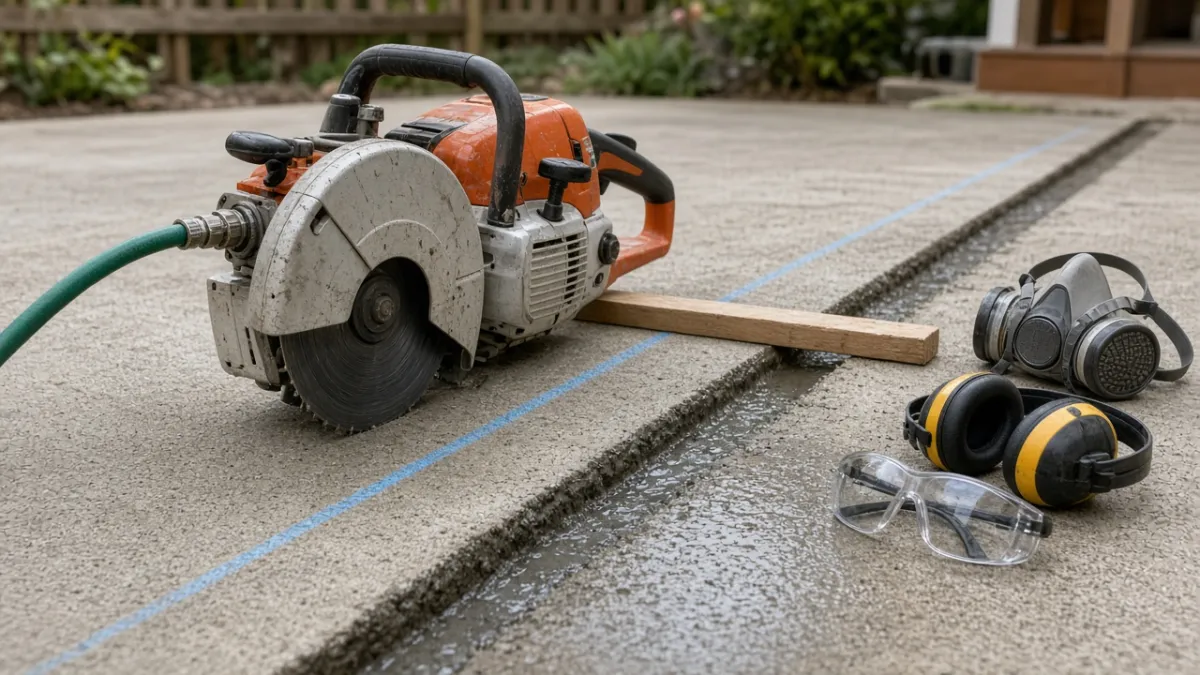
How to cut concrete comes down to three choices: the right saw, a diamond blade made for concrete, and a plan for the dust. With a marked line, water on the blade and a few shallow passes, a homeowner can cut a slab edge, trim a patio, cut a paver or open a section of sidewalk for repair. This guide explains which concrete saw fits which job, how deep to cut, wet vs dry cutting, step-by-step cutting, how to break out the piece, and when to call a pro.
Choose the right concrete saw
The saw you need depends on how deep and how long the cut is. Here is how the common options compare.
| Tool | Best for | Notes |
|---|---|---|
| Angle grinder with a diamond blade | Short, shallow cuts, scoring, trimming pavers and blocks | Light and cheap; too shallow for most slabs |
| Circular saw with a diamond blade | Shallow straight cuts and control joints in thin slabs | Use a masonry-rated blade; dust control is hard |
| Handheld cut-off saw (often called a concrete saw) | Slabs, steps, walls, curbs and sidewalk sections | Gas or electric; most have a water attachment; available at rental stores |
| Walk-behind saw | Long straight cuts in driveways and large slabs | Rolls on wheels; best depth control on long runs |
| Wet tile or masonry saw | Pavers, bricks and concrete blocks | Water-cooled table saw for loose pieces |
For most DIY slab work, a rented handheld cut-off saw or a walk-behind saw is the right tool. Check each tool's manual for its maximum cutting depth before you plan the job, because blade size sets how deep you can go in one setup.
Pick a diamond blade
Concrete is cut by grinding, not slicing, so you need a diamond blade. A few tips:
- Match the blade to the material. Blades are made for cured concrete, green (fresh) concrete, asphalt or masonry. Using the wrong one wears it out fast.
- Segmented or turbo rims cut faster in concrete. Continuous rims give cleaner edges on tile and pavers.
- Wet or dry rated. Some blades must be cooled with water. Check the label.
- Reinforced concrete. If your slab has rebar or wire mesh, choose a blade rated for reinforced concrete. Our rebar vs wire mesh guide shows where steel usually sits in a slab.
Never use a blade rated for a lower speed than your saw, and never force a dull blade.
How deep should you cut?
There are two common goals:
- Cut all the way through to remove a section, such as a broken sidewalk square or a strip for a new drain line. You may need to cut from both sides of a thick piece, or cut as deep as the saw allows and break out the rest.
- Cut partway and snap for thinner pieces. Score a deep line, then break along it with a sledgehammer or a demolition hammer. The break follows the cut, but the edge below it will be rough.
Control joints in a new slab are different. They are shallow grooves cut so the slab cracks neatly in the groove. Published guidance says to cut them at least a quarter of the slab's depth, within hours of finishing, once the surface is firm enough that the blade does not tear the edges. Our concrete expansion joints guide explains spacing and the difference between control and expansion joints.
Wet cutting vs dry cutting
Cutting concrete releases fine crystalline silica dust. OSHA warns that when inhaled, small silica particles can irreversibly damage the lungs. That is why wet cutting is the standard method.
- Wet cutting sends a steady stream of water to the blade. OSHA's fact sheet on handheld saws says the water should flow enough to minimize visible dust, and that you should clean up the slurry before it dries, using a shovel or a wet vacuum with a HEPA filter. Water also keeps the blade cool so it lasts longer.
- Dry cutting is quicker to set up but throws a cloud of dust. If you must cut dry, use a saw with a dust shroud connected to a suitable vacuum, work outdoors, and keep other people and pets away.
OSHA's rules for workers also require respiratory protection with an assigned protection factor of at least 10 when wet cutting with handheld saws indoors or in enclosed areas, or outdoors for more than four hours a shift. Even for a short DIY cut, a well-fitted respirator is a smart choice.
Because water and power tools are a risky mix, OSHA recommends ground-fault circuit interrupters (GFCI) and watertight connectors for electric tools when water is used.
Safety gear and setup
Before you start, gather:
- Safety glasses or goggles and hearing protection
- A respirator suited to silica dust
- Work gloves, long sleeves and sturdy boots
- A garden hose or water tank for the saw
- A GFCI outlet or cord for electric saws
- Chalk line, marker and a straight board as a guide
Read the saw's manual, especially the kickback warnings. Keep both hands on the saw, stand to one side of the blade's path, and never cut with the upper front part of the blade, where kickback is most likely.
Check for hidden hazards
Concrete can hide things you do not want to hit:
- Pipes and wires. Slabs can carry plumbing, electrical conduit or radiant heat tubing. If you are unsure, have the slab scanned before you cut.
- Post-tension cables. Some slabs are reinforced with steel cables under high tension. Never cut a post-tensioned slab yourself. Look for warning stamps and ask a pro if in doubt.
- Structure. Do not cut openings in foundation walls, beams or load-bearing slabs without an engineer's advice and any required permit.
- Underground lines. If the job includes digging under the slab, call 811 before you dig so utility lines are marked.
Step by step: how to cut concrete slabs
- Mark the line. Snap a chalk line and trace it with a marker. Clamp or weigh down a straight board as a guide for long cuts.
- Set the depth. Start shallow. Many pros cut in several passes instead of one deep plunge, which reduces strain on the saw and the blade.
- Start the water. Connect the hose or water tank and make sure water reaches the blade before it touches the concrete.
- Score the line. Make a light first pass along the line to set a clean track.
- Deepen the cut. Make more passes, lowering the blade each time. Let the saw do the work; pushing hard overheats the blade and can cause kickback.
- Keep the blade straight. Twisting the blade in the cut can bind it. If it binds, stop and let it free itself rather than yanking it.
- Finish the corners. Round saws over-cut at the bottom of a corner. Stop at the mark on the surface and finish inside corners with a grinder or chisel.
- Clean up the slurry while it is still wet, so it does not dry and turn back into dust.
Breaking out and removing the cut section
After cutting, break the section into pieces you can lift. A sledgehammer works on thin slabs, while a rented demolition hammer helps on thicker ones. Pry pieces up with a long bar.
Concrete is heavy, so plan the haul before you start. Our concrete weight calculator uses a common default of 150 pounds per cubic foot and shows how much a slab section weighs, so you can size a trailer or a dumpster. Clean broken concrete can sometimes be reused as fill; our crushed concrete calculator helps with volumes.
Cutting pavers, blocks and steps
Small pieces are easier with a wet tile saw or masonry saw, or an angle grinder for a few cuts. Mark the cut on every face, support the piece fully so it does not snap early, and cut slowly.
If you are laying a paver overlay, see our pavers over concrete guide. For walls, the cinder block wall guide and the concrete block calculator cover layout. Damaged steps may only need a patch; see how to patch concrete steps before you cut anything out.
Repairing or replacing after you cut
Most cuts lead to a repair or a pour. Clean the cut edges, compact the base below, and plan new concrete with the concrete slab calculator or the concrete bag calculator. For a small patch or walkway square, follow our small concrete slab guide or the concrete walkway guide. If the slab is sound but cracked, fixing the cracks may be enough.
Wondering how soon you can work on new concrete? Our guide on when you can drill into new concrete covers cure timing, and the same patience applies to cutting.
When to hire a pro
Call a concrete cutting contractor when:
- The cut is deeper than your rented saw can reach, or the slab is very thick
- You need to cut through a foundation, wall or structural slab
- The slab may be post-tensioned or carry hidden utilities
- You have a long run of driveway or a large room to cut indoors
Pros bring larger walk-behind saws, wall saws, slab scanners and dust controls, and they know the local permit rules.
The bottom line
To cut concrete safely, match the saw to the depth, use a diamond blade rated for the material, keep water on the blade, and cut in shallow passes along a marked line. Check for hidden pipes and cables first, wear eye, ear and breathing protection, and leave structural cuts to a pro. Then plan your repair with the concrete calculator.
Frequently asked questions
What is the best saw for cutting concrete?
For slabs, a handheld cut-off saw or a walk-behind saw with a diamond blade is best. An angle grinder handles short, shallow cuts, and a wet tile saw is easiest for pavers and blocks.
Can you cut concrete with a circular saw?
Yes, for shallow cuts, if you fit a diamond or masonry blade. A circular saw cannot cut deep, and it makes a lot of dust, so wet cutting or a dust shroud is important.
Should I cut concrete wet or dry?
Wet cutting is safer because water keeps silica dust out of the air and cools the blade. OSHA's guidance for handheld saws is built around a continuous stream of water on the blade.
How deep do I cut control joints?
Published guidance says at least a quarter of the slab's thickness, cut within hours of finishing, once the surface is firm enough that the blade does not tear the edges.
Can a diamond blade cut through rebar?
Blades rated for reinforced concrete can cut through rebar and wire mesh. Do not cut steel in a structural element without professional advice.
How do I keep concrete dust down?
Use a saw with water on the blade, clean up wet slurry before it dries, work outdoors when you can, and wear a respirator suited to silica dust.
- https://www.osha.gov/sites/default/files/publications/OSHA_FS-3627.pdf
- https://www.osha.gov/silica