- How salt damages concrete
- Deicers ranked: what is safer and what to avoid
- Rock salt vs the alternatives at a glance
- New concrete: no deicers in the first winter
- What makes concrete resist salt damage
- Protecting older concrete from salt
- Salt you did not spread: cars, roads and neighbors
- Is it scaling, spalling or a crack?
- How much deicer should you use?
- Salt alternatives that do not melt ice
- Planning a pour for next year?
- Checklist: salt and concrete this winter
- Frequently asked questions
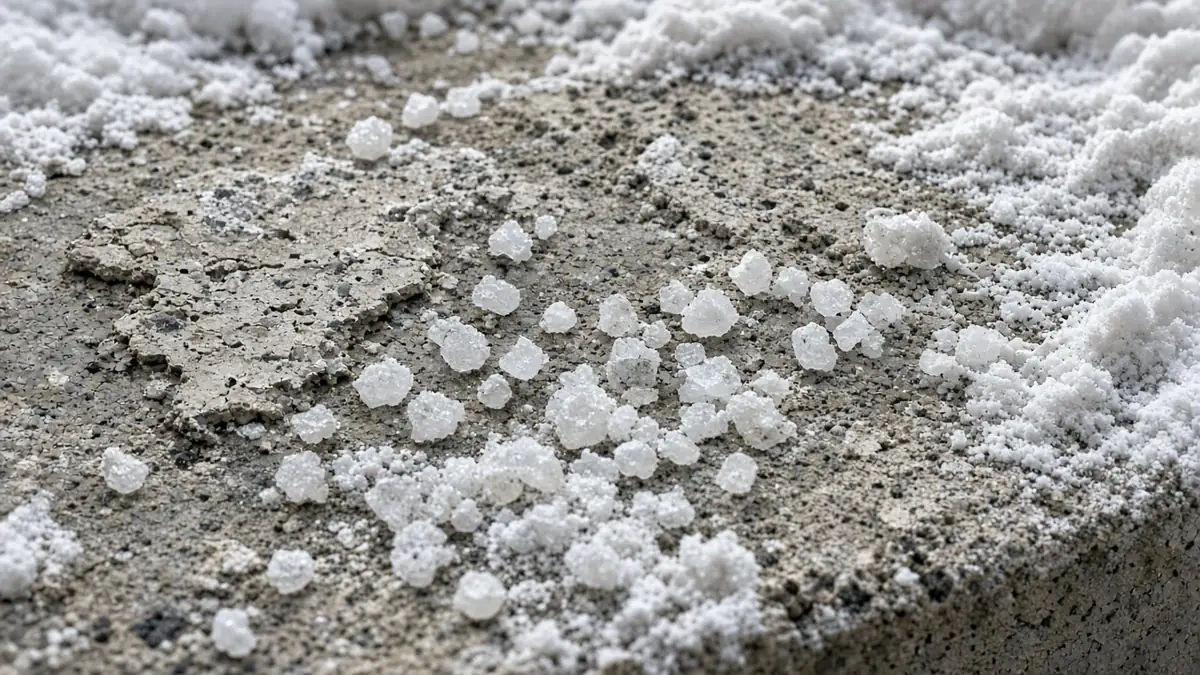
Is salt bad for concrete? It can be. Deicing salts do not dissolve sound concrete overnight, but they make the damage from freezing and thawing worse, and some deicers attack concrete chemically. The two biggest rules from concrete industry groups are simple: use no deicers at all on concrete in its first year, and never use deicers that contain ammonium nitrate or ammonium sulfate.
This guide explains how salt damages a driveway, patio or sidewalk, which deicers are safer and which to avoid, what to do with brand-new concrete this winter, and how to protect older slabs. It is written for homeowners getting ready for the first snow, so it skips the lab chemistry and sticks to what to buy and what to do.
How salt damages concrete
Concrete is porous. Water soaks into the surface, freezes, expands, and thaws again, sometimes dozens of times a winter. Deicers lower the freezing point of water, which melts ice on top, but they also keep the surface wet with salty water that keeps moving in and out of the concrete through more freeze-thaw cycles.
Repeated freeze-thaw and deicers are a common cause of concrete spalling, when the surface flakes off.
The most common result is scaling: the top layer of cement paste flakes or pops off, leaving rough patches and exposed stone. The Pennsylvania Aggregates and Concrete Association (PACA) describes homeowners finding pock marks and flaked areas each spring that were not visible in the fall, and notes that scaling "can be initiated and exacerbated by the use of deicers."
Some deicers go further and react chemically with the cement paste. Those are the ones to avoid entirely.
Deicers ranked: what is safer and what to avoid
Industry groups do not agree on every product, but their guidance lines up on the extremes. Here is how two of them describe the common chemicals:
| Deicer chemical | PACA guidance | Iowa Concrete Paving / Ready Mixed Concrete Associations |
|---|---|---|
| Sodium chloride (rock salt) | Generally acceptable on good-quality, dense concrete | May be used sparingly after the first winter |
| Calcium chloride | Generally acceptable on good-quality, dense concrete | Can attack concrete if applied in concentrated amounts |
| Magnesium chloride | Higher rates of deterioration | Damaging; avoid |
| Potassium chloride | Higher rates of deterioration | Not listed |
| Calcium magnesium acetate, urea | Higher rates of deterioration | Magnesium acetate listed as damaging |
| Ammonium sulfate, ammonium nitrate | Never use | Never use; they rapidly disintegrate concrete |
Two practical takeaways:
- Read the back of the bag. PACA warns that many deicers say "safe" in large letters on the front while the fine print lists conditions. Look for the chemical names.
- Watch out for fertilizer. The Iowa associations' deicer warning notes that common garden fertilizers can contain ammonium nitrate and ammonium sulfate, so do not spread leftover fertilizer on icy concrete.
Rock salt vs the alternatives at a glance
This sums up the guidance in the table above, in the order most people reach for things on an icy morning:
| Option | Melts ice? | First winter on new concrete | Older, sound concrete |
|---|---|---|---|
| Shoveling early and often | No, removes snow before it packs | Best choice | Best choice |
| Plain sand or grit | No, traction only | Yes | Yes |
| Rock salt (sodium chloride) | Yes | No | Sparingly, then shovel the slush off |
| Calcium chloride | Yes | No | Sparingly; avoid concentrated piles |
| Magnesium chloride or acetate products | Yes | No | Avoid |
| Anything with ammonium nitrate or ammonium sulfate (including fertilizer) | Yes | Never | Never |
New concrete: no deicers in the first winter
If your driveway, patio or walk was poured this year, treat it differently. PACA's guidance on protecting concrete from deicer damage says deicers should not be used on concrete less than one year old, and never on concrete that has not reached enough strength to resist freezing and thawing. The Iowa associations put it the same way: avoid any deicing chemical the first winter.
What to use instead:
- Plain sand for traction. The Iowa associations describe it as the only safe material for making new concrete skid-resistant.
- Shovel early and often so snow does not get packed into ice.
- Use a plastic shovel blade on new surfaces to avoid gouging.
- Keep cars from tracking slush onto new concrete where you can. Road salt drips off vehicles and does the same damage as salt you spread yourself.
If you poured late in the season, our guide to pouring concrete in cold weather covers protection during curing, and when you can drive on new concrete explains why the first month matters.
Here is how to protect a new slab in winter with insulated blankets.
What makes concrete resist salt damage
The best protection starts before the concrete is poured. PACA lists what exterior concrete in freeze-thaw climates should have:
- Compressive strength of at least 4,000 psi.
- A maximum water-cementitious ratio of 0.45.
- 5 to 7 percent entrained air, tiny bubbles that give freezing water room to expand.
- Proper placing, finishing and curing. Overworking the surface or adding water while finishing weakens the top layer that salt attacks.
If you are planning a new driveway, our guide to the right concrete PSI for a driveway explains strength and air entrainment, and how to order ready-mix concrete covers what to ask the plant for.
Protecting older concrete from salt
For concrete that has been through at least one winter:
- Use deicers sparingly. Spread a thin layer just to break the bond between ice and concrete, then shovel the slush away. More salt is not faster.
- Choose sodium or calcium chloride if you must use a chemical deicer, and avoid magnesium-based and ammonium-based products.
- Shovel away the slush once the ice loosens so the salty water does not sit and refreeze.
- Rinse in spring. Hose off salt residue once temperatures stay above freezing.
- Seal the surface. PACA says silane or siloxane penetrating sealers give the highest resistance to deicers and freeze-thaw damage, and water-repellent sealers made for concrete also help. Our new guide to how to seal a concrete driveway walks through choosing and applying one before winter.
Salt you did not spread: cars, roads and neighbors
Even if you never buy a bag of ice melt, salt reaches your concrete. Road crews spread deicers on streets, and slush packed under your car's wheel wells drips onto the driveway and garage floor as it melts. A public sidewalk treated by the city or a neighbor can carry salt onto your walk on boots and tires.
You cannot stop all of it, but you can limit it:
- Knock slush off the car in the street before pulling in, where practical.
- Shovel the apron at the end of the driveway, where plow spray collects.
- Rinse the garage floor and driveway during a mild spell in winter, not only in spring.
- Put a boot tray by the door so salty slush does not end up on interior concrete.
For new concrete, these small habits matter even more, because the first winter is when the surface is most vulnerable.
Is it scaling, spalling or a crack?
Not every winter blemish is salt damage. A quick way to tell:
| What you see | Likely cause | What to do |
|---|---|---|
| Thin flakes of surface paste, rough patches | Scaling, often worsened by deicers | Stop using harsh deicers; seal in fall |
| Deeper pieces broken out, sometimes around steel | Spalling | Have it assessed; may need patching |
| Straight or jagged lines through the slab | Cracking | Clean and fill before winter |
For cracks, our recent guide to how to fix cracks in concrete covers fillers, sealants and the temperature rules for applying them.
For slabs that already flake, see our guide to resurfacing scaled concrete.
How much deicer should you use?
There is no single number that suits every product, so follow the bag's coverage directions and aim for the least that works. The goal is to break the bond between ice and pavement, not to melt every flake. Spread the deicer evenly with a hand spreader rather than dumping piles, which concentrate salt in one spot. If you see white residue building up after a storm, you are using more than you need.
Salt alternatives that do not melt ice
If you would rather not use chemicals at all:
- Sand adds traction but does not melt ice. Sweep it up in spring so it does not wash into drains.
- Kitty litter (non-clumping) gives temporary grip in a pinch.
- Heated mats melt snow on steps and short walks without any chemicals.
- A snow blower or plow service keeps snow from turning into ice in the first place.
Planning a pour for next year?
If you are replacing a scaled driveway or patio in spring, now is a good time to plan the size and the order. The concrete slab calculator gives cubic yards for the slab and a gravel base, the concrete yard calculator handles other shapes, and the concrete cost calculator compares ready-mix with bags using your own prices. For small pads, our guide to pouring a small concrete slab covers the whole job.
Checklist: salt and concrete this winter
- [ ] Concrete poured this year: no deicers at all; use plain sand.
- [ ] Never use deicers with ammonium nitrate or ammonium sulfate.
- [ ] Avoid magnesium chloride and other magnesium- or ammonium-based products.
- [ ] Use rock salt or calcium chloride sparingly on older, sound concrete.
- [ ] Keep garden fertilizer off icy concrete.
- [ ] Shovel slush away, rinse in spring, and seal in the fall.
Planning a new driveway? See how concrete or asphalt in winter holds up.
Cleaning up before winter? See how to remove driveway oil stains.
Frequently asked questions
Is rock salt bad for concrete?
Rock salt (sodium chloride) can worsen freeze-thaw scaling, but industry groups consider it generally acceptable on good-quality, dense concrete when used sparingly after the first year. Never use it on concrete in its first winter.
What is the safest ice melt for concrete?
Plain sand is the only material concrete associations call safe for new concrete, though it adds traction rather than melting ice. On older concrete, sodium chloride or calcium chloride used sparingly is generally preferred over magnesium- or ammonium-based products.
Can I put salt on new concrete?
No. PACA and the Iowa concrete associations both advise against any deicer during the first year, or the first winter. Use plain sand for traction instead.
Which deicers should never be used on concrete?
Deicers containing ammonium nitrate or ammonium sulfate. Both groups say these chemicals will rapidly destroy or disintegrate a concrete surface.
Does sealing concrete protect it from salt?
Yes, it helps. PACA says silane or siloxane penetrating sealers give the highest resistance to deicers and freeze-thaw damage, and water-repellent sealers made for concrete also add protection.
Is calcium chloride bad for concrete?
Calcium chloride is generally acceptable on dense, good-quality concrete, according to PACA, but the Iowa associations warn it can attack concrete when applied in concentrated amounts. Use it sparingly and spread it evenly.
Can I use fertilizer to melt ice on concrete?
No. The Iowa concrete associations warn that many garden fertilizers contain ammonium nitrate or ammonium sulfate, which rapidly attack concrete. Use sand for traction instead.
Should I rinse salt off my driveway?
Yes, once temperatures stay above freezing. Hosing off salt residue in spring stops it soaking in and feeding the next freeze-thaw cycle. Shoveling slush away during winter helps for the same reason.
- https://www.pacaweb.org/blog/protecting-concrete-from-deicer-damage
- https://www.concretestate.org/deicer-warning.html
- https://www.pacaweb.org/uploads/documents/PIS_Scaling.pdf