- What you need before you start
- How much water per bag of concrete?
- How many bags of concrete in a wheelbarrow at once?
- How to mix concrete in a wheelbarrow, step by step
- Concrete consistency: what good looks like
- Mistakes that weaken hand-mixed concrete
- Where hand mixing makes sense
- After the pour: cleanup and curing
- Frequently asked questions
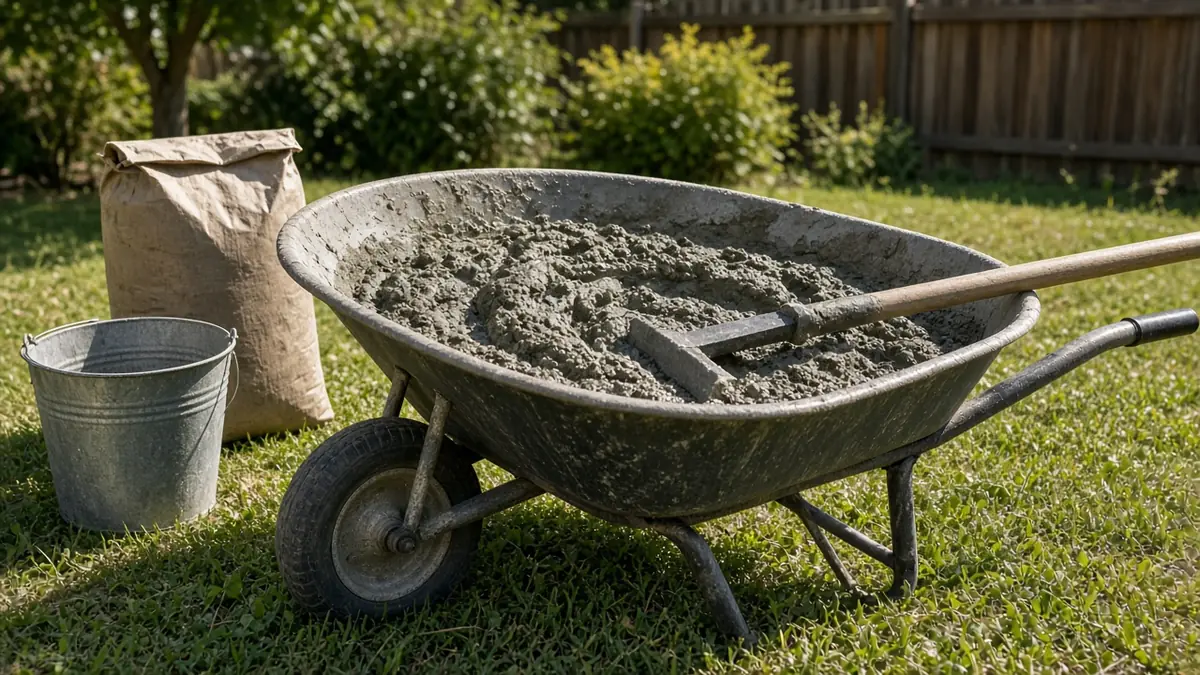
Learning how to mix concrete in a wheelbarrow is the skill behind most small DIY pours: fence posts, a mailbox post, a hoop footing, a step repair or a small pad. You do not need a mixer for a few bags. You need the right amount of water, a hoe, a sturdy wheelbarrow and a few minutes of steady work. This guide gives the water amounts from QUIKRETE, the batch size that stays manageable, the step-by-step method and the mistakes that quietly weaken a mix.
What you need before you start
Get everything in place before the first bag is opened. Once water touches the mix, the clock is running.
- A sturdy wheelbarrow or a plastic mortar tub. QUIKRETE says hand mixing can be done in either, with a shovel or hoe.
- A mortar hoe or a square shovel. A hoe with holes in the blade pulls mix through quickly, but a flat shovel works.
- A bucket marked in quarts, so you add the same water to every batch.
- Bags of concrete mix. Check the bag weight; the water and yield both depend on it.
- Eye protection and waterproof gloves. QUIKRETE's instructions say to always wear both when working with cement-based products.
- A hose or extra bucket to rinse tools straight after the last batch.
Work out how many bags you need first. Our concrete bag calculator turns your hole or form size into a bag count, the cement mix calculator splits site-mixed volume into cement, sand, and gravel, and the concrete weight calculator helps if you need to know what your car or trailer will be carrying.
How much water per bag of concrete?
This is the question that decides whether your concrete ends up strong or weak. QUIKRETE's hand-mixing instructions say each 80 lb bag of concrete mix needs about 3 quarts of water. Yesterday's hoop guide used Goalrilla's figure of about 6 pints per 80 lb bag, which is the same amount (6 pints = 3 quarts).
| Bag size | Approximate yield | Water to start with |
|---|---|---|
| 80 lb | about 0.60 cu ft | about 3 quarts |
| 60 lb | about 0.45 cu ft | about 2¼ quarts (scaled from the 80 lb figure) |
The 60 lb water figure is simply the 80 lb amount scaled by weight. Always read the bag you bought, because product formulas differ.
Why so precise? QUIKRETE warns that "the more water that is added to the mix the weaker it becomes", and that adding one extra quart of water per 80 lb bag can reduce the strength of the concrete by up to 40%. Its dealer training material puts numbers on it: with 4 quarts per 80 lb bag the mix reaches an average of 4,000 psi, while 5 quarts drops it to just 2,500 psi and increases shrinkage cracking. Water makes a mix easier to push around, which is exactly why people overdo it.
How many bags of concrete in a wheelbarrow at once?
Mix in batches you can finish while the concrete is still workable. A good rule for a standard homeowner wheelbarrow is one or two 80 lb bags per batch. Goalrilla's hoop instructions say the same: mix one or two bags at a time.
Here is why small batches win:
- Weight. Two 80 lb bags plus about 6 quarts of water is roughly 175 lb in the barrow. That is about as much as most people can turn with a hoe and still tip safely.
- Even mixing. With too much in the tray, dry pockets hide in the corners and never get wet.
- Working time. The first batch should be placed before the second is mixed, so nothing starts setting in the wheelbarrow.
If your job needs more than about 10 to 15 bags, a rented drum mixer may save your back. QUIKRETE says typical mixers hold up to three 80 lb bags, and for big jobs our guide on how to order ready-mix concrete explains when a truck makes more sense.
How to mix concrete in a wheelbarrow, step by step
These steps follow QUIKRETE's own hand-mixing method, with practical notes added.
Step 1: Empty the bag and make a well
Set the wheelbarrow on flat ground near the pour. Cut the bag along one side, empty it into the front half of the tray and form a depression (a crater) in the middle of the dry mix. Keeping the mix in the front half gives you room to pull it back and forth.
Step 2: Measure the water
Measure the full water amount for the batch before you begin: about 3 quarts per 80 lb bag. Having the measured bucket beside you stops you from "just adding a splash" from the hose.
Step 3: Pour about two-thirds of the water into the well
QUIKRETE says to pour approximately two-thirds of the water into the depression. If you are using liquid cement color, add it to the mixing water first so the color stays even.
Step 4: Pull, chop and fold with the hoe
Work the mix with the hoe, pulling dry material from the edges into the wet center. Chop down through the pile, pull it toward you, push it back and repeat. Scrape the corners and the bottom of the tray, where dry powder likes to hide.
Step 5: Add the rest of the water a little at a time
Gradually add the remaining water while you keep mixing, stopping as soon as the mix is uniform and workable. You may not need every drop.
Step 6: Do the squeeze test
QUIKRETE describes properly mixed concrete as looking like thick oatmeal and says it should hold its shape when squeezed in a gloved hand. If it crumbles, add a little water. If it slumps and runs between your fingers, it is too wet: add a little more dry mix rather than placing soupy concrete.
Step 7: Place it, then start the next batch
Wheel the batch to the form or hole and place it straight away. Rinse loose material from the hoe if the next batch will wait more than a few minutes.
Mixing a small batch for a craft project? See our guide to DIY concrete planters.
Concrete consistency: what good looks like
Beginners often judge consistency by how easy it is to stir, which pushes them toward too much water. Use these checks instead:
| What you see | What it means | What to do |
|---|---|---|
| Crumbly, dry patches, powder in corners | Not enough water or not mixed long enough | Keep mixing, then add water in small amounts |
| Thick oatmeal; holds a shape when squeezed | Correct | Place it |
| Shiny, runny, water pooling on top | Too much water | Add dry mix; do not place it as is |
A slightly stiff mix that you have to push into place is better than a wet one that pours by itself. Stiff concrete compacts with a little rodding and tapping; wet concrete stays weaker for its whole life.
Mistakes that weaken hand-mixed concrete
- Adding water to make it "easier". This is the big one. One extra quart per 80 lb bag can cost up to 40% of the strength, according to QUIKRETE.
- Mixing too many bags at once. Dry pockets and half-mixed lumps are common in an overloaded wheelbarrow.
- Not scraping the corners. Powder trapped in the corners of the tray ends up as weak spots in your post hole or pad.
- Letting a batch sit. Mix only what you can place right away.
- Re-tempering stiffening concrete with water. If a batch is starting to set, adding water to loosen it again lowers the strength. Use it quickly or discard it.
- Skipping protection. Wet cement is caustic. Wear eye protection and waterproof gloves, as QUIKRETE instructs, and wash splashes off your skin promptly.
- Cold weather surprises. Concrete gains strength slowly in the cold. Before an autumn pour, read our guide to pouring concrete in cold weather.
Where hand mixing makes sense
Hand mixing in a wheelbarrow is ideal for jobs measured in bags, not cubic yards:
- Fence posts. Our guide to setting fence posts in concrete shows hole sizes and bags per post.
- Basketball hoop footings. Yesterday's guide on how much concrete for a basketball hoop uses about eleven 80 lb bags, mixed one or two at a time.
- Small pads and steps. A small AC pad or a single step can be done in an afternoon. The concrete step calculator gives the volume.
- Repairs. Patching a broken corner or a sunken paver base.
For a driveway or a large slab, plan for ready-mix. Our concrete PSI for driveways guide explains the strength you should order, and the concrete calculator gives the cubic yards.
After the pour: cleanup and curing
- Clean tools immediately. Rinse the wheelbarrow and hoe before concrete hardens on them. Do not wash cement slurry into storm drains; rinse onto gravel or soil where it can harden.
- Protect the new concrete. Keep it from drying too fast in sun and wind, and from freezing in cold weather.
- Wait before loading it. For posts and footings, follow the product or hardware maker's cure time before you hang a gate or bolt on a hoop. For slabs, see when you can drive on new concrete.
Next project: how to lay concrete block for a garden wall.
A single wheelbarrow batch is enough for a set of DIY stepping stones.
Thinking of skipping the mixing altogether? Read dry pour concrete: when it works and when it fails first.
Frequently asked questions
How much water do you use for an 80 lb bag of concrete?
About 3 quarts. QUIKRETE's hand-mixing instructions say each 80 lb bag of concrete mix needs about 3 quarts of water. Pour about two-thirds first, then add the rest slowly until the mix looks like thick oatmeal.
How many bags of concrete can you mix in a wheelbarrow at once?
One or two 80 lb bags per batch is a practical limit for a standard wheelbarrow. That keeps the load manageable, avoids dry pockets and lets you place each batch before it starts to set.
What should hand-mixed concrete look like?
It should look like thick oatmeal and hold its shape when squeezed in a gloved hand. If it crumbles, it needs a little more water; if it runs, it is too wet.
Does adding more water weaken concrete?
Yes. QUIKRETE says adding one extra quart of water per 80 lb bag can reduce the strength of the concrete by up to 40%. Its training material shows a mix dropping from about 4,000 psi with 4 quarts to 2,500 psi with 5 quarts.
Is it better to mix concrete with a hoe or a shovel?
Both work. QUIKRETE says hand mixing can be done in a wheelbarrow or mortar tub with a shovel or a hoe. A mortar hoe pulls material through faster and makes it easier to reach the corners.
When should I rent a mixer instead of mixing by hand?
When a job needs many bags in one continuous pour. Typical drum mixers hold up to three 80 lb bags, according to QUIKRETE, which speeds up larger jobs. For a driveway or large slab, ready-mix concrete is usually the better choice.
- https://www.quikrete.com/athome/video-mixing-concrete-hand.asp
- https://www.quikrete.com/dealers/training/presentations/3-mixing-placing-concrete-cement-mixes-training.pdf
- https://www.quikrete.com/pdfs/data_sheet-concrete%20mix%201101.pdf