- Ready-mix truck vs bags
- How many yards per truck
- Cubic yard basics
- Calculate how many yards to order
- Rounding, minimum loads, and short loads
- What to tell the batch plant
- Reading the delivery ticket
- Scheduling time and pour rate
- Truck access, chute, and pump
- Pour-day coordination
- Cost planning without fake numbers
- Worked example: order sheet for a 12 × 20 ft slab
- Order mistakes that ruin pour day
- Frequently asked questions
How to order ready-mix concrete starts on paper, not on the phone. Dispatchers batch what you specify: yards, strength, air, slump, and time. Vague orders get default mixes that may be fine—or may be wrong for a freezing-climate patio. Walk through volume, mix language, logistics, and ticket checks so pour day is boring in the best way.
Use the concrete yard calculator to convert dimensions into order yards with waste and rounding. When you are ready to compare supplier quotes line by line, plug those yardages into the concrete cost calculator with your local numbers—this guide does not list prices because plants change them by season and fuel cost.
Ready-mix truck vs bags
Ready-mix wins when:
- Net volume is roughly 1 cubic yard or more (about 45 eighty-pound bags—mixing that by hand is a fitness test, not a project plan).
- You need uniform air content and slump for a large flat finish.
- Time matters: a truck unloads in minutes; bags eat hours.
Bags still make sense for post holes, stair repairs, and tiny pads where a truck minimum would leave you paying for concrete you do not place. The crossover point depends on your plant’s minimum load—always ask.
Cubic yard basics
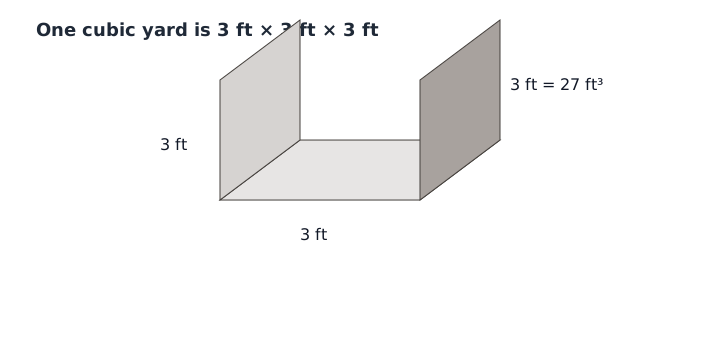
Ready-mix is sold by the cubic yard (27 cubic feet). Visualizing that volume helps you sanity-check takeoffs before you call the plant.
How many yards per ready-mix truck
Mixer trucks in the U.S. commonly carry about 8 to 11 cubic yards per load, depending on axle rules and drum size; NRMCA's Concrete in Practice series is the usual industry reference for what dispatchers mean by a "full truck." Your order can be one truck or a fraction of it—dispatch rounds to batch increments and may send a short load with a fee.
For flatwork:
yd³ = area (sq ft) × thickness (in) ÷ 324
Thickness in inches times area in square feet, divided by 324, equals cubic yards. The constant 324 is 12 inches per foot × 27 cubic feet per yard.
Calculate how many yards to order
- Draw the pour as rectangles, triangles, or trapezoids. Measure each piece in feet, not inches mixed into the formula wrong.
- Compute net volume for each piece and add them. Include thickened edges, footings, and steps—not just the main field.
- Add waste for spillage, uneven subgrade, and form deflection. Flatwork commonly uses 5 to 10 percent; complex forms or pumped lines may need more.
- Round up to the plant’s increment (1/4 yard, 1/2 yard, or whole yard).
The concrete yard calculator does those steps with editable waste and rounding so your order sheet matches what dispatch enters in the computer. For a pour with more than one shape, build the takeoff in the main concrete calculator first, then carry the net yards into your call sheet.
| Step | What you are doing | Typical pitfall |
|---|---|---|
| Measure | Length, width, thickness in consistent units | Using 4 ft where you meant 4 in |
| Net yd³ | Geometry only, no margin | Forgetting edge thickening |
| Waste | Multiply net by 1.05–1.10 | Skipping waste on a first pour |
| Round | Match batch increment | Rounding down to “save money” |
Rounding, minimum loads, and short loads
Batch plants cannot weigh a perfect 1.63 yards on every ticket—they snap to practical steps. When your calculated need is 3.26 yards and the plant batches in half-yard steps, you order 3.5 yards. Running short is worse than having a quarter yard left over for stepping stones.
Minimum load policies exist because setup, washout, and delivery time are similar for 2 yards and 8 yards. If your net need is below the minimum, you may:
- Pay a short-load charge and take the small volume anyway
- Combine pours (patio plus walkway) onto one ticket
- Switch to bagged concrete for that element
Ask the dispatcher: “What is today’s minimum yardage and how do you handle short loads?” Write the answer on your order sheet—do not rely on forum posts from another state.
What to tell the batch plant
Think in the categories ASTM C94 uses for ready-mixed concrete: your order is a specification the producer fulfills.
Identity and schedule
- Customer name, job address, contact cell for the driver
- Date, requested arrival time, and whether you need spacing between trucks on large pours (one truck every 30 to 45 minutes is common for big slabs—small pours usually need one truck)
Volume and use
- Cubic yards after waste and rounding
- Placement type: exterior slab on grade, interior garage, footing, wall, curb
- Exposure: freezing weather, deicing salts, sulfate soils (rare on residential—ask if you are on clay with history of sulfate heave)
Performance requirements
- Specified compressive strength (psi at 28 days)—match code and use. Driveways and garage slabs often specify 4,000 psi in cold climates; basic patios may use 3,000 to 3,500 psi when allowed.
- Air content for exterior freeze-thaw exposure: commonly 5 to 7 percent total air.
- Slump at discharge: 4 to 5 inches for many residential flats; lower on slopes; higher only if the plant approves for your finish crew.
- Maximum aggregate size (often 3/4 inch)
- Admixtures: fiber for shrinkage control, retarder for hot weather, accelerator for cold weather—coordinate with cold-weather rules when temperatures drop.
Repeat the order back to the dispatcher. Misheard “three thousand” vs “four thousand” psi is not fixable at the chute.
Reading the delivery ticket
When the truck arrives, the ticket is your receipt and quality traceability. Check:
- Mix design ID or class matches what you ordered
- Quantity in cubic yards for that load
- Batch time and plant location
- Target slump and measured slump if the driver tested at discharge
- Admixtures listed (air, fiber, retarder)
ASTM C172 covers sampling fresh concrete if you or your inspector test slump or cast cylinders. For a backyard patio, most homeowners rely on the producer’s QC and proper curing—but keep the ticket anyway for warranty or future work.
If concrete is too stiff or too wet, speak up before placement. The driver may adjust within limits or call the plant; adding water on site without documentation hurts strength—ACI guidance discourages casual water addition in the truck.
Scheduling time and pour rate
Order the truck when your forms, steel, and crew are ready—not when you “hope” to be ready. Industry guidance for flatwork often assumes placement within about 90 minutes of batching for standard mixes in moderate weather; hot weather shortens that window.
Estimate your placement rate:
- Two experienced finishers with wheelbarrows might place 1 to 2 yards per hour on a backyard with a long wheelbarrow run.
- Direct chute placement into open forms can exceed that—until you hit obstacles.
If placement is slow, order a smaller first load or add finishers. A half-set pile in front of the truck is stress you do not need.
Truck access, chute, and pump
Before order day, walk the route with a tape measure:
- Overhead: tree limbs, power lines (lines are deadly—stay clear)
- Ground: will a loaded truck rut wet lawn or crack thin pavers?
- Chute reach: can the driver get within roughly 15 to 20 feet of all corners?
- Washout: where will the driver rinse the drum? Provide an approved washout area—not your storm drain.
If the truck cannot reach the forms, check concrete pump cost before you book.
If access fails, book a concrete pump when you book concrete. Give the pump company the same yardage and line layout. Pump day is two vendors to coordinate, not one.
Pour-day coordination
- Confirm the night before or morning of—weather holds and traffic happen.
- One person owns the order—only they change yards or time with dispatch.
- Stage helpers with roles: screed, wheelbarrow, bull float, edges.
- Unload continuously when possible; stop only for safety or finishing limits.
- Document tickets and any rejected loads (rare, but note time and reason).
When the last truck leaves, switch from placement brain to curing brain—spray compound or cover plastic the same day.
Cost planning without fake numbers
Your total ready-mix bill typically includes:
- Concrete material per cubic yard (quote from the plant)
- Delivery or haul charges
- Short-load or environmental fees where applicable
- Pump, if used (separate vendor)
- Finishing labor and reinforcement (your contractor or your time)
Enter your quoted per-yard numbers and tax into the concrete cost calculator alongside bagged alternatives. Compare installed cost, not just material—truck concrete is cheaper per cubic foot than bags, but only if you avoid minimum-load penalties and finish on time.
Get two quotes when you can. NRMCA member plants follow industry standards, but service windows differ. The cheapest yard on paper is not cheap if the truck arrives two hours late.
Worked example: order sheet for a 12 × 20 ft slab
From dimensions to dispatcher script
- Slab: 12 × 20 ft × 4 in → 240 × 4 ÷ 324 = 2.96 yd³ net.
- Waste 10%: 2.96 × 1.10 = 3.26 yd³.
- Round to 1/4 yd: order 3.5 yd³.
- Phone script: “3.5 yards, exterior slab on grade, 4000 psi, 6% air, 4-inch slump plus-minus 1, 3/4-inch aggregate, fiber per your standard patio mix, delivery Saturday 7 a.m., chute reach south side of house, call on approach.”
Adjust psi and air to your climate using our driveway PSI guide when the slab carries vehicles.
Order mistakes that ruin pour day
- No access plan: Truck arrives; gate is too narrow.
- Under-ordered yards: Second truck hours later creates a cold joint.
- Wrong air: Exterior slab without air in a freeze zone scales within winters.
- Slump mismatch: Stiff mix on a hot day before you can screed it.
- Ignored minimums: Sticker shock on the invoice for a 2-yard ticket.
- Changing specs at the chute without plant approval—strength suffers.
Order ready-mix with the same care you pour it: measure twice, specify clearly, confirm access, keep tickets, and cure what you placed. The plant wants you to succeed—clear numbers make that possible.
Frequently asked questions
How many cubic yards of concrete do I order for a 10 × 10 ft slab?
A 10 × 10 ft slab at 4 inches thick is 100 square feet. Volume is 100 × 4 ÷ 324 = 0.99 cubic yards net. Add your waste margin (often 5 to 10 percent), then round up to the supplier’s batch step—commonly the next 1/4 or 1/2 yard.
What information does a ready-mix plant need on the phone?
Job address, delivery date and time window, cubic yards, exposure (interior vs exterior), required compressive strength (psi), air entrainment if needed, slump target, aggregate size, admixtures (accelerator, retarder, fiber), pour type (slab, footing, wall), and site access notes (chute reach, pump, gate width).
What is a short load fee?
Many plants have a minimum ticket volume (often around 3 to 5 cubic yards on residential jobs). If you order less, they may still deliver but charge a short-load or partial-load fee. Ask for the current minimum and fee schedule—policies vary by market and do not belong in a generic price table.
Can I change the order the morning of the pour?
Small increases (an extra half yard) are sometimes possible if the batch plant has capacity. Large changes may slide your delivery window. Call as early as possible; after concrete is batched, changes may be impossible.
Should I order a pump truck?
Order a line pump or boom pump when the ready-mix truck cannot get within about 15 to 20 feet of the forms with the chute, or when you must lift concrete over a house wall or into a basement. Pump vendors need separate scheduling—book when you book concrete.
How do I verify I received the right concrete?
Match the ticket to your order: mix ID, yards, slump at discharge, time batched, and any admixtures. Keep one ticket for your records. If strength is critical, your contractor may cast test cylinders per ASTM C31; residential patios rarely need cylinders unless engineered.
- National Ready Mixed Concrete Association (NRMCA), Concrete in Practice series
- Portland Cement Association (PCA), Design and Control of Concrete Mixtures
- American Concrete Institute (ACI) 304R Guide for Measuring, Mixing, Transporting, and Placing Concrete
- ASTM C94 Standard Specification for Ready-Mixed Concrete
- ASTM C172 Practice for Sampling Freshly Mixed Concrete