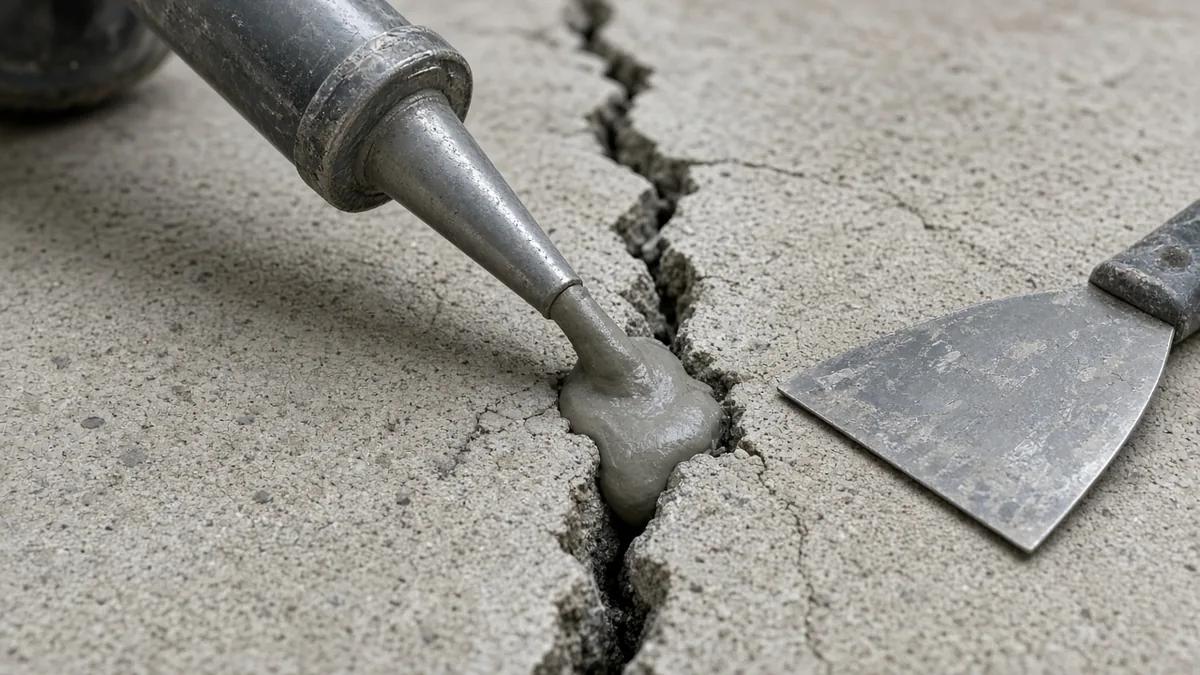
If you want to know how to fix cracks in concrete, the short answer is: clean the crack, open it to at least ¼ inch with clean edges, add backer rod if it is deep, then fill it with a concrete repair caulk or a polyurethane sealant while the temperature is above 40°F. Autumn is the best time to do it. Water that gets into an open crack freezes and expands over winter, and that makes small cracks bigger. This guide covers which cracks you can fix yourself, which product to use, and the steps QUIKRETE recommends.
Why concrete cracks
QUIKRETE lists the usual causes of cracks in exterior concrete: temperature changes, ground movement, control joints in the wrong place, and loads that are too heavy for the slab. Some cracking is normal. Concrete shrinks as it dries, and control joints exist to make it crack in a straight line where you want it.
The problem is water. The USGS notes that water expands by about 9% when it freezes. When water sits in a crack and freezes, it pushes the sides apart. Repeat that every cold night and a hairline crack can become a chip, then a pothole. Sealing the crack keeps water out.
Which cracks you can fix yourself
| Crack type | What it looks like | DIY? |
|---|---|---|
| Hairline | Thinner than a credit card, no height difference | Yes, seal it |
| Narrow, up to about ½ inch | Clean edges, both sides level | Yes, caulk or sealant |
| Wide, over ½ inch | You can fit a finger in it | Yes, with backer rod first |
| Sunken or lifted | One side higher than the other | Repair the surface, but ask a pro about the base |
| Growing every season | Gets longer or wider each year | Call a pro to check drainage and soil |
| Foundation or retaining wall | Structural element | Get a professional inspection |
This guide is for driveways, patios, walkways and other flatwork. Cracks in foundations or retaining walls can be structural, so have them checked.
A planned break at a wall or post is one of the concrete expansion joints you set at pour time, not a crack to fill later.
If one side of a crack has dropped, read about concrete leveling.
Pick the right product
QUIKRETE suggests three products for exterior cracks. Each fits a different crack.
- Concrete crack seal (pourable liquid). For narrow cracks. Pour it straight from the bottle and overfill slightly to allow for settling. QUIKRETE says cracks deeper or wider than ¼ inch need several applications, 24 hours apart.
- Concrete repair caulk (cement-colored acrylic in a caulk tube). For cosmetic repairs. It can be tooled with a trowel, starts to skin in about 20 to 40 minutes and hardens in 1 to 2 hours, according to QUIKRETE.
- Polyurethane self-leveling sealant (caulk tube). For flat surfaces that move with the seasons, like driveways and patios. It stays flexible and levels itself in the crack. Use the non-sag version for vertical surfaces such as steps or wall faces.
If a crack opens and closes with temperature, choose the flexible polyurethane. Rigid fillers can crack again along the same line.
What you need
- Safety glasses and waterproof gloves (QUIKRETE recommends both)
- Cold chisel and hammer, or an angle grinder with a masonry blade
- Stiff wire brush and a shop vacuum or leaf blower
- Foam backer rod if the crack is deep or wide
- Caulk gun and your chosen sealant or filler
- Putty knife or small trowel
- Citrus-based cleaner or the solvent on the sealant label for clean-up
How to fix cracks in concrete, step by step
1. Check the weather
QUIKRETE's polyurethane sealant data sheet says to avoid applying sealant below 40°F, or when rain is likely, and the surface must be clean, dry and frost-free. Some QUIKRETE instructions are stricter and say not to use polyurethane below 50°F, so read your tube. Pick a dry stretch of days with mild daytime temperatures.
2. Open the crack
QUIKRETE's step one is to widen the crack to at least ¼ inch with a chisel and hammer and break away any crumbling concrete. Shape the edges so they are straight down, or slightly wider at the bottom than the top (an upside-down "V"). That shape locks the filler in place.
3. Clean it out
Remove all dust, loose bits, weeds and dirt with a wire brush, then vacuum or blow the crack clean. Sealants stick to clean, dry, sound concrete. If you wash the crack, let it dry completely before you seal.
4. Add backer rod if it is deep or wide
QUIKRETE says to place backer rod in cracks or joints wider or deeper than ½ inch. Backer rod is a round foam cord. Push it into the crack with a putty knife so it sits slightly below the surface. It saves sealant and stops the sealant from sticking to the bottom of the crack. Sealant that sticks to only the two sides can stretch as the concrete moves.
The QUIKRETE sealant spec also gives a useful rule: the working depth of the sealant should be no deeper than ½ inch and no thinner than ⅛ inch, with ¼ inch ideal, and the joint should be about twice as wide as it is deep.
5. Fill the crack
Cut the nozzle at an angle to match the crack width and load the tube into a caulk gun. Move slowly along the crack and force the material deep into it. With self-leveling sealant, let it flow and settle. If it sinks, add a second pass right away so the two layers bond. With pourable crack seal, overfill slightly.
6. Tool and clean up
Smooth caulk-type fillers with a trowel or putty knife right away. Wipe up any extra polyurethane immediately with a citrus cleaner or the solvent on the label. It is very hard to remove once it cures.
7. Let it cure
Keep feet, tires and water off the repair until it has cured. QUIKRETE's spec says its polyurethane sealants are fully cured in 5 to 8 days at about 75°F and 50% humidity, and that cool temperatures and low humidity slow curing. Check the label for walk-on and drive-on times.
If the surface is worn all over, not just cracked, you can resurface the whole slab once the cracks are filled.
Once cracks are filled, seal the concrete driveway before winter.
Once cracks are stable, you can also lay pavers on existing concrete.
Cracks on a stair tread need extra care at the nosing; see our guide to patching concrete steps.
Repairing hairline cracks in concrete
Very fine cracks are often too thin to fill with a caulk tube. You have two options:
- Leave them and seal the whole surface. A good penetrating sealer helps keep water out. Our guide to driving on new concrete covers sealing and salt in the first winter.
- Open them slightly and fill. If a hairline crack is getting longer or collecting dirt, widen it to ¼ inch and treat it like a narrow crack.
How to seal cracks in a concrete driveway
Driveways move more than patios because of vehicle loads and big temperature swings. A few extra tips:
- Use a flexible polyurethane sealant, not a rigid patch.
- Seal control joints too, not just random cracks. Joints are cracks you planned, and they let water in the same way.
- Keep the sealant slightly below the surface so snow shovels and tires do not pull it out.
- If the driveway has many wide cracks or sunken panels, compare repair costs with a new slab. Our concrete cost calculator gives a quick estimate, and the concrete slab calculator works out the volume.
Common mistakes
- Sealing a dirty or damp crack. The sealant peels out within a season.
- Filling a deep crack with sealant alone. It wastes material and fails sooner. Use backer rod.
- Working in the cold. Below 40°F most sealants do not bond or cure properly.
- Overfilling with a rigid patch on a moving crack. It cracks again.
- Ignoring the cause. If downspouts dump water against the slab, redirect them, or the crack will keep growing.
Make the repair last
A good crack repair is a maintenance job, not a one-time fix. Walk your driveway, patio and paths every autumn. Look for sealant that has pulled away from one side, cracked, or been chewed up by shovels, and redo those sections before winter. Keep gutters and downspouts pointed away from slabs so water does not soak the base, and avoid parking heavy trailers or equipment on thin patio slabs. Choose deicers carefully, too; some damage concrete fast.
When to call a professional
Call a concrete contractor if a slab has sunk or heaved by more than a small trip edge, if cracks keep growing every year, if water drains toward your house, or if the crack is in a foundation or retaining wall. A pro can check the soil and base, and may suggest lifting the slab or replacing a section. When you do replace a section, our guides to pouring a small concrete slab and rebar vs wire mesh help you build it to last, and the concrete bag calculator tells you how many bags to buy. For a small patch, here is how to mix concrete in a wheelbarrow.
Once the cracks are filled, you can move on to painting the patio.
If the whole floor is uneven rather than cracked, consider self-leveling concrete.
If a section is too broken to patch, learn how to cut concrete out cleanly before you pour a replacement.
Frequently asked questions
What is the best way to fix cracks in concrete?
Widen the crack to at least ¼ inch, clean it, add backer rod if it is over ½ inch, then fill it with a flexible polyurethane sealant or concrete repair caulk when it is above 40°F and dry.
Can I fix concrete cracks in cold weather?
Not well. QUIKRETE advises against applying its polyurethane sealants below 40°F or on frozen or wet surfaces, and some of its instructions say 50°F. Fix cracks in autumn before the first hard freeze.
Do I need backer rod for concrete cracks?
Use backer rod when a crack or joint is wider or deeper than ½ inch. It supports the sealant, saves material and lets the sealant stretch as the concrete moves.
How long does concrete crack sealant take to cure?
QUIKRETE says its polyurethane sealants cure fully in 5 to 8 days at about 75°F and 50% humidity. Cooler or drier weather takes longer, so check the label before driving on it.
Should I fill hairline cracks in concrete?
Hairline cracks are usually cosmetic. Sealing the whole surface with a penetrating sealer keeps water out. If one is growing, widen it to ¼ inch and fill it like a larger crack.
When is a concrete crack serious?
When one side is higher than the other, when it grows every season, when water drains toward the house, or when it is in a foundation or retaining wall. Have a professional look at it.
- https://www.quikrete.com/athome/video-repairing-sealing-cracks.asp
- https://www.quikrete.com/athome/video-sealing-waterproofing-cracks-in-concrete.asp
- https://www.quikrete.com/pdfs/spec_data-polyurethanesealants.pdf