- Why concrete slabs need a gravel base
- How deep should the gravel be?
- Which gravel is best under concrete?
- How to prepare and compact the base
- Do you need a vapor barrier over the gravel?
- Gravel base calculator
- How much gravel do you need?
- Ordering and delivery tips
- Common gravel base mistakes
- Gravel base vs sand base
- Frequently asked questions
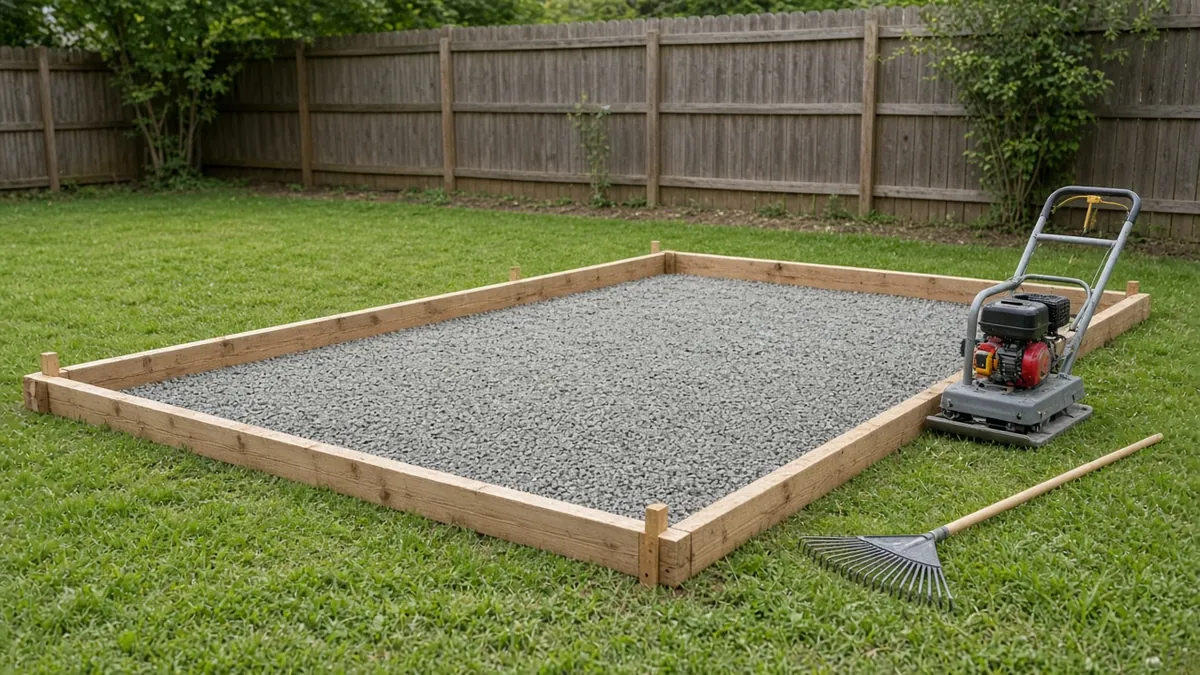
Gravel under a concrete slab gives the concrete a firm, even, well-drained surface to sit on. For most patios, shed pads and walkways, plan on about 4 inches of compacted crushed stone over firm, undisturbed soil. Use more, often 6 inches, for driveways, garage slabs, clay soils or wet sites. This guide explains why the base matters, which stone to buy, how to compact it, when you need a vapor barrier, and how to calculate the gravel you need in cubic yards and tons.
To size the concrete itself, use our concrete slab calculator or the main concrete calculator for mixed shapes. For the full pour from forms to finish, see how to pour a small concrete slab.
Gravel base calculator
Base volume is slab area × gravel depth in feet, ÷ 27 for cubic yards, plus about 20% for compaction. Open the gravel panel on the concrete slab calculator for cubic yards and approximate tons from your dimensions. Ordering recycled aggregate? Use the crushed concrete calculator for yards and tons.
Why concrete slabs need a gravel base
Concrete is strong in compression but cracks easily if the ground beneath it moves unevenly. A gravel base helps in four ways:
- Uniform support. A compacted layer spreads the load so the slab does not rest on soft spots.
- Drainage. Water moves through gravel instead of sitting under the slab, which reduces frost heave and soil softening.
- Capillary break. Coarse stone limits how much moisture wicks up from the soil into the slab.
- A flat working surface. It is much easier to set forms and get an even slab thickness on a graded gravel bed than on lumpy soil.
Skipping the base can work on very firm, well-drained, sandy soil for small, lightly loaded pads. On most sites, though, the gravel layer is cheap insurance against cracks and settling.
Already have a slab that settled? See concrete leveling.
How deep should the gravel be?
| Project | Typical compacted gravel depth | Notes |
|---|---|---|
| Walkway or small patio | 4 in | on firm, well-drained soil |
| Shed pad | 4 in | add more on soft ground |
| Hot tub pad | 4–6 in | heavy point loads |
| Driveway | 4–6 in or more | heavier on clay or wet soil |
| Garage slab | 4–6 in | plus a vapor retarder if enclosed |
| Clay, wet or frost-prone sites | 6–8 in or more | improves drainage; follow local practice |
See the full walkway base and pour steps.
These are common starting points, not engineered designs. Local building codes, soil type and frost depth all matter. For a garage or any slab supporting a structure, check your local code and permit requirements.
Remember that the depth is measured after compaction. Loose gravel compacts by roughly 15 to 25 percent, so you need to order more than the finished depth.
Which gravel is best under concrete?
The best base is usually crushed stone with angular pieces and a mix of sizes, often sold as crusher run, road base, "dense grade aggregate" or 3/4-inch minus. The fine particles fill gaps between larger pieces, so it compacts into a hard, stable layer.
| Material | Compacts well? | Drains well? | Best use |
|---|---|---|---|
| Crusher run / 3/4-in minus | yes, very firm | moderate | most patios, pads and driveways |
| Clean crushed stone (#57, about 3/4 in) | moderate, locks together | excellent | wet sites, under interior slabs as a capillary break |
| Pea gravel (rounded) | poor, rolls under load | good | not recommended as a slab base |
| Sand | fair when damp | good | thin leveling layer only |
| Recycled concrete aggregate | yes | moderate | budget base where available |
Names vary by region, so describe your use to the supplier: "compactable base for a concrete patio" is usually enough. Avoid rounded pea gravel as the main base, because round stones shift instead of locking together.
How to prepare and compact the base
- Excavate. Remove grass, roots and topsoil. Dig to the slab thickness plus the gravel depth. A 4-inch slab on a 4-inch base needs about 8 inches of excavation, minus any height you want the slab to sit above grade.
- Compact the soil. Run a plate compactor over the subgrade. Fill soft spots with base material rather than loose soil.
- Set forms. Stake 2x4 or 2x6 forms level, with a slight slope (about 1/8 inch per foot) away from buildings for drainage.
- Spread gravel in lifts. Add 2 to 3 inches at a time, rake level, lightly dampen, and compact each lift with several passes of a plate compactor.
- Check the depth. Use a string line or straightedge across the forms to check that the base is flat and the slab will be full thickness everywhere.
- Add a vapor retarder if needed. See the next section.
- Pour. Place reinforcement on chairs so it sits in the middle of the slab, then pour. Our rebar vs wire mesh guide covers placement.
A rented plate compactor is the right tool for most DIY slabs. A hand tamper works for very small pads but takes much more effort to reach the same density.
Do you need a vapor barrier over the gravel?
Use a vapor retarder under slabs that will be enclosed or covered with flooring: garages, workshops, basements, sheds with wood floors, and any slab inside a building. Moisture rising from the ground can damage flooring, adhesives and stored items.
Builders often use polyethylene sheeting that meets ASTM E1745, and industry guidance from ACI recommends at least 10-mil thickness under interior slabs. Overlap seams by about 6 inches and tape them. Outdoor patios, walkways and driveways usually do not need one.
How much gravel do you need?
Gravel is sold by the cubic yard or by the ton. Here is the method.
- Find the area. Length × width in feet.
- Convert the depth to feet. Divide inches by 12. Four inches is 0.333 ft.
- Find cubic feet. Area × depth.
- Convert to cubic yards. Divide by 27.
- Add for compaction. Multiply by about 1.2 (20 percent extra).
- Convert to tons if needed. Crushed stone weighs roughly 1.3 to 1.5 tons per cubic yard; ask your supplier for their figure.
Worked example: 12 × 16 ft patio, 4 in base
- Area: 12 × 16 = 192 sq ft
- Volume: 192 × 0.333 = 64 cu ft
- Cubic yards: 64 ÷ 27 = 2.37 cu yd
- With compaction allowance: 2.37 × 1.2 = 2.84 cu yd, so order about 3 cu yd
- Weight at 1.4 tons per cu yd: about 4 tons
Quick reference for a 4 in compacted base
| Slab size | Cubic yards (with 20% extra) | Approx. tons at 1.4 t/yd³ |
|---|---|---|
| 10 × 10 ft | 1.5 | 2.1 |
| 12 × 12 ft | 2.1 | 3.0 |
| 12 × 16 ft | 2.8 | 4.0 |
| 20 × 20 ft | 5.9 | 8.3 |
| 24 × 24 ft (2-car garage) | 8.5 | 11.9 |
For the concrete volume on top of the base, our concrete yard calculator and concrete bag calculator do the math.
Ordering and delivery tips
- Bulk vs bags. Bagged gravel makes sense for tiny pads. For anything over about 1 cubic yard, bulk delivery from a landscape or quarry yard is usually far cheaper and much less work.
- Ask about minimums. Many suppliers have a minimum delivery or charge a flat delivery fee, so order the base and any extra for paths or drainage at the same time.
- Choose the drop spot. Have the truck dump the stone on a tarp close to the slab, but not where it will block the concrete truck or pump later.
- Rent the compactor for the same day. Spreading and compacting in one session avoids rain softening a half-finished base.
- Time the pour. Pour soon after the base is finished. If it rains, let the surface drain and re-compact any soft spots before the concrete arrives. In winter, also read our guide to pouring concrete in cold weather, because a frozen base must thaw before you pour.
Common gravel base mistakes
- Spreading it all at once. A thick, single lift will not compact at the bottom. Work in 2 to 3 inch layers.
- Compacting dry. Slightly damp gravel compacts much better than dry stone.
- Using pea gravel. Rounded stones roll and settle.
- Building on topsoil. Organic soil compresses and rots. Always dig down to firm subsoil.
- Ignoring drainage. If water pools on the site after rain, improve the slope or add more base before pouring.
- Thin edges. A base that slopes up at the edges makes the slab thinner where it needs strength most.
Gravel base vs sand base
Sand alone is sometimes used under slabs on very well-drained sites, but it washes out more easily and does not lock together like crushed stone. Many builders use crushed stone as the main base and, if needed, a thin layer of sand on top to fine-level the surface. For most DIY projects, compactable crushed stone alone is simpler and more stable.
Frequently asked questions
How much gravel do you put under a concrete slab?
Most patios, walkways and shed pads use about 4 inches of compacted crushed stone. Driveways, garage slabs and sites with clay or wet soil often use 6 inches or more. Follow local code for structural slabs.
Do you need gravel under concrete?
On most sites, yes. Gravel provides even support and drainage, which reduces cracking and settling. Very small pads on firm, sandy, well-drained soil can sometimes go without, but a base is cheap insurance.
What is the best gravel for under a concrete slab?
Crushed stone with mixed sizes, often called crusher run, road base or 3/4-inch minus, compacts into a firm layer. Clean crushed stone like #57 is useful where drainage is the priority. Avoid rounded pea gravel.
How do I calculate how much gravel I need?
Multiply length by width in feet, then by the depth in feet, and divide by 27 for cubic yards. Add about 20 percent for compaction, then multiply by your supplier's tons per yard, often about 1.4.
Should I put plastic under concrete?
Use a vapor retarder under slabs that will be enclosed or covered with flooring, such as garages and workshops. Outdoor patios and driveways usually do not need one.
Can I pour concrete directly on dirt?
You can on very firm, well-drained soil for small, lightly loaded pads, but it is riskier. Remove topsoil, compact the subgrade, and add a gravel base for most slabs to prevent cracks and settling.