- Can you paint a concrete patio?
- How long to wait before painting new concrete
- Test for moisture first
- Tools and materials checklist
- The best time of year to paint a patio
- Step 1: Repair cracks and damage
- Step 2: Clean and degrease
- Step 3: Etch the surface
- Step 4: Prime if needed
- Step 5: Choose the right paint
- Step 6: Lay out a checkerboard or rug design
- Step 7: Apply two coats and let it cure
- How long does a painted patio last?
- Painted vs stained vs sealed concrete
- Frequently asked questions
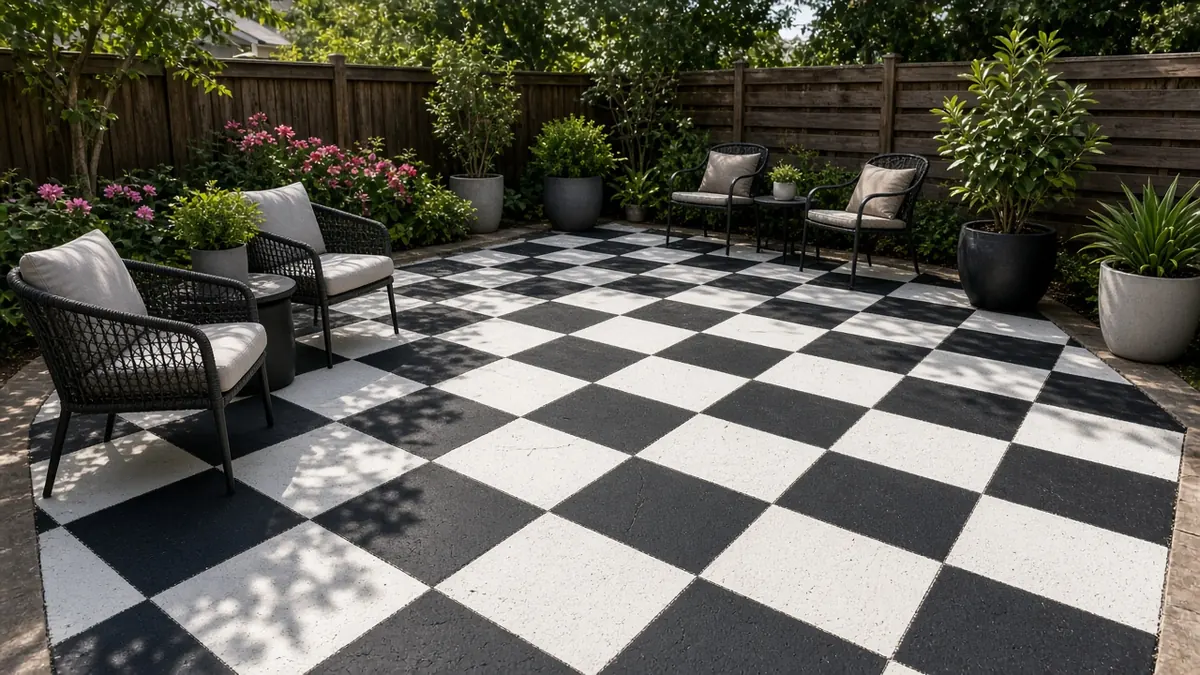
Painting a concrete patio gives a tired slab a new look for the cost of a few cans of paint, and painted "rug" designs such as checkerboards have become a popular way to do it. The process is simple but strict: the concrete must be fully cured, clean, dry and etched, and you need a paint made for exterior concrete floors. This guide covers each step, how to lay out a checkerboard or rug pattern, and how to keep the finish from peeling.
Before you start, check what you are painting. A new slab needs time to cure, and any slab with cracks or flaking needs repair first. If you are planning a new patio instead, our guide on how to pour a small concrete slab and the concrete slab calculator cover the build.
Can you paint a concrete patio?
Yes, as long as the concrete is sound and you prepare it properly. Paint sticks to concrete by gripping a slightly rough, clean surface. Most failures come from painting too soon, painting over dirt or sealer, or painting a slab that holds moisture.
Good candidates:
- a solid slab with no loose or flaking surface,
- a slab that drains and dries after rain,
- a slab that is not already coated with a sealer, or one where the old coating can be removed.
Poor candidates:
- a slab that stays damp, shows white powdery deposits (efflorescence) or sits in a low spot,
- a surface with large cracks that are still moving,
- a slab that was sealed recently with a penetrating or film-forming sealer you cannot remove.
How long to wait before painting new concrete
New concrete must cure before it is painted. Rust-Oleum's support guidance is to let newly poured concrete cure for a minimum of 28 days before painting, and to etch it before painting even then. Behr's porch and patio product guidance likewise calls for new concrete to cure for about a month.
Cold weather slows curing. If the slab was poured in cool conditions, add time. Our guide to driving on new concrete explains how concrete gains strength over its first weeks.
Test for moisture first
Moisture coming up through a slab will lift paint. A simple test used in paint makers' prep guides:
- Tape a square of clear plastic sheet, about 2 feet by 2 feet, flat on the concrete, sealing all four edges.
- Leave it for 24 hours.
- Lift it. If there is condensation under the plastic, or the concrete underneath has darkened, moisture is coming through. Do not paint yet.
Try again after a dry spell. If the slab is always damp, paint is the wrong finish; a breathable penetrating stain or simply cleaning and sealing the concrete may be better.
Tools and materials checklist
Gather everything before you start, because the prep steps follow each other quickly.
- Stiff broom, scrub brush and garden hose
- Concrete cleaner and degreaser
- Etching product, plastic watering can for applying it, and chemical-resistant gloves, goggles and protective clothing
- Concrete crack filler and a putty knife
- Clear plastic sheet and tape for the moisture test
- Bonding primer, if your paint or slab needs it
- Exterior porch and patio floor paint in your base and pattern colors
- Roller frame, 3/8 to 1/2 inch nap roller covers, extension pole and an angled brush
- Painter's tape, chalk line, tape measure and a long straightedge for patterns
For indoor floors with dips, a self-leveling underlayment comes before any finish.
For garage or basement floors, see our concrete floor coating guide.
The best time of year to paint a patio
Paint needs mild, dry weather to cure well. Check the temperature range on the can and the forecast for at least a day after you finish. Early fall is often a good window in many regions: temperatures are moderate and the sun is less intense than in midsummer, which can dry paint too fast.
Avoid painting when dew will settle on the slab overnight, or when the surface is in direct midday sun on a hot day. Start in the morning once any dew has dried, so the paint has the warmest part of the day to set.
Step 1: Repair cracks and damage
Paint will not hide cracks; it will show them. Fill hairline and small cracks with a concrete crack filler and let it cure as directed. For wider or uneven cracks, see our guide on how to fix cracks in concrete. Scrape off any loose or flaking surface.
Step 2: Clean and degrease
Sweep the slab, then scrub it with a concrete cleaner and degreaser, following the label. Pay extra attention to grill spots, planter rings and oil drips. Rinse thoroughly and let the surface dry. Start with a thorough wash; this patio cleaning guide explains how to scrub and rinse without etching the surface.
Paint over white salt deposits on concrete and the haze can telegraph through or lift the film.
Step 3: Etch the surface
Etching opens the surface so paint can grip. Behr's concrete prep guide describes the process:
- Apply an etching product, such as a muriatic acid etcher, following the label exactly.
- Scrub it in and let it sit for 5 to 10 minutes.
- Rinse thoroughly and let the surface dry.
- Wipe your fingers across it. If you pick up powder, rinse again.
- Sprinkle a few drops of water. If they soak in quickly and the surface feels like 150-grit sandpaper, it is ready. If the water beads, etch again.
Etchers are strong chemicals. Wear chemical-resistant gloves, eye protection and protective clothing, keep children and pets away, and protect nearby plants.
Step 4: Prime if needed
Some paints need a primer on bare concrete, and a bonding primer helps in tough spots: areas that see car tires, heavy foot traffic, constant moisture, or that once had efflorescence. Check the paint's label; some porch and patio paints are self-priming on properly etched concrete.
Step 5: Choose the right paint
Use a paint labelled for exterior concrete floors, often sold as porch and patio floor paint. These are designed for foot traffic and weather. Wall paint or interior floor paint will wear and peel quickly.
Things to look for:
- Exterior, foot-traffic rating.
- Anti-slip texture or additive, especially around pools and on north-facing slabs that stay damp.
- Light colors stay cooler in summer sun than dark ones.
Step 6: Lay out a checkerboard or rug design
A painted rug is the trend that has made patio painting popular again. Here is how to lay out a classic checkerboard.
- Pick the rug size. Leave a border of bare or base-colored concrete around it, usually 12 inches or more from the edges.
- Paint the base color over the whole rug area and let it dry fully, as the label directs.
- Choose a square size that divides evenly into the rug. For a 10 by 12 foot rug, 12-inch squares give 10 by 12 squares; 24-inch squares give 5 by 6.
- Mark a starting line at the center of the rug and work outwards so any partial squares end up equal at both sides.
- Snap chalk lines for the grid, then tape off alternate squares with painter's tape. Press the edges down firmly.
- Paint the second color, remove the tape while the paint is still slightly wet, and let it dry.
For a stripe, a border band or a stencil pattern, the same rules apply: base coat first, tape crisp edges, and remove tape before the paint fully hardens.
Step 7: Apply two coats and let it cure
Use a roller with an extension pole for large areas and a brush for edges. Two thin coats last longer than one thick one. Wait the recoat time on the can between coats.
Paint can feel dry within hours but still be soft underneath. Keep furniture and planters off for the time the label gives for normal use, and longer for heavy items. Avoid painting if rain is forecast or the temperature is outside the range on the can.
How long does a painted patio last?
It depends on prep, traffic and weather. A well-prepared slab with a quality porch and patio paint can look good for a few years; high-traffic paths and spots under planters wear first. Plan to touch up worn areas each spring, and expect to recoat the whole rug eventually. Keeping leftover paint makes touch-ups match.
Painted vs stained vs sealed concrete
| Finish | Look | Upkeep |
|---|---|---|
| Paint | solid color, patterns possible | can peel if prep or moisture is poor; touch-ups needed |
| Penetrating stain | translucent, mottled color | does not peel; fades over time |
| Clear sealer | natural concrete | reseal every few years |
If you want a pattern, paint is the only one of the three that allows crisp designs.
If paint will not hold up, another option is pavers over concrete.
Want color that soaks in instead of sitting on top? See how to stain concrete.
Pair a freshly painted patio with a few DIY concrete planters.
Frequently asked questions
Can you paint a concrete patio?
Yes. Use an exterior porch and patio floor paint, and prepare the slab by repairing cracks, cleaning, degreasing and etching it. The concrete must be cured and dry.
How long should new concrete cure before painting?
Wait at least 28 days. Rust-Oleum's guidance is a minimum of 28 days for new concrete, and it still needs to be etched before painting.
Do you need to etch concrete before painting?
Usually, yes. Etching gives the surface a texture like 150-grit sandpaper so paint can grip. Test by sprinkling water: if it soaks in quickly, the surface is ready.
How do you paint a checkerboard rug on a concrete patio?
Paint a base coat over the rug area, let it dry, snap a chalk grid, tape alternate squares and paint the second color. Remove the tape while the paint is still slightly wet.
Why is my concrete patio paint peeling?
The most common causes are moisture coming up through the slab, painting too soon after pouring, skipping cleaning or etching, and using paint not made for exterior concrete floors.
Is painted concrete slippery?
Paint can be slippery when wet. Choose a paint with an anti-slip texture or add an anti-slip additive, especially near pools or on shaded slabs.
- https://rustoleumsupport.zendesk.com/hc/en-us/articles/4404480878349-New-Concrete-Cure-Time-before-Painting
- https://www.behr.com/how-to/floor-coating/how-to-prep-concrete
- https://www.behr.com/consumer/products/floor-coatings-sealers-and-prep/porch-and-patio-floor-paints/porch-patio-anti-slip-floor-paint/