- What "dry pour" actually means
- Where dry pouring works: fence and mailbox posts
- Why a dry pour slab is a bad idea
- Dry pour vs wet mix at a glance
- When a wet mix is worth the effort
- How to dry pour a post the right way
- How much dry pour concrete do you need?
- Dry pour myths
- Safety and curing tips
- The bottom line
- Frequently asked questions
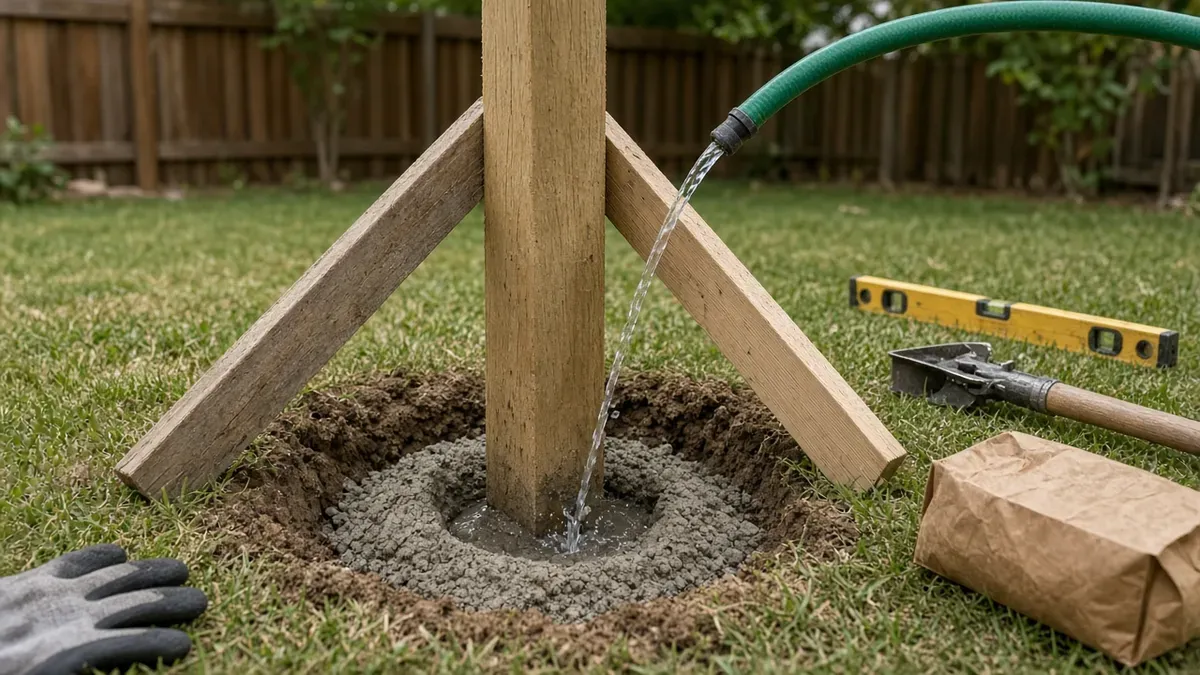
Dry pour concrete means putting bagged concrete mix into a hole or form dry and adding water afterward instead of mixing it first. It is popular because it skips the wheelbarrow, the mixing hoe and the heavy lifting. For the right job, a dry pour is fast and perfectly sound. For the wrong job, it leaves weak, crumbly concrete that you will be breaking out next year. This guide explains how dry pouring works, where bag makers say it is fine, why it is a bad idea for slabs, and how to plan the bags either way.
What "dry pour" actually means
Concrete hardens through a chemical reaction called hydration, where water reacts with the cement in the mix. In a normal pour, you mix the dry bag with a measured amount of water until every bit of cement, sand and stone is evenly wet, then place it.
In a dry pour, you skip that step. You pour the dry mix where you want it and let water soak in from the top, from a hose, or from damp soil. Some people also call this a "dry set" or "no-mix" pour. Searches such as "kind of concrete that does not require pre-mixing" usually point to the same idea: a bagged mix that is designed to be wetted in place.
The big question is whether water will reach all of the cement, and in the right amount. That is what decides whether a dry pour works.
Where dry pouring works: fence and mailbox posts
The one job bag makers openly support is setting posts with a fast-setting post mix. Quikrete's own instructions for its Fast-Setting Concrete Mix are titled "Set posts without mixing." The steps are roughly:
- Dig a hole about three times the width of the post.
- Put about 6 inches of gravel in the bottom.
- Set and brace the post so it is plumb.
- Fill the hole with the dry mix to 3 to 4 inches below ground level.
- Pour water into the hole until the mix is saturated.
The maker says the mix sets in 20 to 40 minutes and recommends waiting 4 hours before putting heavy loads on it. A post hole works for a dry pour because it is narrow and deep, the mix is formulated for it, and you add plenty of water so it soaks down through the whole column.
For the full post procedure, including hole depth, gravel and why gate and corner posts deserve a wet mix, read our guide to setting fence posts in concrete. For bag counts, use the fence post concrete calculator or the post hole concrete calculator for decks, mailboxes and pergolas.
Always follow the bag. Only use a dry pour if the product's instructions say it can be used that way. A standard concrete mix that tells you to mix with water first should be mixed first.
Why a dry pour slab is a bad idea
People often ask whether they can spread dry concrete mix in a form for a patio, shed pad or walkway, wet it with a hose and call it a slab. It is tempting, but it usually goes wrong. Even Quikrete's slab instructions for the same fast-setting product say to mix the concrete and shovel it into the form, not to pour it dry.
Here is why a dry pour slab struggles:
- Uneven water. A hose wets the top inch or so well. Lower layers may get too little water, while the surface may get too much. Concrete strength depends heavily on the right amount of water, so you end up with a slab that is strong in some places and weak in others.
- No consolidation. When you place wet concrete, you work it, tamp it and screed it so the stones settle and air pockets come out. Dry powder does not flow, so voids stay trapped inside.
- Weak, dusty surface. Sprayed water can wash cement out of the surface and leave loose sand and stone. That top layer can wear, flake or dust long before it should.
- No real finish. You cannot properly screed, float and trowel a dry pile. You will not get a flat, smooth or broom finish surface.
- Cracking. Weak, uneven concrete is more likely to crack and crumble, especially where it freezes.
For anything you walk on, drive on or build on, mix the concrete wet. Our step-by-step guides show how to pour a small concrete slab and pour a concrete walkway the right way.
Dry pour vs wet mix at a glance
| Dry pour | Wet mix | |
|---|---|---|
| Best for | Line posts with a mix rated for dry use | Slabs, walkways, steps, footings, gate and corner posts |
| Mixing | None; water added in place | Mix bag with measured water first |
| Water control | Hard to control | Measured and even |
| Strength consistency | Varies through the pour | Even throughout |
| Finish | Not finishable | Screed, float, trowel or broom |
| Speed | Fastest for posts | Slower but reliable |
| Main risk | Dry pockets, weak spots | Adding too much water |
When a wet mix is worth the effort
Mixing concrete is not as hard as it looks, and it is the safe choice for most projects. Use a wet mix for:
- Patios, shed pads and walkways
- Driveway repairs and anything carrying vehicles
- Steps and landings (see how to pour concrete steps)
- Footings for decks, porches and walls
- Gate, corner and end posts that take extra load
A wheelbarrow and hoe handle a few bags at a time. Our guide on how to mix concrete in a wheelbarrow walks through water amounts and mixing order. For larger jobs, a rented mixer or a ready-mix truck saves your back and gives a more even result.
How to dry pour a post the right way
If you are setting line posts with a mix rated for dry use, these habits help:
- Call 811 before you dig. In the US, have buried utilities marked first.
- Dig the right hole. About three times the post width, deep enough for your fence and frost line.
- Add gravel. A few inches of gravel at the bottom helps water drain away from the post end.
- Brace the post. Get it plumb before the mix goes in, because fast-setting mix locks it in place quickly.
- Fill with dry mix. Stop a few inches below grade so you can cover the top with soil or sod later.
- Soak it well. Add the amount of water the bag lists. If the soil is very dry, pre-wet the hole so the ground does not pull water from the mix.
- Check plumb again. You have only minutes before the mix sets.
- Wait before loading. Follow the bag's time before hanging rails, panels or gates.
If your soil is bone dry, sandy or the hole is unusually deep, consider mixing the post concrete wet in a bucket. It takes a few more minutes and removes the guesswork.
How much dry pour concrete do you need?
A dry pour does not save material. You still fill the same volume, so you need the same number of bags as you would for a wet pour. The yield printed on each bag (for example, cubic feet per bag) is what you plan with.
To count bags:
- For posts, use the fence post concrete calculator, which multiplies hole volume by the number of posts.
- For tubes and piers, try the Sonotube calculator.
- For a slab you plan to mix wet, use the concrete slab calculator or the concrete bag calculator for 40, 60 and 80 lb bags.
Buy one or two extra bags. Holes are rarely perfect cylinders, and a short bag on pour day costs more time than an extra one costs money. If your numbers differ between tools, our explainer on why concrete calculators disagree shows where waste and yield assumptions change the count.
Dry pour myths
"Rain will mix it for me." Rain wets the surface unevenly and can wash cement away. It does not replace mixing.
"It is just as strong." For a post mix designed for dry use and soaked properly, it can do the job the bag describes. For a slab or footing, a dry pour is usually weaker and less consistent than the same mix placed wet.
"Dry pack and dry pour are the same." No. "Dry pack" usually refers to a stiff sand-and-cement mortar that is mixed with a small amount of water and packed in place, for example under a shower pan. It is still mixed before use.
"More water makes it better." Too much water weakens concrete. Use what the bag says.
Safety and curing tips
Wet concrete is caustic and can burn skin, so wear gloves, long sleeves and eye protection, and wash off splashes quickly. Dust from dry mix irritates lungs, so pour gently and consider a dust mask, especially when tipping bags into a hole.
After any pour, keep the concrete from drying out too fast. In hot or windy weather, mist it or cover it. In cold weather, protect it from freezing; our guides to pouring concrete in cold weather and concrete curing blankets explain how.
The bottom line
Dry pour concrete is a smart shortcut for one job: setting line posts with a fast-setting mix whose bag says it can be used dry. For slabs, walkways, steps, footings and heavily loaded posts, mix the concrete wet so every bit of cement gets the right amount of water. Plan the same number of bags either way, follow the bag instructions, and let the concrete cure before you load it.
Ready to plan your project? Start with the concrete calculator for yards and bags.
Frequently asked questions
Can you pour concrete dry and add water?
Yes, for products made for it, such as fast-setting post mixes. Fill the hole with dry mix and soak it with the water the bag lists. For slabs and footings, mix the concrete first.
Is dry pour concrete as strong as mixed concrete?
A post mix designed for dry use can do the job its bag describes. For slabs, dry pouring usually gives uneven water and weaker, less consistent concrete than mixing first.
Can I dry pour a concrete slab?
It is not recommended. Bag makers' slab instructions say to mix the concrete and place it in the form. A dry pour slab tends to be weak, dusty and hard to finish.
How much water do I add to dry pour concrete?
Use the amount on the bag. For fast-setting post mix, Quikrete says to pour in enough water to saturate the mix in the hole.
How long does dry pour concrete take to set?
Quikrete says its Fast-Setting Concrete Mix sets in 20 to 40 minutes and recommends waiting 4 hours before heavy loads. Other products differ, so check your bag.
Do I need fewer bags for a dry pour?
No. A dry pour fills the same volume, so plan the same number of bags. Use the bag yield and a calculator, and buy one or two extra.
- https://www.quikrete.com/dealers/literature/tear%20pads/fast-setting%20concrete%20mix%20tear%20pad.pdf